
The Donroe Doctrine Goes Global
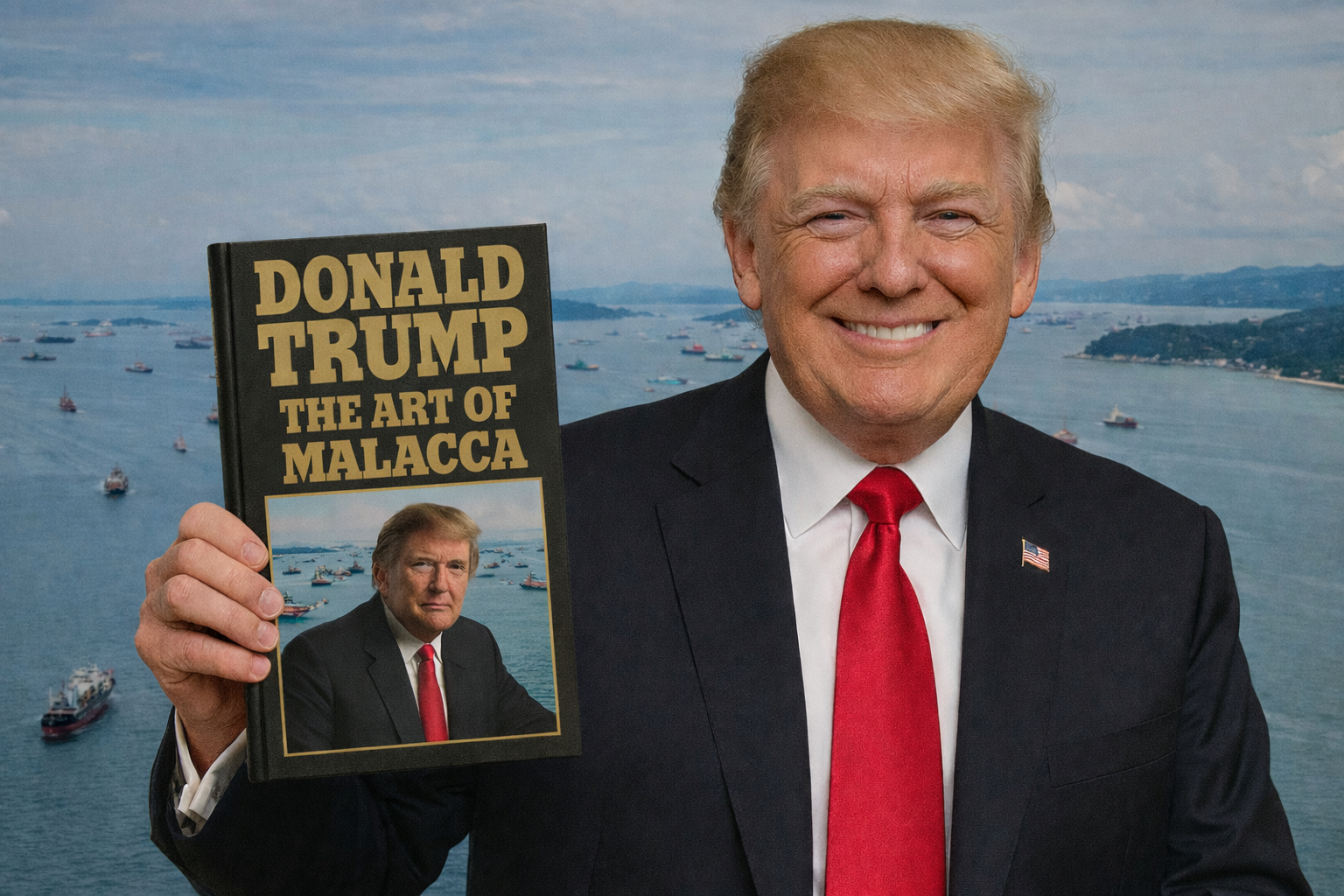
Two developments landed on Monday, and the symmetry was no accident. While the U.S. Navy enforced a blockade of Iranian ports and coastal areas in the Strait of Hormuz, targeting vessels entering or exiting Iranian-controlled waters after peace talks collapsed, Secretary of War Pete Hegseth stood alongside Indonesian Defense Minister Sjafrie Sjamsoeddin at the Pentagon and announced the elevation of bilateral ties to a Major Defense Cooperation Partnership (MDCP). This new framework establishes a guiding structure for defense modernization, joint training, operational collaboration, interoperability, and enhanced maritime domain awareness, subsurface and autonomous systems, and special forces cooperation, all while respecting Indonesia’s sovereign “bebas-aktif” non-alignment.
This is not diplomacy for its own sake. It is the Donroe Doctrine operating at global scale, with the Panama Canal as its foundational proof point in the Western Hemisphere.
In my Art of the Hemisphere series, I mapped Trump’s statecraft as a pragmatic, leverage-driven update to the Monroe Doctrine: identifying geographic and energy pressure points, applying asymmetric tools like targeted interdictions, tariffs, and smart partnerships, denying adversaries easy access to resources, and securing U.S. primacy with minimal domestic cost and no endless wars. The Donroe Doctrine is not retrenchment, but offensive realism with American characteristics. The backyard laboratory, from Venezuelan oil leverage triggering the Cuban cascade, to the JOH pardon flipping Honduras, to Operation Absolute Resolve, to Greenland tariff brinkmanship, proved the method works. The Panama Canal was the first critical chokepoint Trump secured, setting the template for everything that followed, including the Hormuz-Malacca pincer.
The Donroe Doctrine, Recapped from the Backyard
As I wrote:
“Trump’s ‘Donroe Doctrine’ revives historical assertiveness… demanding rivals ‘get out’ of the hemisphere.”
(America First in Our Backyard)
It is the Art of the Deal applied to statecraft. Command the arteries that feed rivals. Turn vulnerabilities into American strength. Force realignment without dogma or quagmires. From the Caribbean and Gulf, we demonstrated that geography remains the ultimate leverage and energy security the decisive battlefield.
The Panama Canal stands as the clearest early demonstration. Trump began his second term by declaring that “China is operating the Panama Canal. And we didn’t give it to China. We gave it to Panama, and we’re taking it back.” Through sustained pressure, including threats of retaking control, diplomatic engagement, and leveraging the broader tariff strategy, the administration achieved a major victory. In January, Panama’s Supreme Court ruled that the contract held by Panama Ports Company (a subsidiary of Hong Kong-based CK Hutchison, with deep Chinese ties) breached Panama’s constitution. The ports at both ends of the canal were effectively removed from Chinese operational influence, with temporary management shifting toward neutral or U.S.-friendly operators. Additional security agreements followed, including discounted or facilitated transits for U.S. military vessels and enhanced hemispheric cooperation. No full U.S. takeover, no boots on the ground in perpetuity, just calibrated leverage that restored American primacy over this vital artery without quagmires.
This was the first critical chokepoint secured under the Donroe Doctrine. It sent an unmistakable signal across the hemisphere: hostile foreign influence, particularly Chinese control over strategic ports and logistics, would not stand.
The Present-Day Pincer: Hormuz + Malacca
The Hormuz blockade is the immediate pressure point. By interdicting traffic to and from Iranian ports, the U.S. has disrupted a meaningful slice of China’s discounted crude imports while spiking global energy prices and forcing rerouting. This is calibrated enforcement: not a full strait closure, but targeted leverage that raises costs for Beijing without broader disruption to non-Iranian Gulf flows.
Simultaneously, the MDCP at Malacca, the world’s busiest energy chokepoint, delivers the long-term structural tilt. Roughly 80 percent of China’s seaborne oil imports still squeeze through this narrow passage between Sumatra and the Malay Peninsula. The partnership does not plant new U.S. bases; it quietly builds Indonesian capacity and U.S.-partner “eyes” on everything that moves between the Indian Ocean and the South China Sea. In any Taiwan, South China Sea, or broader crisis, Chinese planners must now assume richer maritime domain awareness and potential leverage exactly where Hu Jintao warned two decades ago that Beijing was most vulnerable.
The sequencing, from Panama Canal ports in early 2026, to Hormuz enforcement, to the Indonesia MDCP on the same day, shows board-level thinking. David Marcus captured the style days earlier in his Fox column on high-stakes geopolitical poker. Trump treats strategic assets as chips, forces opponents to show their cards, and resets terms on American terms.
Mahan Meets Donroe
Alfred Thayer Mahan would recognize the logic instantly. Sea power has always been about chokepoints and commerce. The Panama Canal was the hemispheric test case; Malacca is its Indo-Pacific extension. Hu Jintao’s 2003 “Malacca Dilemma” was Mahan rendered in modern energy terms: a continental power whose lifeblood moves by sea lives or dies by narrow straits policed by others. Beijing’s pipelines, BRI ports, and overland routes have mitigated but never resolved it. Tanker volumes still rule.
This strategic reality was captured perfectly by market strategist James E. Thorne (@DrJStrategy) in a lengthy analysis, well worth the read so I quoted the whole thing here. Thorne connects the Indonesia MDCP directly to Hu Jintao’s long-standing warning and frames the move as classic Mahanist sea-power logic applied to 21st-century energy dependence:
Food for thought.
Trump’s Deal With Indonesia: Mahan at the Strait of Malacca
Hu Jintao warned China about this moment more than twenty years ago. In 2003, the then Chinese president coined the phrase “Malacca dilemma” to describe a simple, brutal fact: the country’s economic… pic.twitter.com/X5PMAn4DNh
— James E. Thorne (@DrJStrategy) April 14, 2026
…rise depended on foreign oil sailing through a narrow strait that other powers could, in a crisis, choose to close. Most of China’s imported crude and gas still squeezes through that same bottleneck between Indonesia, Malaysia and Singapore. The US has just moved to wire that vulnerability, and it is no accident this is happening on Donald Trump’s watch.
Washington’s new Major Defense Cooperation Partnership with Indonesia is being sold in the usual diplomatic euphemisms: capacity building, maritime security, joint training. Strip away the boilerplate and you see something far sharper. The agreement’s focus on maritime domain awareness, subsurface and autonomous systems, and special forces training is about giving Indonesia and by extension the U.S. and its allies, a far richer picture of everything that moves between the Indian Ocean and the South China Sea, and greater ability to shape it in a crisis. As with Trump’s broader Indo‑Pacific posture, this is one more move to reassert the US as the pre‑eminent maritime power of the age, and to ensure China feels that reality every time a tanker clears the Strait.
Hu’s “Malacca dilemma” was never only about a single shipping lane. It was about the geometry of China’s energy dependence. Oil from the Gulf and Africa has to arrive by sea. The shortest, cheapest route runs past India, through Malacca and adjacent Indonesian straits, and then up into waters where the U.S. Navy and its partners have operated for decades. A coalition that can see, track and, if necessary, interdict that flow holds a lever over China’s economy that no amount of rhetoric about multipolarity can wish away.
More than a century ago, Alfred Thayer Mahan argued that sea power, fleets, chokepoints and maritime commerce, would decide the fate of great powers. The Malacca dilemma is Mahan’s theory rendered in modern energy terms: a continental power whose trade and fuel move by sea lives or dies by access to narrow maritime bottlenecks policed by others. Trump’s Indonesia move is pure Mahan: rather than chasing dominance on land, Washington is tightening its grip on the sea lanes and straits through which China’s economic lifeblood must flow.
Beijing has spent two decades trying to escape this trap with pipelines from Central Asia and Russia, a corridor through Myanmar and a “string of pearls” of ports from Gwadar to Djibouti. Yet the volumes tell a less reassuring story: overland routes move at the margin, while the bulk of China’s energy still comes by tanker and still passes through Southeast Asian chokepoints. The dilemma has been managed, not resolved.
That is why Indonesia matters. Jakarta insists it is not choosing sides and will continue to balance between Washington and Beijing. It doesn’t have to do more than that for this pact to bite. As Indonesian officers train with American counterparts and integrate U.S.‑supplied surveillance and patrol systems, the operational environment quietly changes. Chinese planners contemplating a crisis over Taiwan, the South China Sea or even a clash around Hormuz now have to assume that traffic through Malacca and its alternatives will unfold under a web of sensors and partnerships that lean, in practice if not in rhetoric, toward Washington.
Another move by President Trump, in other words. From rebuilding American shipyards to pouring money into Indo‑Pacific maritime forces, the pattern is clear: the United States intends to remain a maritime superpower, and to make China live with Hu Jintao’s old nightmare instead of escaping it. Mahan would have recognised the logic instantly: in the end, it is the power that commands the sea, and the straits, that sets the terms for everyone else.
Thorne’s analysis reinforces exactly what the Donroe Doctrine achieves in practice: using targeted partnerships and maritime awareness to reassert control over critical chokepoints without direct confrontation. The MDCP is not about bases or alliances; it is about quietly wiring the vulnerability Hu Jintao identified, turning geography into sustained leverage.
The Donroe Doctrine exports the hemispheric playbook without alteration. Panama was step one: remove Chinese operational influence from a critical trade artery. Chokepoint leverage becomes the new oil blockade. The MDCP becomes the new asymmetric partnership. Indonesia continues balancing, but the operational environment tilts. This is realpolitik: tilt the correlation of forces, raise the adversary’s costs, and let geography do the work.
Forward Look: From Proven Economic Squeeze to Strategic Squeeze and Taking a Nuclear Threat Off the Table
We have already proven we can squeeze China economically through sustained, high-impact tariffs. Throughout 2025, aggressive reciprocal and targeted tariffs slashed China’s share of U.S. imports dramatically, accelerated decoupling, generated substantial federal revenue, and raised Beijing’s costs even as China rerouted exports and maintained record global trade surpluses elsewhere. That economic pressure complemented the Panama Canal moves, contributing to the environment that forced the court ruling and port realignment.
The Hormuz-Malacca pincer now layers on the strategic squeeze, building directly on the Panama precedent. Higher baseline energy costs. Rerouting friction on alternative routes. Permanent enhancement of domain awareness that changes Chinese assumptions in any crisis. Next moves follow the pattern established at the Panama Canal: deeper integration with regional partners, expanded subsurface capabilities, quiet pressure on BRI logistics nodes. Chinese countermeasures, stockpiles, Russian supplies, renewables acceleration, naval growth, provide buffers at the margin. They do not change the geography. Malacca’s (and Panama’s) volume remains decisive.
And here is the broader reset of the global map: we have taken a nuclear threat off the table. Operation Epic Fury degraded Iran’s nuclear infrastructure, missile program, and command structure. Khamenei’s elimination removed the central figure who had driven proliferation for decades. The residual capabilities that once loomed as a wildcard, potentially emboldening proxies or complicating energy-security calculations for Beijing, are functionally neutralized. China can no longer count on a nuclear-armed Iran as strategic depth.
This is the Donroe Doctrine resetting the globe for the 21st century and securing it for our children and grandchildren. Tariffs for the economic squeeze. The Panama Canal as the first chokepoint secured, followed by Hormuz and Malacca for the strategic squeeze. Decisive action to remove nuclear wildcards so no peer competitor can treat the global commons as a free ride. As noted:
“This is the 2025 National Security Strategy in full force, a calculated gut-punch to the anti-U.S. axis. It starts with decapitating Iran’s mullahs, then ripples out to starve China’s oil lifeline and cripple Russia’s drone arsenal..”
The backyard proof-of-concept in The Art of the Hemisphere now demonstrates its power against the peer competitor.
Mahan would recognize the maritime logic. I anticipated the strategic payoff. It is happening, and the board is being reset on American terms. From the Panama Canal, the first critical chokepoint secured, to the Indo-Pacific straits, one consistent playbook: command the arteries, secure the commons, and restore U.S. primacy through geography, leverage, and calibrated strength.
The Donroe Doctrine is not a regional slogan. It is the operating system for 21st-century American leadership.
Recommended for jameskay.online
Cross-link the full series:
Part I,
Part II,
Part III,
Part IV, and
America First in Our Backyard.
