
The Assault on Charles Sumner and the Road to Ruin
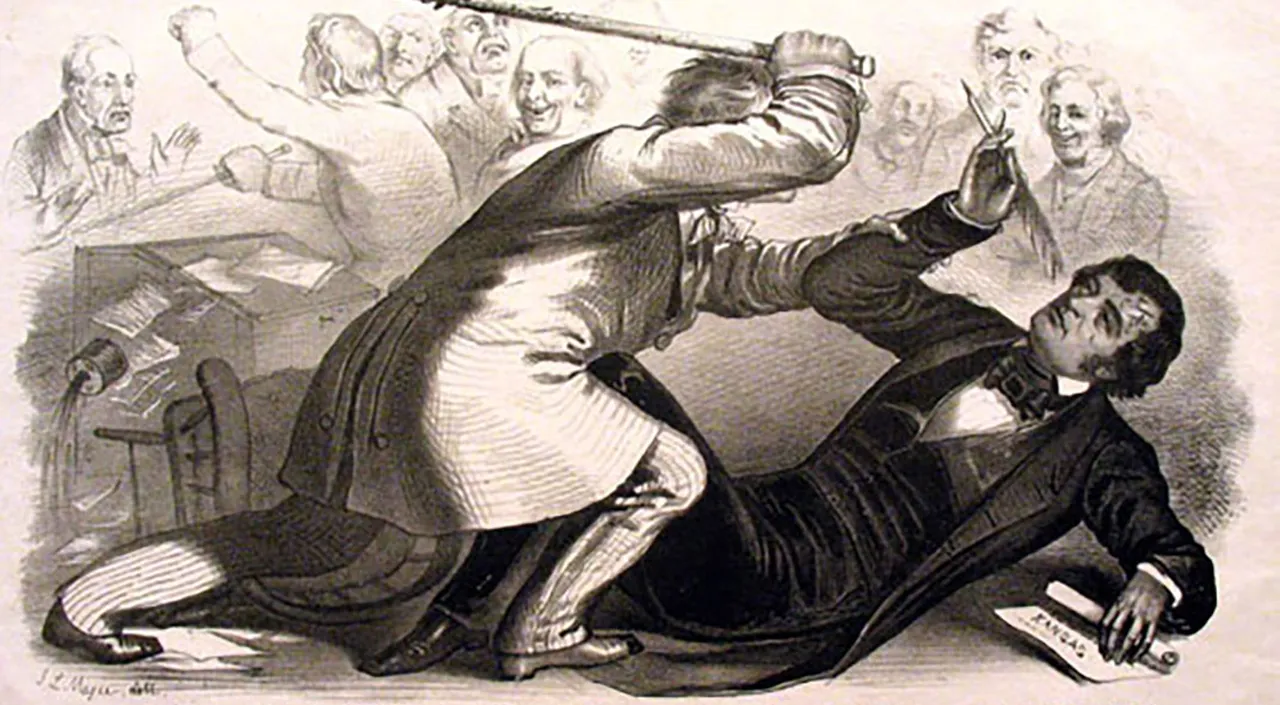
In the sweltering spring of 1856, the United States Capitol stood as a fragile monument to compromise, its marble halls echoing with the bitter debates that had long simmered over the peculiar institution of slavery. The nation, stretched thin across a continent, was tearing at its seams. The Kansas-Nebraska Act of 1854 had ignited the powder keg, repealing the Missouri Compromise and thrusting the question of slavery’s expansion into the hands of territorial voters through “popular sovereignty.” What followed was “Bleeding Kansas,” a frontier bloodbath where pro-slavery “Border Ruffians” from Missouri clashed with free-soil settlers, turning the plains into a rehearsal for civil war. Into this maelstrom stepped Senator Charles Sumner of Massachusetts, a towering figure of abolitionist fervor, whose words would provoke not a duel of gentlemen, but a savage beating that exposed the raw nerve of American division.
Sumner was no ordinary politician. Born in 1811 to a Boston family of modest means, he had risen through Harvard Law and a grand tour of Europe to become a scholar-statesman, elected to the Senate in 1851 as a Free Soil Democrat before joining the nascent Republican Party. At six-foot-four, with a mane of dark hair and a voice like rolling thunder, Sumner embodied the moral absolutism of the North’s anti-slavery crusade. He viewed compromise with slavery as moral cowardice, campaigning tirelessly for abolition and equal rights. His colleague, the pragmatic William Seward, once quipped that Sumner “loves liberty as the saint loves the altar,” but warned that his rhetoric could “break the Union.” Sumner cared little; he saw the Senate as a pulpit for righteousness.
The spark came on May 19, 1856. For two days, Sumner held the floor in a nearly empty chamber, delivering his magnum opus: “The Crime Against Kansas.” It was a blistering jeremiad, excoriating the “Slave Power” that he believed had hijacked the Republic. He eviscerated Illinois Senator Stephen Douglas, architect of the Kansas-Nebraska Act, as a “noise-making, speech-making, and vote-harvesting brawler” whose “squatter sovereignty” was but a fig leaf for slavery’s spread. But the personal barbs cut deepest for the absent Senator Andrew Butler of South Carolina, a pro-slavery stalwart felled by a stroke. Sumner painted Butler as a chivalric fool who had “chosen a mistress [who] . . . though ugly to others is always lovely to him; though polluted in the sight of the world, is chaste in his sight-I mean the harlot, Slavery.” He taunted Butler for his state’s reliance on “the shameful imbecility of slavery.” The sexual imagery was deliberate, evoking abolitionist tropes of slaveholders’ depravity. Douglas, listening from his seat, muttered to a colleague, “This damn fool is going to get himself killed by some other damn fool.”
The speech ended to a smattering of applause from Northerners and stony silence from Southerners. Over a million copies were printed and distributed, flooding the North like abolitionist propaganda. In the South, it was received as an unpardonable insult-a Yankee’s libel on Southern honor. Enter Preston Smith Brooks, a 37-year-old firebrand from South Carolina’s lowcountry, Butler’s first cousin once removed. Brooks was no stranger to violence; a West Point washout and Mexican War veteran, he limped from a 1840 dueling wound and carried a cane not just for support, but as a symbol of mastery. A slaveholder with a temper as hot as Carolina summers, Brooks stewed over the affront to his kin. Dueling, he confided to Representative Laurence Keitt, was for gentlemen; Sumner, with his “coarse language,” was “no better than a drunkard” and deserved public humiliation instead.
On the afternoon of May 22, as the Senate adjourned and the galleries emptied-Brooks had waited to spare “ladies” the spectacle-he strode into the chamber with Keitt and Representative Henry Edmundson of Virginia in tow. Sumner sat alone at his desk, oblivious, affixing postage to stacks of his speech for distribution. The chamber was quiet, save for the scratch of his pen. Brooks approached from behind, his gutta-percha cane-thick, flexible, with a gold head-gripped tightly. “Mr. Sumner,” he said in a low, calm voice, “I have read your speech twice over carefully. It is a libel on South Carolina, and Mr. Butler, who is a relative of mine.”
Sumner looked up, rising halfway from his chair. Before he could speak, Brooks raised the cane high and brought it down with shattering force on the senator’s skull. A sickening crack echoed through the hall. Sumner gasped, blinded by blood, his hands flailing to shield his head. Trapped by the bolted desk-its chair on tracks that pinned his legs-he could only lurch backward, ripping the fixture from the floor in a futile bid for escape. Brooks struck again and again, “to the full extent of [my] power,” as he later boasted, delivering “about 30 first-rate stripes.” The cane splintered after a dozen blows, but Brooks pressed on with the gold-headed fragment, thrashing Sumner’s face, shoulders, and hands until the victim collapsed unconscious, “bellow[ing] like a calf.”
Chaos erupted. Senators John J. Crittenden and Robert Toombs rushed forward, but Keitt blocked them, brandishing a pistol and cane, snarling, “Let them be! … Let them alone, God damn you!” Edmundson joined the fray, forming a human wall. Representatives Ambrose Murray and Edwin Morgan finally wrestled Brooks away after a minute of savagery that left the floor slick with blood and shards of cane scattered like broken oaths. Sumner, barely breathing, was carried out by pages and the Sergeant at Arms, his scalp lacerated to the bone, his right hand mangled. Doctors stitched him up-seven on his head alone-but the damage was profound: fractured skull, severed tendons, and nerves so inflamed he could scarcely move. Brooks, his own hand bruised from backswings, departed calmly, tipping his hat to a stunned page.
Word spread like wildfire via telegraph, the first time such technology carried news of congressional violence nationwide. In the North, horror reigned. The Cincinnati Gazette thundered that the South could not tolerate free speech anywhere, and would stifle it in Washington with the bludgeon and the bowie-knife. William Cullen Bryant of the New York Evening Post lamented, “Has it come to this, that we must speak with bated breath in the presence of our Southern masters? … Are we too, slaves, slaves for life, a target for their brutal blows?” Rallies erupted in Boston, Albany, and New York, where over 20,000 gathered under banners reading “The Slave Power Must Be Crushed.” Ralph Waldo Emerson captured the zeitgeist: “I do not see how a barbarous community and a civilized community can constitute one state. I think we must get rid of slavery, or we must get rid of freedom.” Even moderates who had recoiled at Sumner’s vitriol now hailed him as a martyr; cartoons depicted Brooks as an ape-like thug wielding a slave-whip, Sumner as a bound Prometheus.
The South, by contrast, erupted in jubilation. The Richmond Enquirer crowed that the attack was “good in conception, better in execution, and best of all in consequences,” suggesting Sumner “ought to have nine-and-thirty [lashes] every morning.” Gifts poured into Brooks’s office: dozens of new canes, some inscribed “Hit Him Again” or “Use Knock-Down Arguments.” Other southerners picked up pieces of the splintered cane; later, these scraps were fashioned into rings that many southern lawmakers wore on neck chains as a sign of solidarity with Brooks. An Alabama paper opined, “Sumner has been needing something of the sort since the first day he put his foot into the Senate chamber.” Brooks, censured but not expelled by the House (falling short by 19 votes), resigned in defiance, only to be reelected by acclamation in South Carolina. A Baltimore court fined him $300 for assault-pocket change for a hero. Keitt faced similar adulation, his pistol-waving blockade earning him reelection too.
For Sumner, the aftermath was a descent into personal hell. Confined to a darkened room for months, he endured migraines, vertigo, and phantom pains that left him bedridden or pacing like a caged lion. Doctors prescribed sea voyages and European spas, but recovery was glacial; he attempted a brief return in 1857 only to collapse after minutes. Massachusetts, undeterred, reelected him in January 1857, leaving his seat vacant as a protest-a hollow chair in the Senate symbolizing Southern brutality. Not until 1859 did Sumner resume full duties, his once-commanding frame stooped, his right hand a claw. Yet the caning forged him anew. “I have suffered more for my country than any other man,” he wrote, but the fire burned hotter. He became the Senate’s moral compass, chairing Foreign Relations during the Civil War and championing Reconstruction’s civil rights, insisting the conflict must end slavery as much as preserve the Union: “Slavery is the main-spring of Rebellion.” He served until 1874, a trailblazer whose legacy endures in the 14th Amendment’s equal protection clause and the Civil Rights Act of 1875, which he drafted to guarantee equal rights in public accommodations.
Brooks’s triumph was fleeting. In January 1857, at 37, he succumbed to croup-a sudden throat inflammation-while traveling to nurse his dying son. Thousands mourned in Washington, his funeral procession a Southern spectacle, but his name became synonymous with barbarism in the North.
Politically, the caning was a fulcrum. It galvanized the floundering Republican Party, unifying moderates and radicals around the cry of “Bleeding Sumner, Bleeding Kansas.” Fundraising surged; Frémont’s 1856 presidential bid swept the North, nearly toppling Buchanan. The incident eroded the Whigs, accelerated Democratic fractures, and normalized violence in politics-John Brown’s raid and secession followed inexorably. As historian Joanne B. Freeman notes, it marked “the breakdown of reasoned debate,” proving words could summon clubs, amid over 70 violent incidents in Congress in the decades before the war. By 1861, when cannon fire echoed from Fort Sumter, the cane’s shadow loomed large: a nation where insults bred blood, and honor demanded fracture.
In the end, the caning was more than an assault; it was a prophecy. Sumner, rising from his bloodied desk, embodied the North’s resilient fury; Brooks, cane in hand, the South’s defiant code. Their clash in that sunlit chamber did not start the war, but it foretold its savagery-a reminder that when democracy falters, the body politic bleeds. As Sumner himself reflected years later, “Out of such a tragedy good may come.” And so it did, in emancipation’s dawn. But the cost was etched in every scar: the Union remade, at the price of kin against kin.
