
Charting America’s Budget
A Tale of Reconciliation, Rescissions, and Deficit Debates
Before we get into the heart of this lesson, let’s review how a bill becomes a law.
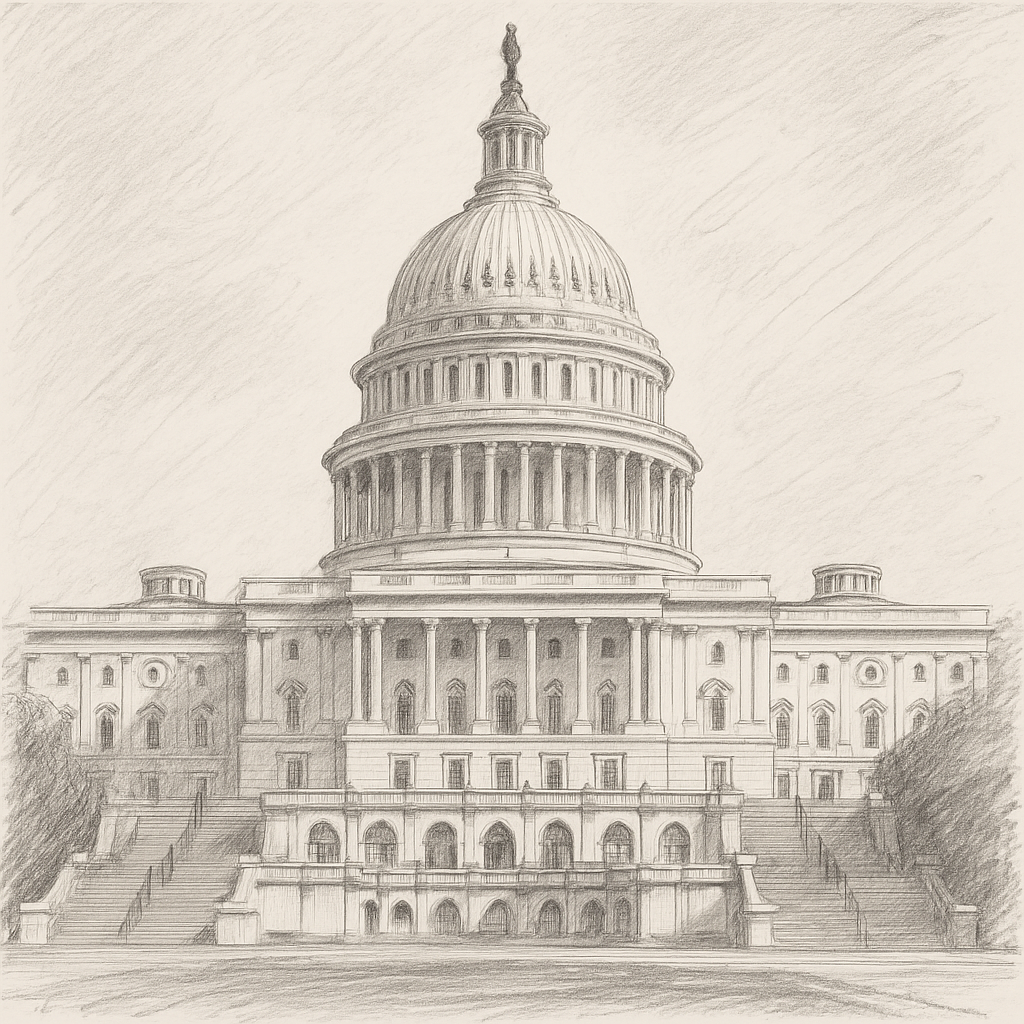 In the heart of Washington, D.C., in June 2025, a fiscal tempest brews, captivating lawmakers, analysts, and citizens. H.R. 1, the “Big Beautiful Bill,” a daring reconciliation bill passed the House, promising to extend Trump tax cuts and carve $1.6 trillion from federal spending. Yet, the Congressional Budget Office (CBO) sounds a warning, estimating a $4 trillion deficit increase, igniting fierce debate. Meanwhile, a “DOGE rescissions package,” driven by the Department of Government Efficiency, charts a parallel course to excise government waste. This saga weaves the intricate threads of the federal budget process-baseline budgeting, the Byrd Rule, rescissions, impoundment, enhanced rescission authority, dynamic scoring, the Joint Committee on Taxation (JCT), the Joint Economic Committee (JEC), and Conference Committees-into a vivid tapestry, illuminating how Congress and the President navigate fiscal waters.
Our journey begins with the CBO, a seasoned navigator born from the Congressional Budget and Impoundment Control Act of 1974. Tasked with charting fiscal paths, the CBO is no oracle but a meticulous cartographer, using a budget resolution to map a 10-year course. This baseline assumes current laws-like tax cuts set to expire-persist unchanged, projecting revenues, spending, and deficits. For the “Big Beautiful Bill,” the baseline expects those cuts to lapse, boosting revenue. Extending them, as the bill proposes, “costs” $4 trillion in forgone revenue, per the CBO’s estimate, swelling the deficit. This article cries foul, arguing this static scoring ignores economic winds-growth that could offset losses. The CBO, candid about its projections’ limits due to economic uncertainties, can employ dynamic scoring to estimate growth’s impact, but it’s like forecasting a storm’s path: complex and uncertain. Congress can request dynamic scoring for major bills, yet the “Big Beautiful Bill” likely bears the CBO’s cautious, static chart, fueling controversy over its fiscal footprint.
The “Big Beautiful Bill” rides the swift currents of reconciliation, a streamlined process from the 1974 Act that lets budget bills-tweaking taxes, spending, or the debt limit-pass with a simple majority, dodging the Senate’s 60-vote filibuster. It begins with a budget resolution, a fiscal compass crafted by the House and Senate Budget Committees. In 2025, this resolution likely directed committees like Senate Finance and House Ways and Means to draft the bill, blending tax cut extensions with $1.6 trillion in spending reductions. The process unfolds like a tightly choreographed voyage:
-
Committees draft provisions, scored by the CBO and JCT.
-
The Byrd Rule, a vigilant lighthouse, ensures fiscal focus, barring “extraneous” provisions with no direct budgetary impact. DOGE’s spending cuts, aimed at government waste, were cast adrift here, deemed too policy-driven to pass muster.
-
The Senate debates for 20 hours, voting with a simple majority. The House follows its own rules, needing a simple majority.
-
If versions diverge, a Conference Committee reconciles them, forging a unified conference report.
The Conference Committee is the ship’s bridge, where House and Senate conferees negotiate a single course. The President, though not aboard, signals from shore-publicly advocating for tax cuts, privately nudging allies, or threatening a veto to shape the report. The “Big Beautiful Bill” likely faces this stage if the Senate amends it, balancing tax cuts with spending reductions while heeding the Byrd Rule’s fiscal beacon.
The DOGE rescissions package takes a different tack, using the 1974 Act’s rescission process to trim unspent funds, like pruning deadwood to lighten the ship. The President sends a special message within 45 days of an appropriation’s enactment, proposing to cancel funds for inefficient programs. Congress has 45 days to pass a rescission bill, with the Senate’s 10-hour debate limit ensuring a simple-majority vote. Crucially, Congress can adjust the proposal-cutting less, more, or different programs. The DOGE package targets waste, but Congress might tweak it to balance fiscal goals with political currents, reflecting its command over the purse.
Impoundment, the broader act of withholding funds, encompasses rescissions (permanent cuts) and deferrals (temporary delays). The 1974 Act tamed this power after Nixon’s overreach, requiring congressional approval for rescissions and oversight for deferrals. The DOGE package is a rescission effort, not a deferral, aiming for lasting savings. But imagine a bolder helm: enhanced rescission authority would let presidential cuts take effect unless Congress objects, unlike the 1974 Act’s need for approval. The Line-Item Veto Act of 1996 tried this, but the Supreme Court sank it in 1998 for tilting power too far. Congress could grant such authority via a new law, not a budget resolution, but the DOGE package sails the standard course, tethered to congressional consent.
Two expert crews aid navigation: the JCT and JEC. The JCT, tax policy’s cartographer, maps revenue impacts, feeding the CBO’s $4 trillion score for the “Big Beautiful Bill’s” tax cuts. Dynamic scoring could show growth easing the deficit, aligning with this article’s critique, but static scoring prevails unless requested. The JEC, scanning economic horizons, offers insights on growth or jobs, not scores, perhaps bolstering arguments for the bill’s benefits. Together, they illuminate fiscal fog, guiding Congress’s course.
Reconciliation’s voyage faces turbulent waves. Politics propel the “Big Beautiful Bill,” with partisan debates over its deficit impact echoing the critique of the CBO’s score. Republicans may champion tax cuts as growth engines, while opponents decry fiscal recklessness. CBO scoring shapes perceptions, its $4 trillion estimate a storm cloud, debated for its static assumptions. Dynamic scoring, if used, could paint a brighter picture, but its uncertainty-acknowledged by the CBO’s own caveats-adds complexity. Timing confines reconciliation to yearly voyages, tied to the budget resolution, pushing DOGE cuts to rescissions. Committees balance jurisdictions, with Senate Finance and House Ways and Means steering tax provisions, while Appropriations eyes spending cuts. The President’s influence-via advocacy or veto threats-looms, especially in Conference Committee talks. Public perception, swayed by CBO numbers, fuels debate, while legal constraints, like the Byrd Rule and 1974 Act, anchor the process, ensuring no one-President or Senate minority-commands the helm alone.
Rescissions and reconciliation intersect, as the DOGE package addresses cuts excluded from the “Big Beautiful Bill” due to the Byrd Rule. This interplay highlights the budget process’s flexibility: reconciliation’s broad strokes pair with rescissions’ precision cuts, like a ship’s sails and rudder working in tandem. Conference Committees bridge House-Senate divides, ensuring a unified bill, while the JCT and JEC provide critical charts-revenue estimates and economic context-to navigate fiscal straits.
In this fiscal odyssey, the “Big Beautiful Bill” and DOGE package chart democracy’s turbulent waters. Reconciliation’s swift currents enable bold policies, but the Byrd Rule and CBO’s cautious maps temper ambition. Rescissions offer a lifeline for cuts, with Congress adjusting the President’s course. The JCT and JEC illuminate paths, Conference Committees forge unity, and the 1974 Act balances power. As the ship sails, it reveals a timeless truth: budgeting is a voyage of compromise, where every charted course shapes the nation’s destiny, guided by navigators who, despite imperfect maps, strive for clarity in an uncertain sea.
Explore More: Navigate cbo.gov for scores, jct.gov for tax estimates, jec.senate.gov for economic trends, senate.gov or house.gov for rules, and govinfo.gov for the 1974 Act.
