
Chasing the Dragon from the Market
China Faces the Same Economic Realities the Soviets Did in the 1980s
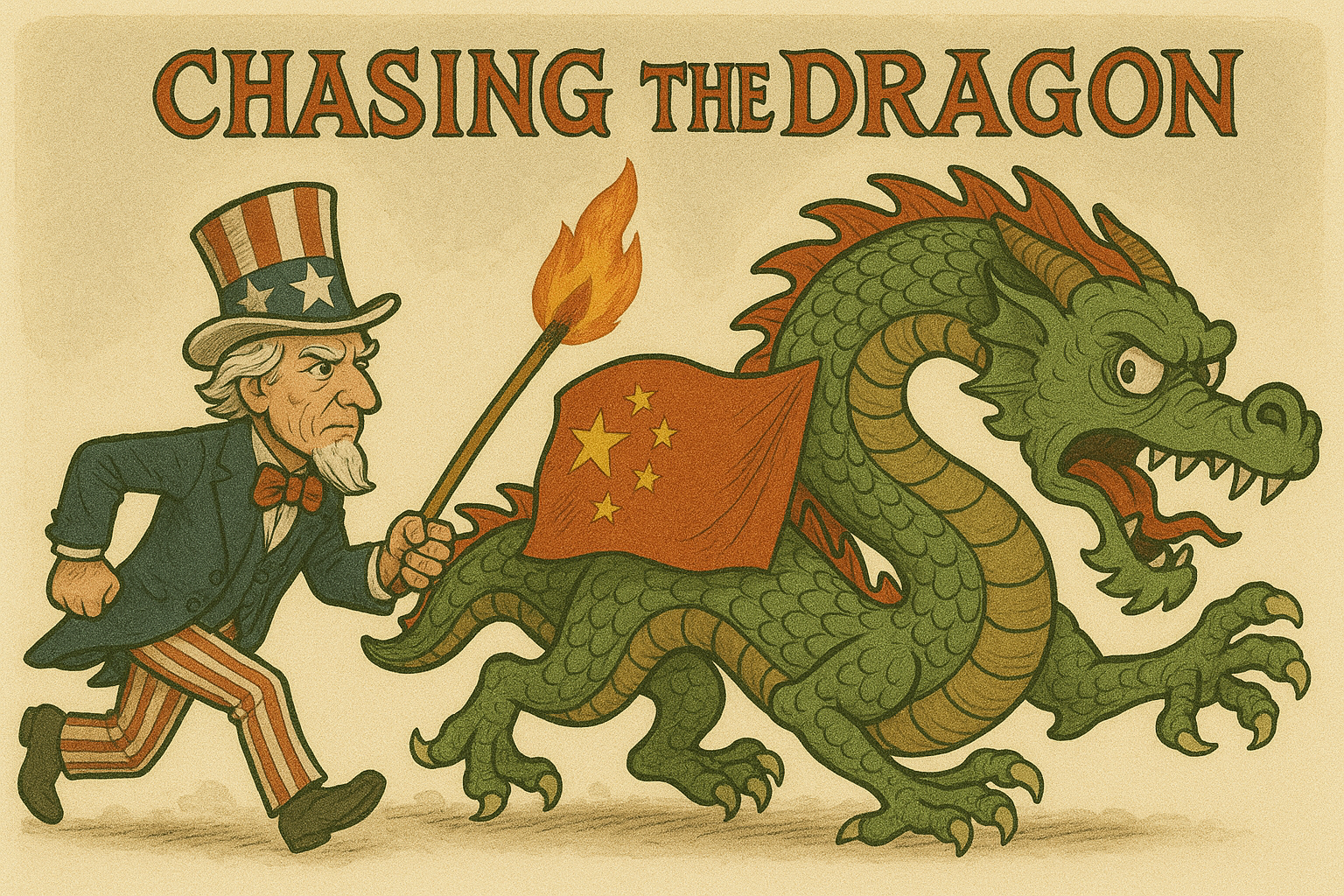 As the U.S.-China trade war escalates, two starkly different visions for confronting China’s economic might are taking center stage. The Trump administration’s 145% tariffs on Chinese goods, effective April 2025, have already sent shockwaves through China’s export-driven economy, slashing U.S.-bound shipments by 30% and threatening 16 million jobs. Yet, investor Kevin O’Leary’s audacious call for 400% tariffs aims to deliver a knockout blow, targeting Beijing’s alleged trade violations with unprecedented aggression. China, reeling from deflation, a property crisis, and faltering consumer confidence, is scrambling to redirect U.S.-bound goods to its domestic market of 1.4 billion consumers. But can this high-stakes pivot absorb the tariff shock, or will O’Leary’s sledgehammer proposal push China’s economy to the breaking point? The answer lies in a delicate balance of resilience, defiance, and global consequences.
China’s Domestic Pivot: Can It Absorb the Shock of Trump’s Tariffs?
As the Trump administration’s 145% tariffs on Chinese goods took effect in April 2025, China’s economic landscape trembled. The U.S., long a cornerstone of China’s export-driven growth, is projected to see a 30% drop in Chinese imports, slashing overall exports by 4.5% and dragging GDP growth down by 1.3 percentage points. Facing this seismic disruption, Beijing is betting on a bold strategy: redirecting goods meant for American consumers to its own domestic market. But with deflation gripping the economy, consumer confidence faltering, and a property crisis looming large, can China’s 1.4 billion-strong market absorb the surplus, or is this pivot a desperate gamble?
The government is pulling out all stops to make this work. Consumption vouchers, tax breaks, and subsidies for electric vehicles (EVs) and appliances are flooding cities like Shanghai and Shenzhen, aiming to spur spending on tariff-hit goods like electronics and textiles. E-commerce giants like Alibaba and JD.com are enlisted in patriotic “Buy Chinese” campaigns, while manufacturers slash prices-sometimes by 20%-to clear bulging inventories. In the EV sector, companies like BYD are seeing some success, with domestic sales up 15% in Q1 2025, buoyed by relaxed urban purchase restrictions. Yet, these wins are outliers in a broader struggle.
The numbers tell a grim story. China’s factory activity contracted sharply, with the Purchasing Managers’ Index (PMI) plummeting to 49.0 in April 2025, the lowest since December 2023. Ocean container bookings to the U.S. collapsed by 60%, threatening 16 million jobs in export, wholesale, and retail sectors, according to Goldman Sachs. Meanwhile, deflation is tightening its grip, with consumer prices down 0.5% and producer prices off 2.8% year-on-year in Q1 2025. This price spiral, fueled by weak demand and discounted export goods flooding the domestic market, risks squeezing corporate profits and triggering more layoffs, particularly for small and medium-sized enterprises (SMEs) that drive 60% of GDP and 80% of urban jobs.
The challenges run deeper than numbers. Many export goods-think oversized SUVs or premium electronics-are tailored for American tastes, not Chinese preferences for compact EVs or budget-friendly gadgets. Repackaging and rebranding help, but they can’t bridge the gap entirely. Domestic consumers, battered by a property crisis that’s left enough vacant homes to house 3 billion people, are hoarding cash, with savings rates at 32%. Why buy a new TV when prices might drop further? This deflationary mindset, coupled with stagnant wages and a youth unemployment rate hovering at 15.3%, stifles the spending Beijing desperately needs.
Beijing’s response is a mix of urgency and ambition. The People’s Bank of China has cut interest rates and eased reserve requirements, while the National Development and Reform Commission is rolling out fiscal measures to boost domestic demand. Inland provinces like Sichuan are being tapped as new consumer markets, but logistical bottlenecks and fierce competition from established local brands like Huawei complicate the pivot. The government’s long-term vision-expanding the middle class and urbanizing inland regions-holds promise, but it’s a slow burn, offering little relief for exporters drowning in surplus stock today.
The math isn’t encouraging. The NDRC estimates that only 20–25% of U.S.-bound goods can be redirected domestically without significant losses. Flooding the market with discounted products risks deepening deflation, creating a vicious cycle that could push China toward stagnation. While Beijing frames this as a step toward self-reliance, the reality is messier. SMEs lack the marketing muscle to compete with domestic giants, and overcapacity in sectors like steel and electronics threatens to destabilize local producers.
China’s leadership, under Xi Jinping, remains defiant, refusing to negotiate under U.S. pressure and rallying global partners against what it calls American “bullying.” Diversifying exports to Asia and the Global South is part of the playbook, but these markets can’t fully replace the U.S. Yet, there’s a silver lining: China’s reduced reliance on American exports compared to a decade ago, coupled with its dominance in EVs and AI, gives it some resilience. The question is whether it can weather the immediate storm.
In the end, China’s domestic pivot is a high-stakes experiment. It’s a pragmatic move to cushion the tariff blow, but weak demand, deflation, and structural mismatches limit its impact. Without bolder reforms to ignite consumer spending and tackle the property crisis, Beijing risks merely shifting the pain from exporters to the broader economy. As the trade war escalates, China’s ability to turn inward will test not just its economic ingenuity but its social and political resilience. For now, the jury’s out-and the clock is ticking.
The O’Leary Option
China’s Economic Breaking Point? The Potential Fallout of Kevin O’Leary’s 400% Tariff Proposal
Kevin O’Leary, the brash “Shark Tank” investor, has thrown a grenade into the U.S.-China trade war, advocating for a staggering 400% tariff on Chinese imports to force Beijing to the negotiating table. His rationale: China’s alleged intellectual property theft, non-compliance with World Trade Organization (WTO) rules, and unfair trade practices demand a sledgehammer response. With current tariffs at 145% as of April 2025, escalating to 400% would be an unprecedented move, dwarfing even the Trump administration’s aggressive “Liberation Day” strategy. But what would such a policy mean for China’s economy, already reeling from export declines, deflation, and a property crisis? The consequences would be seismic, potentially crippling China’s economic model while risking global fallout-though not without significant costs to the U.S. and the world.
Devastating Blow to China’s Exports
China’s economy, heavily reliant on exports, would face catastrophic disruption under 400% tariffs. The U.S. accounts for 17% of China’s export market, and current projections already estimate a 30% drop in U.S.-bound exports due to the 145% tariffs, cutting overall exports by 4.5% and GDP growth by 1.3 percentage points. A 400% tariff would effectively halt trade with the U.S., as costs would render Chinese goods uncompetitive. O’Leary argues this would pressure Chinese President Xi Jinping by threatening mass unemployment, estimating that 39% of China’s manufactured goods rely on U.S. consumers. Goldman Sachs’ earlier estimate of 16 million jobs at risk under current tariffs could balloon to 25–30 million, particularly in manufacturing hubs like Guangdong and Zhejiang, where electronics, textiles, and machinery dominate.
The ripple effects would be brutal. China’s factory activity, already contracting with a Purchasing Managers’ Index (PMI) of 49.0 in April 2025, would likely plummet further, potentially dipping into the low 40s, signaling a severe industrial slowdown. Small and medium-sized enterprises (SMEs), which generate 60% of GDP and 80% of urban jobs, would face insolvency as export revenues dry up. Unlike state-owned enterprises (SOEs), SMEs lack the financial cushion to weather such a shock, risking widespread bankruptcies and localized economic crises in export-dependent regions.
Deepening Deflation and Domestic Strains
China’s existing deflationary pressures-consumer prices down 0.5% and producer prices off 2.8% year-on-year in Q1 2025-would intensify under a 400% tariff regime. With exports to the U.S. effectively blocked, manufacturers would flood the domestic market with surplus goods, driving prices even lower. This would exacerbate the deflationary spiral, further eroding corporate profits and consumer confidence. Households, already battered by a property crisis with enough vacant homes to house 3 billion people, are saving at a 32% rate, reluctant to spend amid job insecurity and falling property values. A surge in discounted goods could delay purchases further, as consumers anticipate even cheaper prices, strangling domestic demand.
The property sector, a cornerstone of China’s economy, would face additional pressure. Reduced export revenues would limit government funds for stimulus, slowing efforts to stabilize real estate. This could deepen the crisis, further depressing household wealth and consumption, creating a vicious cycle of economic stagnation.
Employment Crisis and Social Risks
O’Leary’s strategy explicitly targets China’s labor market to force compliance, arguing that mass unemployment would pressure Xi’s regime, as “Xi can only stay the supreme leader if people are employed.” The loss of U.S. market access could push unemployment rates, already a concern with youth unemployment at 15.3%, to historic highs. Coastal provinces, where export industries employ millions of migrant workers, would be hit hardest. These workers, often without local social safety nets, could return to rural areas, straining underdeveloped regions and risking social unrest. While Beijing’s authoritarian controls suppress public dissent, widespread job losses could test the Communist Party’s grip, especially if urban protests or “riots in the streets,” as O’Leary predicts, emerge.
Policy Responses and Limitations
Beijing would likely respond with aggressive countermeasures, but its options are constrained. Current stimulus measures-interest rate cuts, reduced bank reserve requirements, and consumption vouchers-have failed to reverse deflation or boost demand significantly. A 400% tariff would force China to double down on fiscal and monetary easing, potentially devaluing the yuan to make non-U.S. exports more competitive. However, this risks capital flight and inflation in import costs, complicating China’s economic balancing act.
China’s pivot to alternative markets like the EU, ASEAN, and the Global South would accelerate, but these regions cannot absorb the volume of goods previously destined for the U.S. For instance, redirecting electronics or textiles to Europe, where demand is softening due to its own trade tensions, is unlikely to offset losses. Efforts to sell export goods domestically, already struggling due to weak demand and product mismatches (e.g., U.S.-tailored SUVs vs. China’s preference for compact EVs), would face even greater hurdles under a flood of surplus inventory.
Beijing could also retaliate with higher tariffs on U.S. goods-already at 125%-or restrict critical exports like rare earths, which the U.S. relies on for tech and defense. However, O’Leary argues China lacks leverage, as selling U.S. Treasury securities ($760 billion in holdings) would harm its own economy by strengthening the yuan and further choking exports.
Global and U.S. Implications
The impact wouldn’t be confined to China. U.S. consumers would face higher prices, as economists like Michael Ryan note that tariffs are largely borne by Americans, not Chinese producers. Substitutes for Chinese goods-whether from Vietnam, India, or domestic U.S. production-wouldn’t fully offset cost increases, with some estimating a 5–10% rise in prices for electronics, clothing, and appliances. This could fuel U.S. inflation, potentially forcing the Federal Reserve to tighten monetary policy, risking a slowdown.
Globally, China’s deflationary exports could depress prices in markets like the EU, sparking trade disputes as countries protect local industries. Supply chain disruptions would hit industries reliant on Chinese components, from semiconductors to solar panels, raising costs for global manufacturers. Emerging markets dependent on Chinese investment, like those in Africa, could see reduced capital flows as China’s economy contracts.
Critical Perspective
O’Leary’s 400% tariff proposal is a high-risk gambit. For China, it would be an economic sledgehammer, potentially crushing export industries, deepening deflation, and sparking an unemployment crisis that tests Beijing’s political stability. While China’s resilience-built on a reduced reliance on U.S. exports and strengths in EVs and AI-might mitigate long-term damage, the short-term pain would be immense, with GDP growth likely falling below 3%, far from Beijing’s 5% target.
Yet, O’Leary’s logic hinges on a questionable assumption: that China’s leadership would buckle under pressure. Xi’s authoritarian regime has prioritized self-reliance and domestic control, and Beijing’s defiant stance-refusing talks and rallying global partners-suggests it may endure economic pain to avoid perceived capitulation. Moreover, the collateral damage to the U.S. and global economies could undermine the strategy’s effectiveness, as higher consumer prices and supply chain chaos erode support for such aggressive measures. Critics like Larry Summers warn of lost U.S. credibility and economic harm, while others argue that China’s robust IP litigation system and foreign investment inflows contradict O’Leary’s narrative of unchecked theft.
In sum, a 400% tariff would push China’s economy to the brink, decimating exports, exacerbating deflation, and risking social unrest. But it’s a double-edged sword: the U.S. risks inflation and global trade chaos, and China’s resilience and retaliatory options could prolong the standoff. O’Leary’s call for “squeezing Chinese heads into the wall” may sound bold, but it underestimates the complexity of forcing a superpower to kneel. For now, China’s domestic pivot and global outreach are its lifelines-but a 400% tariff could test their limits like never before.
China’s attempt to pivot U.S.-bound exports to its domestic market is a pragmatic but precarious gambit, constrained by deflation, weak demand, and structural mismatches-challenges that a 400% tariff, as proposed by Kevin O’Leary, would magnify into an existential crisis. While the current 145% tariffs threaten economic stagnation, O’Leary’s plan could decimate exports, push unemployment to historic highs, and risk social unrest, testing Beijing’s authoritarian grip. Yet, Xi Jinping’s defiance, coupled with China’s strengths in EVs and AI, suggests it may endure rather than capitulate. The global fallout-U.S. inflation, supply chain chaos, and trade disputes-further complicates this high-stakes game. As China leans on domestic consumption and global alliances, the trade war’s outcome hinges on whether its economic resilience can outlast the West’s resolve. For now, the world watches as two superpowers brace for impact, with the clock ticking on a precarious standoff.
Quote of the Day
Chinese consumers can’t afford to pay the prices those goods sell for in the US.
