
Reliving the Alamo Siege on Its 190th Anniversary
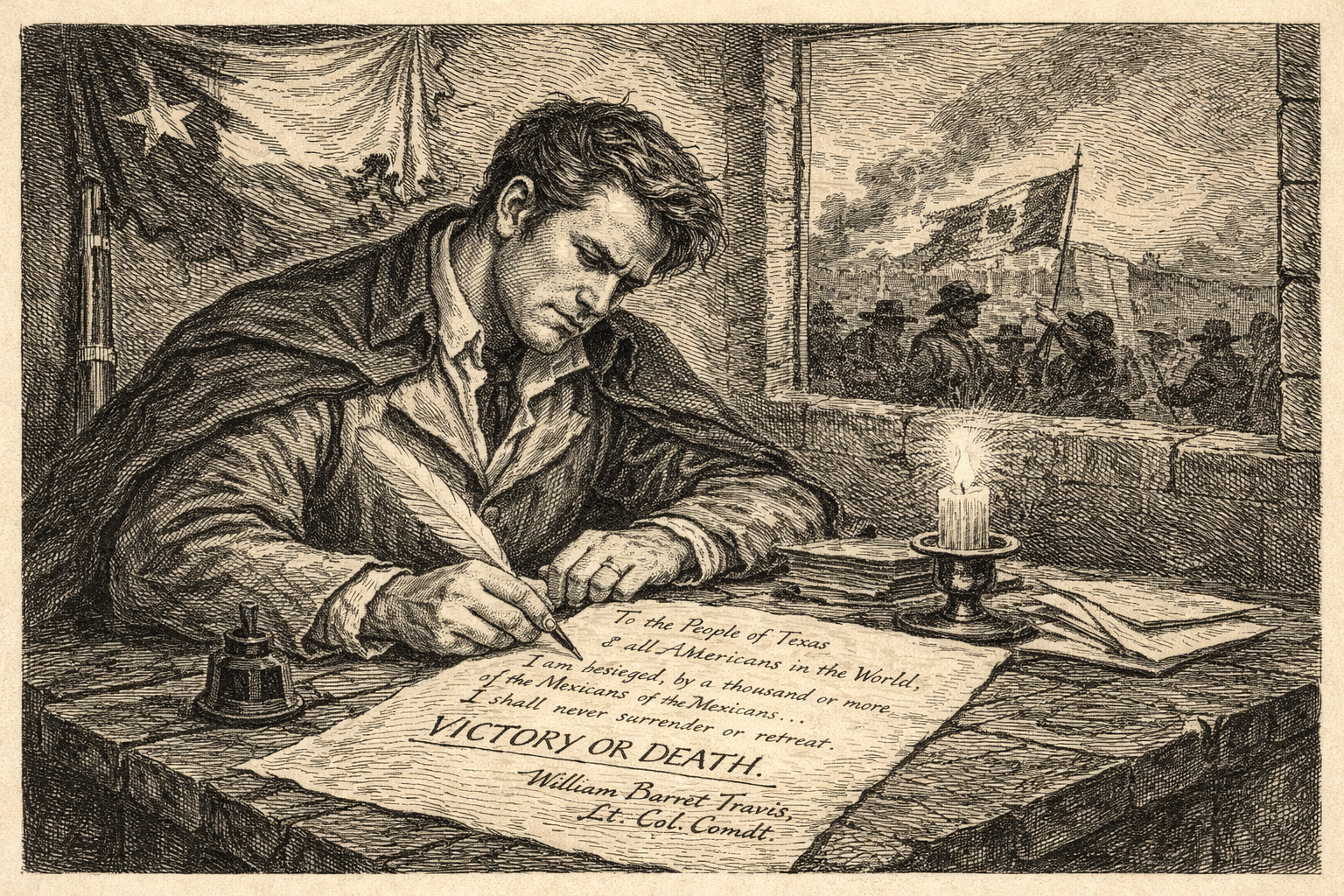
Imagine, if you will, the dusty chill of a late February dawn in 1836 Bexar—modern-day San Antonio. The air hangs heavy with the scent of gunpowder and mesquite smoke, the distant lowing of scavenged cattle mingling with the rhythmic thud of Mexican artillery. It’s been scarcely a day since General Antonio López de Santa Anna’s forces unfurled their blood-red flag from the tower of San Fernando Cathedral, signaling no quarter for the rebels holed up in the old mission turned fortress: the Alamo. And here, on this very date—February 24, exactly 190 years ago—Lieutenant Colonel William Barret Travis scratches out a letter that would echo through history like a cannon’s roar.
Commandancy of the The Alamo
Bejar, Feby. 24th. 1836
To the People of Texas & All Americans in the World-
Fellow Citizens & compatriots-
I am besieged, by a thousand or more of the Mexicans under Santa Anna – I have sustained a continual Bombardment & cannonade for 24 hours & have not lost a man – The enemy has demanded a surrender at discretion, otherwise, the garrison are to be put to the sword, if the fort is taken – I have answered the demand with a cannon shot, & our flag still waves proudly from the walls – I shall never surrender or retreat. Then, I call on you in the name of Liberty, of patriotism & everything dear to the American character, to come to our aid, with all dispatch – The enemy is receiving reinforcements daily & will no doubt increase to three or four thousand in four or five days. If this call is neglected, I am determined to sustain myself as long as possible & die like a soldier who never forgets what is due to his own honor & that of his country – Victory or Death.
William Barret Travis.
Lt. Col.comdt.
P. S. The Lord is on our side – When the enemy appeared in sight we had not three bushels of corn – We have since found in deserted houses 80 or 90 bushels and got into the walls 20 or 30 head of Beeves.
Travis
This is the story of that moment, told not from the sterile pages of a textbook, but from the grit and sweat of those who lived it. It’s the kind of tale the late Dr. June Rayfield Welch might spin over a campfire at a Texas history gathering, or that Dr. Paul Hutton could deliver with the gravitas of a frontier bard—stories that fired my own passion for recounting the past as a living, breathing saga. As a raconteur inspired by their legacy, let’s step into the shadows of those adobe walls and the sprawling camps beyond, glimpsing the hearts and hardships of the men who shaped Texas’ defiant birth.
Inside the Alamo: Whispers of Defiance and Desperation
The Alamo’s compound sprawls like a ragged scar across the landscape—a former Spanish mission with thick walls, a chapel scarred by neglect, and makeshift ramparts bolstered by earth and timber. Inside, perhaps 180 to 200 Texians—volunteers, adventurers, and settlers—huddle against the barrage. They’ve sustained 24 hours of cannon fire without losing a man, but the strain shows in their gaunt faces and powder-blackened hands. Supplies are thin: just three bushels of corn at the siege’s start, supplemented by 80 or 90 more scavenged from deserted houses, along with 20 or 30 head of beeves driven inside. The men rotate watches on the walls, sharpening knives, loading muskets, and sharing tales to stave off the encroaching dread.
At the center of it all is William Barret Travis, a 26-year-old firebrand from South Carolina, lawyer by trade and revolutionary by choice. He’s assumed full command this day, as his co-leader, the legendary James Bowie, lies bedridden in a dim interior room, wracked by what might be pneumonia or tuberculosis, his once-formidable frame weakened by fever and the siege’s unrelenting toll. Bowie, the knife-fighter whose exploits in duels and land deals made him a Texas icon, can only listen to the bombardment’s thunder, his mind drifting between pain and resolve. He knows the odds: Santa Anna’s demand for unconditional surrender means death if the walls fall. Yet from his cot, Bowie urges the men on, his spirit unbroken even as his body fails.
And then there’s Davy Crockett, the Tennessee frontiersman whose larger-than-life persona—bear hunter, congressman, storyteller—has drawn him to this distant fray. Crockett arrived at the Alamo just weeks earlier, in early February 1836, with a band of volunteers, seeking not just adventure but redemption. Back home, his political career had stalled; defeated in his 1835 bid for reelection to Congress after clashing with President Andrew Jackson over Indian removal policies, Crockett famously quipped to his constituents, “You may all go to hell, and I will go to Texas.”
He saw in this wild frontier a chance for revival, much like his fellow Tennessean Sam Houston, who had parlayed his own political setbacks—resignation as Tennessee governor amid scandal—into leadership of the Texian army. For Crockett, Texas promised land, opportunity, and a fresh stage for his charisma. On this February 24, he mans the walls with his fiddle nearby, cracking jokes to lighten the mood amid the cannonade. He envisions victory here as a springboard: perhaps a seat in the new Texas government, or even higher office in a fledgling republic. But as Mexican scouts probe the defenses and artillery shells whistle overhead, Crockett’s optimism tempers with the reality of isolation—no reinforcements in sight, the enemy swelling to thousands.
Travis, pacing the compound, pens his plea in a hurried script: “To the People of Texas & All Americans in the World—Fellow Citizens & compatriots—I am besieged, by a thousand or more of the Mexicans under Santa Anna… I shall never surrender or retreat… Victory or Death.” He seals it with a postscript of faith and fortune: “The Lord is on our side… We have since found in deserted houses 80 or 90 bushels and got into the walls 20 or 30 head of Beeves.” Courier Albert Martin slips out under cover of darkness, carrying the words that will rally distant aid—but too late for these walls.
Beyond the Walls: The Mexican Soldado’s Vigil and Santa Anna’s Grand Ambition
Outside, the Mexican Army of Operations encircles Bexar in a vast, makeshift camp—tents pitched amid the scrub, campfires flickering under a vast Texas sky. These are not the faceless horde of legend, but men: conscripts from Yucatán’s jungles, veterans from central Mexico’s highlands, many marching hundreds of miles through winter sleet and mud. On this day, they haul cannons into new positions, digging earthworks under the watchful eyes of officers. The air buzzes with bugle calls and the clatter of supply wagons; reinforcements trickle in, swelling their ranks toward 3,000 or more. Two scouts fall this afternoon—the siege’s first Mexican casualties—cut down by Texian musket fire as they venture too close.
For the average soldado, life is a grind of drills, meager rations (corn tortillas, salted beef if lucky), and the ache of homesickness. Conscripted under Santa Anna’s centralist regime, they fight to reclaim what Mexico sees as its sovereign territory, stolen by Anglo settlers and Tejanos alike. Pride mixes with resentment: the long march north has claimed lives to exposure and disease, and whispers of the rebels’ defiance stir unease. Yet discipline holds; they fire their 8-pounders and mortars methodically, probing for weakness.
Commanding it all is Antonio López de Santa Anna, the self-styled “Napoleon of the West,” whose traveling headquarters moves like a royal entourage—complete with aides, musicians, and a personal guard. On February 24, he personally leads a cavalry reconnaissance within musket range of the Alamo, his uniform resplendent, testing the defenders’ mettle while boosting his troops’ morale with distributions of shoes and supplies. At 39, Santa Anna views this campaign as a triumphant procession: crushing the “pirates” and traitors to restore Mexican glory. His mind races ahead—to Goliad, to the Brazos, to total victory. Overconfident, he dismisses the garrison’s resolve, expecting bombardment to force surrender without a costly assault. Little does he know, ten days hence, on March 6, his storming of the walls will cost hundreds of his men, birthing a martyr’s cry that seals his downfall.
Far to the east, meanwhile, Sam Houston—the tall, brooding commander of the fledgling Texian forces—grapples with the siege’s grim tidings from his vantage in Washington-on-the-Brazos and then Gonzales. In late February, as Travis’s desperate letter races across the prairies, Houston is still rallying scattered volunteers, negotiating supplies, and urging caution amid the chaos of a revolution barely organized. By early March, news of the bombardment reaches him; he knows the Alamo’s plea for aid is heartfelt but impossible to answer in time with the ragtag army at his disposal—poorly armed, ill-trained, and too few to challenge Santa Anna head-on. Houston, like Crockett, had come to Texas seeking renewal after personal and political storms back in Tennessee. Now, as commander-in-chief (reappointed amid the crisis), he faces the bitter calculus of leadership: sacrifice the few at the Alamo to buy precious weeks for building a real force. His mind turns to strategy—retreat if needed, drill the men, wait for the moment—while the weight of those inside the walls presses on him like a stone.
A Moment Frozen in Time, Echoing Today
Ten days before the final, furious dawn assault—when bayonets would clash and legends like Crockett, Bowie, and Travis would fall—the Alamo hangs in suspense. Hope flickers inside; inevitability tightens outside. Travis’s letter, carried forth, ignites a fire that leads to independence declared on March 2, the horrors of Goliad, the chaos of the Runaway Scrape, and triumph at San Jacinto. It’s a story of human frailty and fierce will, one that Crockett chased for personal renewal, mirroring Houston’s own rebirth in Texas’ soil.
As we mark this 190th anniversary here in Texas—perhaps with a visit to the Alamo’s hallowed grounds or a quiet reflection under the same vast sky—remember: history isn’t dates and dust; it’s the pulse of those who dared. Inspired by raconteurs like Dr. Welch and Dr. Hutton, I’ll continue this series next with the Texas Declaration of Independence. Until then, in the name of liberty: Victory or Death.
