
The Tueller Drill and a Split-Second Choice in Minneapolis
In the cold light of a Minneapolis morning, video footage captures a stark encounter: an ICE agent stands inches from the bumper of a red Honda Pilot. The vehicle accelerates forward, and in under two seconds, shots ring out. This moment, frozen in bystander and security camera recordings, serves as a real-world echo of the Tueller Drill-a training exercise that boils down to simple math and the unforgiving reality of human reaction time.
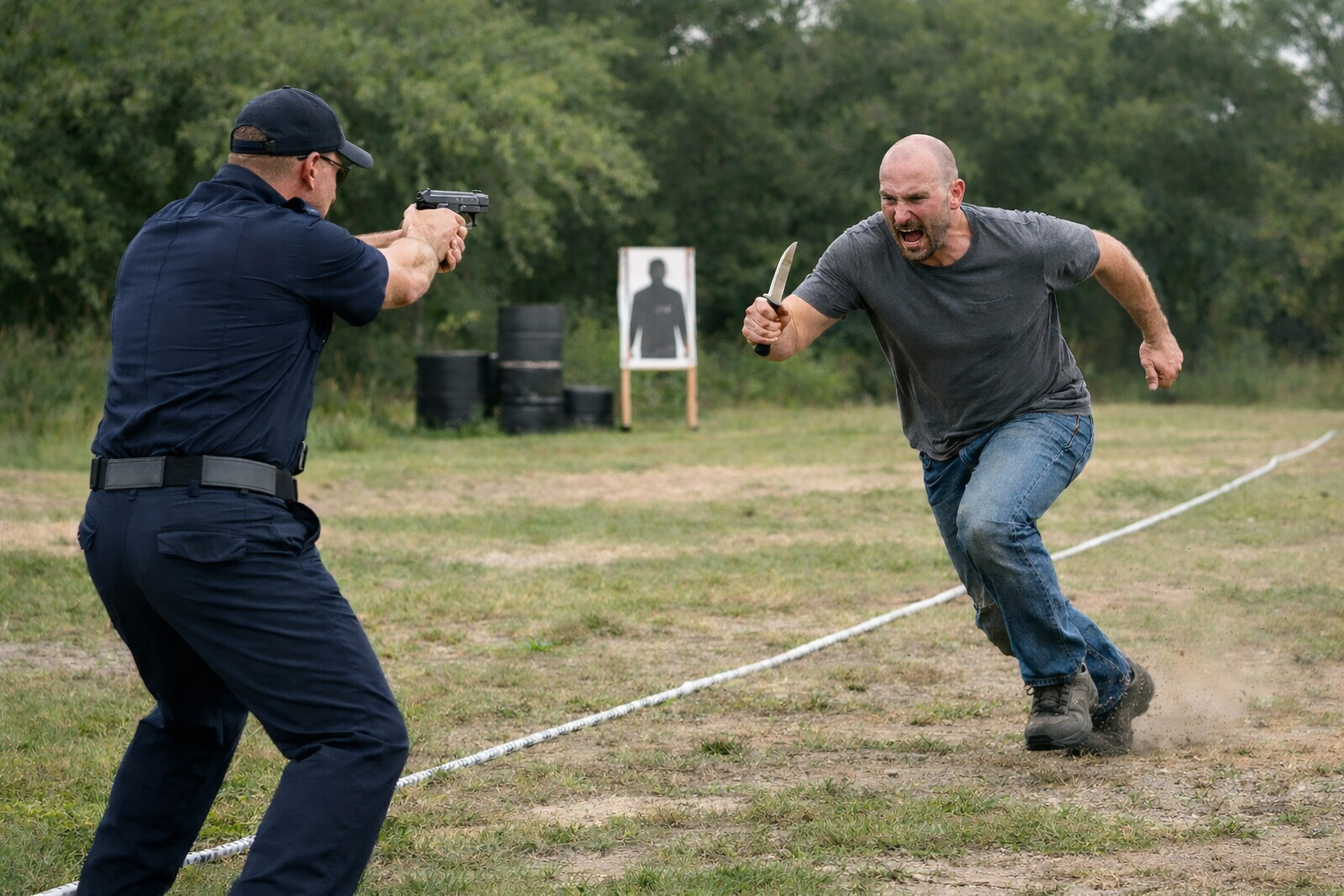
The Tueller Drill traces its origins to 1983, when Sergeant Dennis Tueller, a firearms instructor with the Salt Lake City Police Department, sought to answer a practical question in self-defense training: How close is too close when facing an attacker armed with an edged weapon? Tueller’s curiosity stemmed from his work training officers, where he observed a gap in understanding the dynamics of close-quarters threats. He conducted informal experiments, timing volunteers as they sprinted toward a target with a simulated knife, covering a distance commonly used in police firearms practice-21 feet, or seven yards.
The results were straightforward yet profound. An average adult could traverse those 21 feet in about 1.5 seconds. Tueller compared this to the time required for an officer to recognize the threat, draw a holstered handgun, aim, and fire two accurate shots-also approximately 1.5 seconds. He published his findings in an article titled How Close is Too Close? in the March 1983 issue of SWAT magazine, accompanied by a training video of the same name. The exercise wasn’t intended as a rigid doctrine but as a demonstration of the “reactionary gap,” the spatial buffer needed to respond effectively to a sudden assault.
Over the decades, the drill gained traction in law enforcement circles. It was further popularized in the 1980s through references in Caliber Press’s book The Tactical Edge: Surviving High-Risk Patrol and their video Surviving Edged Weapons, which illustrated the principles with dramatic reenactments. Trainers adapted it into what became known as the “Tueller Drill,” though Tueller himself never framed it as a “21-foot rule.” Instead, it evolved organically, emphasizing variables like attacker speed, defender readiness, and environmental factors. By the 1990s, it was a staple in police academies and self-defense courses, highlighting that threats aren’t static-distance collapses quickly, demanding proactive awareness.
At its mathematical heart, the Tueller Drill is about speed, distance, and time. The baseline speed derived from Tueller’s tests is 14 feet per second. To convert this to miles per hour, multiply by 3,600 (seconds in an hour) and divide by 5,280 (feet in a mile): (14 × 3,600) ÷ 5,280 ≈ 9.55 mph. This isn’t a sprint; it’s a brisk run, achievable by most fit adults in a burst of aggression. Over 1.5 seconds, that pace covers exactly 21 feet: distance = speed × time, or 14 ft/s × 1.5 s = 21 ft.
Human reaction time adds another layer. Studies in ergonomics and psychology peg average perception-reaction time under stress at 0.5 to 1 second-spotting the movement, processing it, deciding to act, and initiating a response. In Tueller’s scenario, this leaves scant margin; the attacker has already closed much of the gap before the defender moves. If the starting distance shrinks-to 10 feet, say-the time drops to about 0.71 seconds (10 ÷ 14), compressing the window further.
Extend this to vehicular threats, as seen in the Minneapolis footage, and the equations intensify. A vehicle at 5 mph travels at roughly 7.33 feet per second (5 × 1.4667, using the mph-to-ft/s conversion factor). At 10 mph, it’s 14.67 ft/s-faster than Tueller’s pedestrian. From a standstill or low speed, momentum builds rapidly; even a gentle forward shift at contact range (zero feet) allows no evasion. In the videos, the Honda’s initial forward motion is estimated at 5-10 mph, covering mere feet in fractions of a second: at 5 mph, 3.67 feet in 0.5 seconds; at 10 mph, 7.33 feet.
To visualize this, consider the following chart, plotting distance covered over time for these speeds.
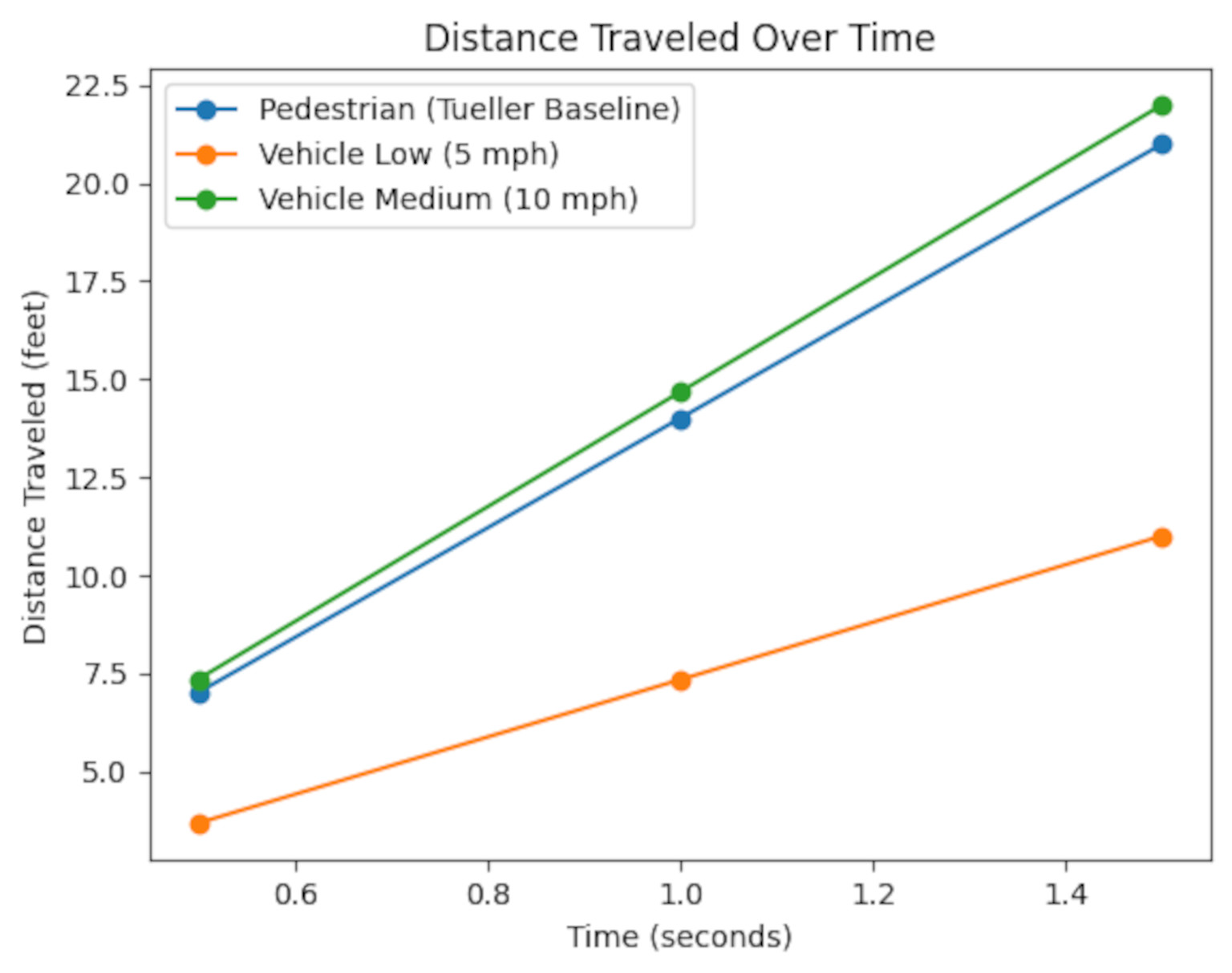
The lines illustrate how even modest velocities erase buffers. At 1 second, the pedestrian covers 14 feet; a 10-mph vehicle, nearly 15 feet. In practice, if a defender starts at zero distance-as the agent does in the footage-the math turns absolute: any motion initiates the threat instantly, with reaction time eating into survival odds.
Frame-by-frame analysis of the Minneapolis videos underscores this. The sequence from door attempt to reverse (brief, low-speed) to forward shift spans seconds, but the critical forward-to-shot interval is about 0.8 seconds. The agent, at bumper range, perceives motion and fires-muzzle flash follows the lurch almost immediately. Exhaust plumes suggest engine engagement, but no tire squeal indicates initial low acceleration. Yet, per the equations, at 5 mph, the vehicle could cover 5.87 feet in 0.8 seconds-enough for impact if unchecked.
This isn’t abstract calculation; it’s the drill’s enduring lesson. Tueller’s work, born from 1980s range tests, reminds that threats accelerate decisions to mere heartbeats. Variables like snow-slick roads or holster type might shave or add milliseconds, but the core remains: time is finite, distance is currency. In that Minneapolis clip, the numbers play out raw-math meets motion, and in that sliver, a life-or-death call crystallizes. The drill demands we respect these limits, training not for perfection, but for the possible in the unforgiving now.
