
Parental Rights Upheld: An Originalist Victory in the Landmark Mahmoud v. Taylor
 In its landmark 6-3 decision in Mahmoud v. Taylor (2025), the Supreme Court bolstered parental rights under the First Amendment’s Free Exercise Clause, shielding families from state-mandated curricula that clash with their religious beliefs. From an originalist perspective, interpreting t
Like this post? Become a Citizen Producer!


 he Constitution by its 1791 text and public meaning, this ruling echoes the Framers’ commitment to protecting religious liberty from government overreach. Yet, it also sparks debate about balancing individual rights with state authority over education-a tension rooted in Founding-era principles. Drawing on the Court’s opinion, concurring and dissenting views, and commentary from National Review, The Blaze, The Daily Signal, and Townhall, this column examines how Mahmoud v. Taylor upholds religious freedom while exposing flaws in the dissent.
The Case
Parents challenged Montgomery County Public Schools (MCPS) in Maryland for mandating LGBTQ+-inclusive storybooks, like Uncle Bobby’s Wedding, in its elementary curriculum without opt-out options. Representing diverse faiths, the parents argued these materials, promoting same-sex marriage and gender identity, violated their First Amendment right to guide their children’s religious upbringing. The Court, led by Justice Alito, issued a preliminary injunction requiring advance notice and opt-outs for such books. Conservative outlets hailed the ruling: National Review called Alito’s opinion “excellent,” The Blaze celebrated it as “nuking” an “LGBT indoctrination campaign,” The Daily Signal stressed parents’ “fundamental right,” and Townhall noted support from groups like the Heritage Foundation and Moms for Liberty.
Majority Opinion: Defending Parental Liberty
The majority opinion (pp. 4–37), rooted in Wisconsin v. Yoder (1972), held that the MCPS policy substantially burdened parents’ free exercise by mandating exposure to storybooks deemed “hostile” to their beliefs (pp. 21–27). It highlighted Uncle Bobby’s Wedding for its “subtle” message that marriage is valid regardless of partners’ sex, clashing with parents’ religious teachings (p. 23). Teacher guidance, urging reinforcement of these views and labeling dissenting comments like “That’s so gay” as “hurtful,” was seen as coercive (pp. 27, 30–32). Applying strict scrutiny, the Court found the policy not narrowly tailored to the interest of an undisrupted school session, noting MCPS’s existing opt-outs for its “Family Life and Human Sexuality” unit as proof accommodations were feasible (pp. 38–39). The ruling extended to “any other similar book” (p. 41). The core holding states:
“Today, we hold that the parents have shown that they are entitled to a preliminary injunction. A government burdens the religious exercise of parents when it requires them to submit their children to instruction that poses ‘a very real threat of undermining’ the religious beliefs and practices that the parents wish to instill. Wisconsin v. Yoder, 406 U.S. 205, 218 (1972). And a government cannot condition the benefit of free public education on parents’ acceptance of such instruction. Based on these principles, we conclude that the parents are likely to succeed in their challenge to the Board’s policies.”
From an originalist lens, this aligns with the 1791 Free Exercise Clause, which protected religious practice from state coercion. The Framers, guided by natural law, viewed parental authority over children’s moral and religious education as fundamental. The MCPS policy’s mandate, sans opt-outs, was coercive, violating Founding-era principles. National Review praises Alito for rejecting the claim that mere exposure to ideas avoids burdening religious exercise.
Criticism of the Dissent in the Majority
The majority critiques Sotomayor’s dissent for downplaying the policy’s coercion and misapplying precedent. She claims the storybooks only expose students to ideas and the “very real threat” test risks overbroad objections (pp. 21–23). The majority counters that teacher guidance creates “psychological pressure to conform” by promoting specific views and reprimanding dissent, undermining parental religious instruction (pp. 25, 27). It rejects Sotomayor’s reliance on Employment Division v. Smith (1990), noting Smith recognized Yoder’s hybrid rights (free exercise and parental authority) as an exception, applicable here (pp. 36–37). Sotomayor’s view that the policy is neutral ignores its targeted impact on religious parents, unlike the incidental burdens in Bowen v. Roy (1986) and Lyng v. Northwest Indian Cemetery Protective Assn. (1988) (pp. 18–19). Her approach risks weakening the Free Exercise Clause’s protections, defying the Framers’ intent.
Justice Thomas’ Concurrence: A Historical Anchor
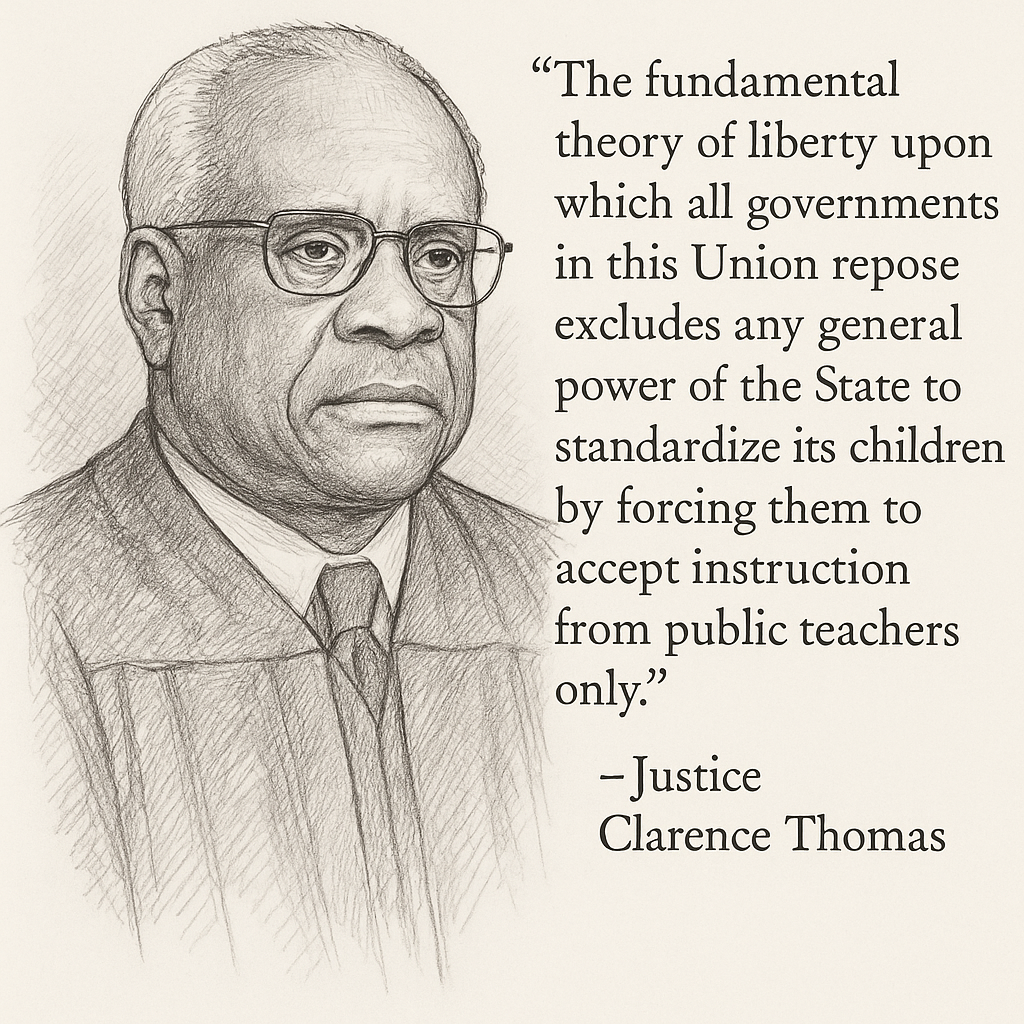 Justice Thomas’ concurrence (pp. 103, 107) offers a robust originalist framework, arguing that schools must show a “history and tradition” of teaching controversial topics like same-sex marriage to justify overriding religious objections (p. 107). In 1791, education was a parental and local duty, with schools teaching basics like reading and arithmetic, aligned with community values. No historical precedent supports mandating modern social issues, weakening the state’s claim to a compelling interest. Thomas calls the MCPS policy “ideological conformity” for urging teachers to reinforce storybook messages and reprimand religious objections, like labeling “That’s so gay” as “hurtful” (pp. 10, 32). Guidance suggesting teachers counter statements like “Being gay is wrong in my religion” with calls for kindness subtly coerces students, implying their beliefs are inappropriate (p. 31).
Thomas roots his argument in the 1791 debates, citing Madison’s view of religious liberty as a natural right. The policy’s conditioning of public education on ideological exposure penalizes religious parents, a practice the Framers would reject. His “history and tradition” test, while rigorous, risks limiting curricula to Founding-era subjects, potentially excluding modern fields like technology. Thomas prioritizes parental rights, urging schools to justify controversial curricula historically or offer opt-outs. This approach reinforces the Free Exercise Clause’s original purpose as a shield against state coercion.
Justice Sotomayor’s Dissent: Local Governance Overreach
Sotomayor’s dissent (pp. 18–38) argues the “very real threat” test misapplies Yoder and could allow vetoes of curricula like evolution or women’s rights (pp. 21–23). She sees the storybooks as exposing ideas, not coercing conformity, and defends teacher guidance as fostering civility, not ideology (pp. 30–32). For example, responding to “Being gay is wrong” with kindness respects beliefs while maintaining classroom harmony (p. 31). She disputes the books’ “hostile” label, arguing their messages are subtle, unlike Yoder’s threat to Amish survival (pp. 21–25).
Sotomayor warns of administrative burdens in Montgomery County, with over 370 religious groups, noting that opt-outs could chill inclusive curricula and harm marginalized students (pp. 24–25, 32). She highlights democratic remedies, like the 2024 MCPS board turnover, as noted in Townhall (p. 28). Citing Smith (1990), she argues neutral laws don’t violate the Free Exercise Clause unless targeting religion, and Yoder’s hybrid claim doesn’t apply (p. 35). Cases like Bowen and Lyng support her view that incidental burdens don’t trigger strict scrutiny (pp. 18–19). From an originalist perspective, her emphasis on local governance aligns with the Framers’ 1791 view of education as a state matter.
Conclusion and Criticism of the Dissent
The landmark Mahmoud v. Taylor upholds the Free Exercise Clause’s 1791 purpose, protecting parents’ right to guide their children’s religious upbringing. The majority, rooted in Yoder, rightly sees the MCPS policy as coercive, a violation the Framers would reject. Thomas’ concurrence, demanding historical precedent, reinforces this, echoing the Framers’ suspicion of state-imposed beliefs. Support from National Review, The Blaze, The Daily Signal, and Townhall frames the ruling as a triumph for parental autonomy.
Sotomayor’s dissent, while invoking local governance, falters by downplaying the policy’s coercion. By deeming the storybooks neutral, she ignores their impact on religious parents, misapplying Smith and overlooking Yoder’s hybrid rights (pp. 25, 103). Her focus on administrative burdens and diversity in Montgomery County prioritizes state convenience over the Framers’ emphasis on individual liberty. Her reliance on democratic processes, like the MCPS board turnover noted in Townhall, underestimates the Bill of Rights’ role in curbing majoritarian overreach. The majority’s broad opt-out mandate risks judicial overreach into local education, a valid concern Sotomayor raises, but her deference to local processes fails to protect the religious liberties the Framers prioritized. The ruling’s legacy will depend on balancing these constitutional protections with the Framers’ vision of local governance.
