
The Supreme Court’s Rebuke of Universal Injunctions: An Originalist Victory in Trump v. CASA, Inc.
 On June 27, 2025, the Supreme Court’s 6-3 decision in Trump v. CASA, Inc., authored by Justice Amy Coney Barrett, decisively curtailed the use of universal (nationwide) injunctions in legal challenges to President Trump’s Executive Order No. 14160, which seeks to redefine birthright citizenship under the Fourteenth Amendment. From an originalist perspective, rooted in the Constitution and statutes like the Judiciary Act of 1789, this ruling stands as a triumph for confining judicial remedies to their historical limits, thereby preserving the separation of powers envisioned by the framers. By granting the Trump administration’s request to partially stay universal injunctions issued by district courts in Maryland, Massachusetts, and Washington, the Court restricted relief to named plaintiffs with standing, allowing the executive order to potentially take effect for nonparties after a 30-day review period. The majority’s historical focus, reinforced by robust concurrences and Barrett’s pointed rebuke of Justice Jackson’s dissent, prevails over the dissent’s modern, pragmatic arguments. This column synthesizes the case, media coverage, and the justices’ opinions to underscore this originalist milestone.
The Majority: Rooted in Historical Fidelity
The case originated from three district court injunctions that blocked Executive Order No. 14160 not only for the plaintiffs-individuals, advocacy organizations, and states-but for all individuals nationwide. The Trump administration sought partial stays, contending that these universal injunctions exceeded the equitable authority granted by Congress under the Judiciary Act of 1789. Justice Barrett’s majority opinion, joined by Chief Justice John Roberts and Justices Clarence Thomas, Samuel Alito, Neil Gorsuch, and Brett Kavanaugh, held that such injunctions “likely exceed the equitable authority that Congress has given to federal courts,” limiting relief to plaintiffs with standing. The Court’s decision to avoid ruling on the executive order’s constitutionality reflects originalist restraint, focusing solely on the scope of judicial authority.
Originalism demands that judicial power align with the historical meaning of the Judiciary Act’s grant of jurisdiction over “suits … in equity.” Barrett argues this authority encompasses only remedies recognized in founding-era equity courts, citing English and early American practices where injunctions were strictly party-specific, as evidenced by cases like Iveson v. Harris (1802) and Scott v. Donald (1897). Universal injunctions, which bar enforcement against nonparties, were absent from founding-era practice, as scholar Samuel Bray observes in Multiple Chancellors. The majority rejects the respondents’ reliance on “bills of peace,” historical equitable mechanisms for group litigation, noting that these addressed small, defined groups, not the sweeping, nationwide scope of modern universal injunctions. This historical fidelity ensures courts do not encroach on legislative or executive functions, upholding the framers’ separation of powers.
Footnote 8 addresses the dissent’s challenge that no founding-era case explicitly prohibits universal injunctions. Barrett counters that their absence in historical practice shifts the burden to proponents to justify their legitimacy, a test they fail given equity’s party-specific nature. Social media lauded this footnote as a clear rejection of “universal jurisdiction,” reinforcing the originalist commitment to historical evidence over modern judicial innovation.
Concurrences: Fortifying the Originalist Framework
The concurring opinions by Justices Thomas, Alito, and Kavanaugh deepen the majority’s originalist foundation, elaborating on the historical and constitutional constraints on judicial power. Justice Thomas, joined by Gorsuch, delivers a robust concurrence emphasizing that the Judiciary Act’s equitable authority is strictly limited to remedies available in 1789. He cites Perkins v. Lukens Steel Co. (1940) and Frothingham v. Mellon (1923) to underscore that early American courts consistently rejected relief extending beyond named parties, viewing such actions as exceeding the Article III requirement of a “case or controversy.” Thomas argues that universal injunctions, by affecting nonparties without jurisdiction, violate the framers’ intent to confine courts to resolving specific disputes, as articulated in The Federalist Papers No. 78. He warns that allowing courts to issue broad, legislative-like remedies risks transforming the judiciary into a policymaking body, undermining the constitutional balance. His concurrence, noted in National Review, reinforces the majority’s historical analysis by stressing that courts lack authority to issue remedies that mimic legislative or executive action.
Justice Alito, joined by Thomas, offers a detailed concurrence that blends originalist principles with practical concerns about universal injunctions’ impact on executive authority. He argues that such injunctions, absent from founding-era practice, allow a single district judge to effectively “veto” executive action nationwide, contravening the framers’ design of a limited judiciary under Article III. Alito cites the absence of universal injunctions in early equity courts, referencing historical practices that confined relief to parties before the court. He warns that these modern remedies create a “shadow legislative process,” enabling judges to impose policy preferences under the guise of equity, a concern echoed in PJ Media. Alito further contends that universal injunctions disrupt the constitutional allocation of powers, particularly the executive’s Article II authority to execute laws, by allowing unelected judges to halt national policies based on localized disputes. His concurrence underscores the originalist imperative to tether judicial remedies to their historical roots, ensuring courts do not usurp the roles of the elected branches.
Justice Kavanaugh’s concurrence focuses on the principle of judicial restraint, arguing that the Court’s refusal to address the executive order’s constitutionality aligns with originalist minimalism. He emphasizes that equitable remedies must be narrowly tailored to avoid unnecessary interference with executive action, citing Doran v. Salem Inn, Inc. (1975) to affirm that injunctive relief should not extend beyond the plaintiffs’ specific injuries. Kavanaugh elaborates that universal injunctions, by affecting nonparties, exceed the historical scope of equity jurisdiction and risk overstepping the judiciary’s constitutional bounds. He argues that courts should defer to traditional mechanisms like class actions for broader relief, which respect the framers’ intent for limited judicial intervention. His position, highlighted in RedState, reinforces the majority’s commitment to historical norms, ensuring courts remain within their Article III mandate.
Dissents: Modern Pragmatism Over Historical Limits
The dissents by Justices Sotomayor and Jackson, joined by Kagan, prioritize contemporary judicial roles over historical constraints, rendering them less persuasive from an originalist perspective. Justice Sotomayor’s dissent argues passionately that universal injunctions are essential to prevent “exceptional, irreparable harm” from an executive order deemed “patently unconstitutional” by lower courts. She invokes the judiciary’s fundamental role as a check on executive power, citing Marbury v. Madison (1803) to assert that courts must enforce constitutional limits broadly to protect rights. Sotomayor contends that restricting injunctions to named plaintiffs allows the Executive to evade accountability for widespread constitutional violations, particularly in the context of birthright citizenship, which she argues implicates core Fourteenth Amendment protections. She cites historical cases like Ex parte Young (1908) to support the judiciary’s authority to issue broad equitable relief when necessary to uphold the Constitution. She further argues that the majority’s ruling risks creating a patchwork of legal protections, where only those with the resources to sue can secure relief, leaving others vulnerable to executive overreach. However, from an originalist lens, Sotomayor’s argument falters because it assumes courts can wield remedies beyond those authorized by the Judiciary Act’s historical scope. Her reliance on modern judicial duties, as noted in RedState and The Federalist, prioritizes policy outcomes over the framers’ intent for party-specific relief.
Justice Jackson’s dissent is even more forceful, delivering a scathing critique of the majority’s ruling as creating a “law-free zone” where the Executive can violate constitutional rights of non-plaintiffs with impunity. She argues that limiting injunctions to named plaintiffs results in a bifurcated legal landscape: one where the Executive must comply with the law for plaintiffs and another where it can act unchecked for others. Jackson invokes Youngstown Sheet & Tube Co. v. Sawyer (1952) and United States v. Lee (1882) to assert that the judiciary’s core function is to ensure the Executive adheres to the Constitution universally, not selectively. She challenges the majority’s reliance on English equity practice, arguing that the framers, in rejecting a monarchical system, intended courts to have robust powers to protect constitutional rights, as reflected in The Federalist Papers No. 69. Jackson’s hypothetical of an Executive indefinitely detaining political foes without due process illustrates her concern that the ruling weakens judicial oversight, risking “chaos” in areas like citizenship administration, as noted in RedState. She further criticizes the majority for ignoring the practical realities of modern governance, where executive actions often have nationwide impact requiring commensurate judicial remedies. Jackson argues that the majority’s historical focus is overly formalistic, failing to account for the evolving nature of constitutional challenges in a complex, interconnected society. From an originalist perspective, Jackson’s dissent is unpersuasive because it prioritizes contemporary judicial roles over the historical limits of the Judiciary Act. Her argument for universal injunctions as necessary to uphold the rule of law ignores the party-specific nature of founding-era remedies, as emphasized in HotAir and Twitchy. The absence of historical precedent for universal injunctions undermines her claim, as does her reliance on policy-driven hypotheticals rather than the framers’ intent.
Barrett’s Rebuke of Jackson: Defending Originalist Principles
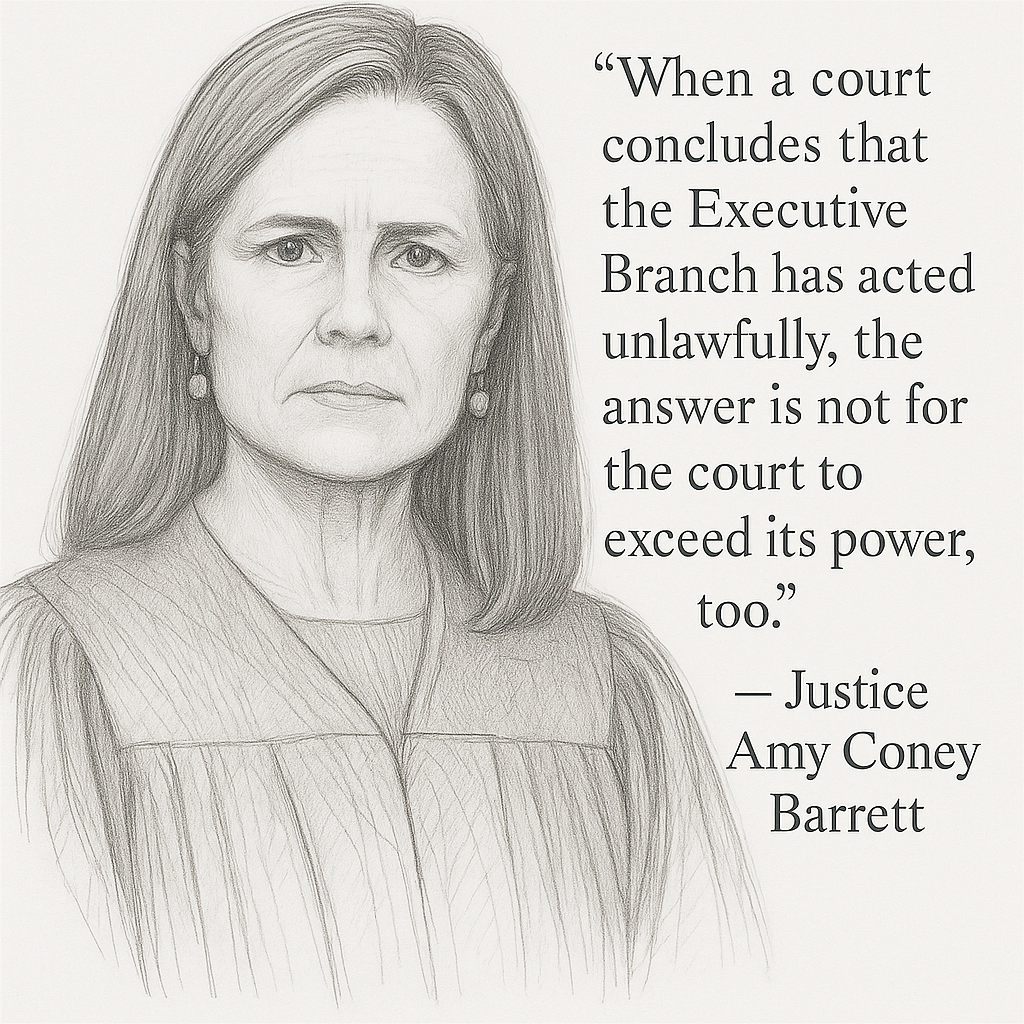 In her majority opinion, Barrett delivers a pointed rebuke of Justice Jackson’s dissent, which argues that limiting injunctions undermines the judiciary’s role in checking executive power. Barrett calls Jackson’s claim of a “law-free zone” an overreach that misrepresents the majority’s position, asserting that the judiciary’s role is to resolve disputes within the historical bounds of Article III and the Judiciary Act, not to issue sweeping remedies lacking precedent. She criticizes Jackson’s reliance on modern notions of judicial authority, arguing it ignores the framers’ intent for party-specific equitable relief, as evidenced by the absence of universal injunctions in founding-era practice. Barrett dismisses Jackson’s hypothetical of unchecked executive detention as an exaggeration, noting that plaintiffs can seek broader relief through traditional mechanisms like class actions, which align with historical practice. She further contends that Jackson’s approach would expand judicial power beyond the constitutional framework, effectively allowing courts to act as policymakers. This rebuke, highlighted in HotAir as a “sharp critique,” is exemplified in Barrett’s own words:
Justice Jackson, however, chooses a startling line of attack that is tethered neither to these sources nor, frankly, to any doctrine whatsoever. Waving away attention to the limits on judicial power as a “mind-numbingly technical query,” she offers a vision of the judicial role that would make even the most ardent defender of judicial supremacy blush. In her telling, the fundamental role of courts is to “order everyone (including the Executive) to follow the law-full stop.”
. . . .
We will not dwell on Justice Jackson’s argument, which is at odds with more than two centuries’ worth of precedent, not to mention the Constitution itself. We observe only this: Justice Jackson decries an imperial Executive while embracing an imperial Judiciary.
No one disputes that the Executive has a duty to follow the law. But the Judiciary does not have unbridled authority to enforce this obligation-in fact, sometimes the law prohibits the Judiciary from doing so. See, e.g., Marbury v. Madison, 1 Cranch 137 (1803)
This passage underscores Barrett’s commitment to originalism, prioritizing the Judiciary Act’s historical scope over the expansive judicial roles advocated by Jackson. By framing Jackson’s arguments as disconnected from the framers’ intent, Barrett reinforces the majority’s position that courts must adhere to historical equitable practices, not modern policy imperatives.
Media and Implications
Media outlets like HotAir, RedState, National Review, PJ Media, and The Federalist celebrate the ruling as a curb on judicial overreach. They highlight its restriction on district courts’ geographic authority, aligning with the Judiciary Act’s localized intent. The decision may facilitate Trump’s agenda, including policies on sanctuary cities and refugee resettlement, by reinforcing Article II powers. Trump’s “YUGE WIN” post on Truth Social reflects this restoration of executive authority. The rise of universal injunctions-86 in Trump’s first term, 28 under Biden, 17 in Trump’s second term’s first 100 days-marks them as modern anomalies, not historical norms, as supported by Solicitor General concerns across administrations. Class-action lawsuits, a traditional remedy, remain viable, as seen in Maryland plaintiffs’ actions, aligning with originalist preferences for established mechanisms.
Conclusion
Trump v. CASA, Inc. is an originalist triumph, restoring the judiciary’s role as a limited arbiter, not a super-legislature. The majority, fortified by concurrences and Barrett’s pointed rebuke of Jackson, anchors remedies in the Judiciary Act’s historical scope, ensuring party-specific relief upholds the framers’ separation of powers. The dissents, though raising valid concerns about constitutional enforcement, falter for lacking historical grounding. By rejecting universal injunctions, the Court ensures courts stay within Article III, leaving policy to elected branches, as the framers intended.
