
Eisenhower’s Absolute Accountability on D-Day
Last year we honored the raw courage of Rudder’s Rangers at Pointe du Hoc and the big guns of the Battleship Texas pounding the Normandy beaches. This anniversary, let us look higher in the chain: to the supreme commander who carried the loneliest burden of all.
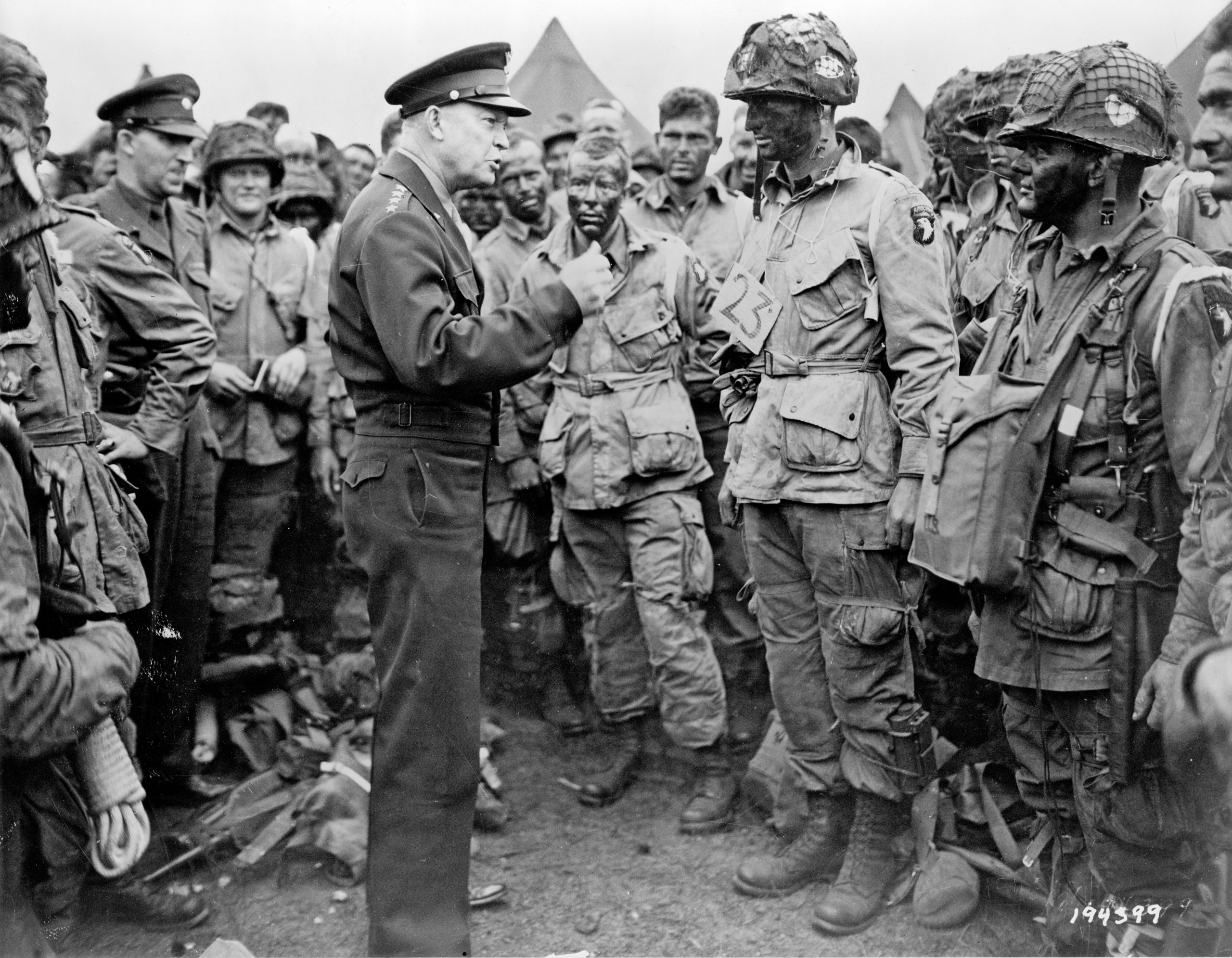
On the evening of June 5, 1944, at Greenham Common airfield in England, General Dwight D. Eisenhower walked among the paratroopers of the 101st Airborne Division. The iconic photograph captures the moment: Ike in simple uniform, surrounded by young men in full jump gear, faces darkened with camouflage, some with chalked numbers on their chests. He chats casually, asks about hometowns, talks fly fishing—offering calm confidence while knowing many would not return.
The invasion, Operation Overlord, the largest amphibious assault in history, was hours away. Eisenhower had just made the call to launch despite marginal weather after a 24-hour postponement. The responsibility rested on him alone.
The Public Face of Resolve
To the troops, sailors, and airmen, he issued the full Order of the Day:
SUPREME HEADQUARTERS
ALLIED EXPEDITIONARY FORCESoldiers, Sailors, and Airmen of the Allied Expeditionary Force!
You are about to embark upon the Great Crusade, toward which we have striven these many months. The eyes of the world are upon you. The hope and prayers of liberty-loving people everywhere march with you. In company with our brave Allies and brothers-in-arms on other Fronts, you will bring about the destruction of the German war machine, the elimination of Nazi tyranny over the oppressed peoples of Europe, and security for ourselves in a free world.
Your task will not be an easy one. Your enemy is well trained, well equipped and battle-hardened. He will fight savagely.
But this is the year 1944! Much has happened since the Nazi triumphs of 1940-41. The United Nations have inflicted upon the Germans great defeats, in open battle, man-to-man. Our air offensive has seriously reduced their strength in the air and their capacity to wage war on the ground. Our Home Fronts have given us an overwhelming superiority in weapons and munitions of war, and placed at our disposal great reserves of trained fighting men. The tide has turned! The free men of the world are marching together to Victory!
I have full confidence in your courage, devotion to duty and skill in battle. We will accept nothing less than full Victory!
Good luck! And let us beseech the blessing of Almighty God upon this great and noble undertaking.
Dwight D. Eisenhower
These words were meant to inspire. They projected shared purpose and unshakeable confidence.
The Private Weight of Command
Yet in his pocket, Eisenhower carried a very different message: one he wrote himself and hoped never to release. Handwritten in haste (he even misdated it July 5 in his exhaustion), the full “In Case of Failure” note read:
“Our landings in the Cherbourg-Havre area have failed to gain a satisfactory foothold and I have withdrawn the troops. My decision to attack at this time and place was based on the best information available. The troops, the air and the Navy did all that bravery and devotion to duty could do. If any blame or fault attaches to the attempt it is mine alone.”
No excuses. No diffusion of responsibility to the weather, the intelligence officers, subordinate commanders, or politicians. Mine alone.
In Crusade in Europe, Eisenhower later reflected on the agony of one critical decision—the airborne drops supporting Utah Beach. Air Chief Marshal Leigh-Mallory had warned strongly of potentially catastrophic losses:
“I went to my tent alone and sat down to think. Over and over I reviewed each step… I realized, of course, that if I deliberately disregarded the advice of my technical expert on the subject, and his predictions should prove accurate, then I would carry to my grave the unbearable burden of a conscience justly accusing me of the stupid, blind sacrifice of thousands of the flower of our youth. Outweighing any personal burden, however, was the possibility that if he were right the effect of the disaster would be far more than local: it would be likely to spread to the entire force.”
He made the call. The airborne divisions suffered real losses (roughly 18–20% on D-Day for the U.S. 82nd and 101st) but far less than the worst fears, and their scattered drops sowed confusion among the Germans while securing vital objectives.
The Lesson in Leadership
The juxtaposition between the two messages reveals the true nature of command. Publicly, Eisenhower lifted men toward victory. Privately, he prepared to shield them from blame if the gamble failed. This was not showmanship; it was the essence of leadership as Eisenhower understood it: absorb the counsel, make the decision, give credit for success, and shoulder the full weight of failure.
In an era of committees, spin, and blame-shifting, where responsibility is endlessly outsourced to “circumstances,” predecessors, or institutions, Ike’s example stands as a rebuke and a model. True accountability is personal. The weight of command is the willingness to bear it alone when necessary.
As Texans and Americans, we honor D-Day not merely as triumphant history but as a living lesson. Whether leading a family, a business, a precinct, a unit, or a nation, the standard is the same: own your decisions. Inspire others with confidence while standing ready to accept the consequences. Eisenhower did both: publicly and privately. That character under pressure is why the Great Crusade succeeded and why his leadership endures.
Let us carry that forward. In our own fights to preserve liberty, restore the American melting pot, and defend what matters, may we emulate the quiet resolve that says, without qualification: the responsibility is mine.
