
The Man Who Let the Dirt Tell the Truth
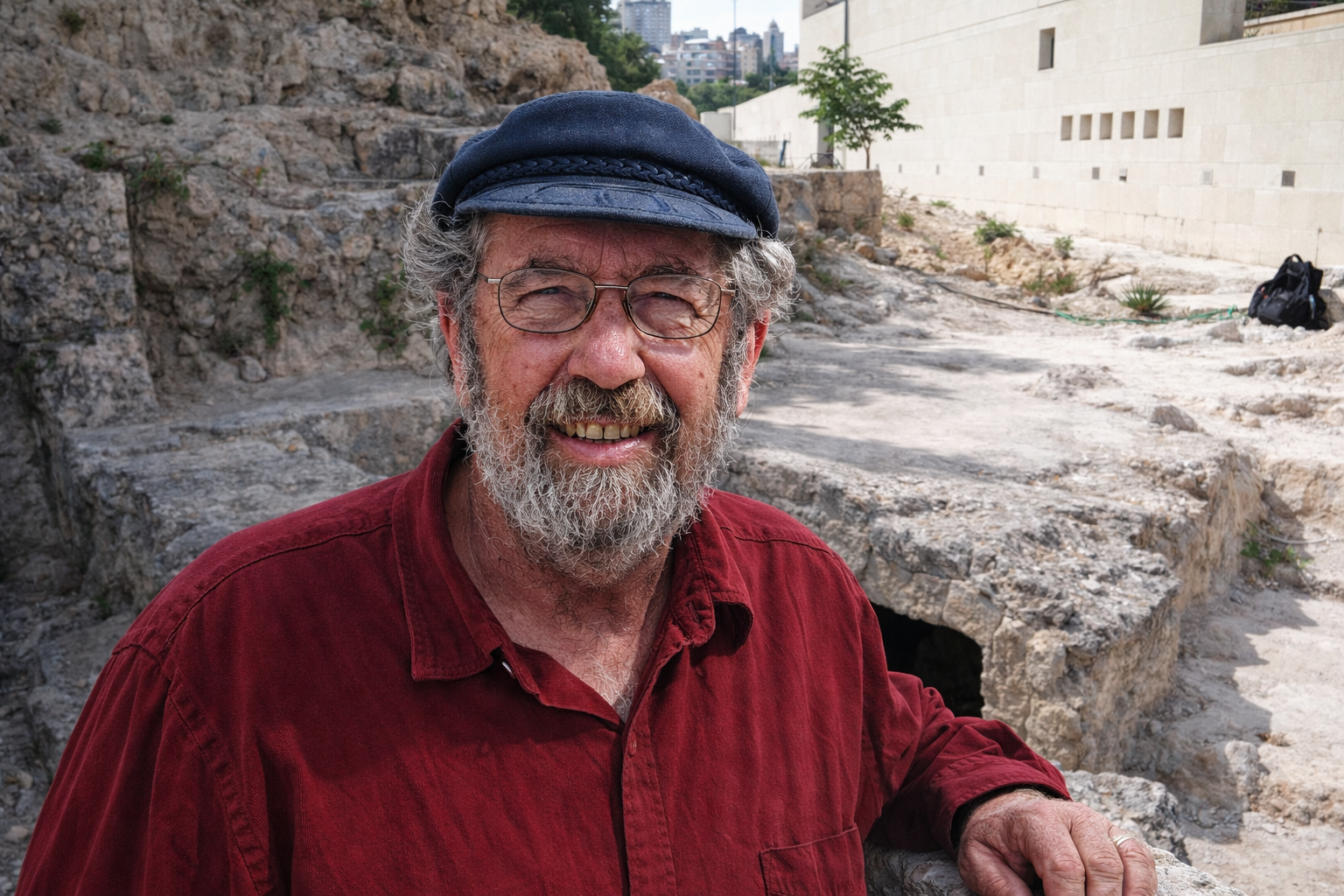
I’ve spent more evenings than I care to count parked in front of the TV, letting ancient Jerusalem rise from the screen like dust off a dig. That was back in the aughts, when The Naked Archaeologist aired-Simcha Jacobovici charging through history like a man possessed, and there, steady as bedrock, was Professor Gabriel Barkay. Calm. Precise. And armed with a dry wit so sharp it could cut through limestone.
I laughed out loud more times than I can count, not because the man was a comedian, but because truth delivered deadpan hits harder than any punchline. Take the Ketef Hinnom silver scrolls, the greatest find of his lifetime. Barkay was excavating those First Temple burial caves southwest of the Old City, low on budget, so he brought in a pack of 12- and 13-year-old volunteers from a Tel Aviv youth club. Most were eager. One boy-Nathan-was a walking question mark, tugging at Barkay’s sleeve every five minutes. To buy himself a moment’s peace, Barkay stuck the kid in a small bone repository under a burial bench with strict orders: “Clean it spotless, like your mother’s kitchen. Don’t touch anything else.”
Nathan, bored and perhaps a touch defiant, started hammering on what looked like solid rock floor. It wasn’t. The layer collapsed into a hidden lower chamber, untouched since the 7th century BCE, full of pottery, bones, and-miracle of miracles-two tiny silver amulets rolled tight as secrets. Inscribed on them? Variants of the Priestly Blessing from Numbers 6: “May the Lord bless you and keep you…” The oldest biblical text ever found, predating the Dead Sea Scrolls by centuries. Barkay’s line about it still makes me grin: “He made the greatest discovery of my lifetime-not his.” A kid’s mischief became proof that the Torah’s words were already being worn close to the heart in Jerusalem 2,600 years ago. I replayed that segment so many times the remote control buttons nearly wore out.
Then there was the Assyrian army, 701 BCE, Sennacherib’s juggernaut rolling up to Jerusalem’s walls under Hezekiah. The Bible says an angel struck down 185,000 soldiers overnight. Assyrian records brag of shutting Hezekiah up “like a bird in a cage” but mysteriously skip any victory parade. Barkay, ever the practical man, leaned on Herodotus’s parallel tale of field mice (or desert rats) swarming an Assyrian camp, gnawing through quivers, bowstrings, shield handles, horse harnesses-every scrap of leather that kept an empire’s war machine moving. In a sprawling camp under the Levantine sun, with grain stores drawing rodents by the thousands, those little chewers could render chariots useless and archers toothless in a single night. Barkay delivered it with that signature deadpan: God may have sent the miracle, but the rats did the paperwork. I chuckled every time, because it turned cosmic drama into the kind of gritty logistics any Texan who’s dealt with varmints understands.
He had a way of grounding the grand in the everyday. People don’t bury their dead in cities they don’t occupy, he’d point out. Those Ketef Hinnom tombs, layered with generations of Judahite bones and grave goods stretching into (and perhaps through) the Babylonian exile? That’s not speculation; that’s evidence of people living, dying, and honoring their kin right there in Jerusalem. You don’t maintain family crypts in a ghost town. Simple. Irrefutable. The kind of logic that cuts through noise.
Seth Mandel captured the essence in his Commentary tribute, and three lines burned into me like hot brands:
-
“The truth has a ‘pro-Israel bias.’” Because when you sift half a million artifacts from the Temple Mount earth the Waqf dumped in the Kidron Valley-seals with Hebrew names, First Temple pottery, arrowheads from 70 CE-the facts keep lining up on one side. Barkay co-founded that sifting project in 2005 to rescue history from bulldozers. No apologies. Just receipts.
-
“You cannot argue the archaeology,” quoting Ambassador Mike Huckabee. Those silver scrolls, the bullae reading “Belonging to Yedaya son of Asayahu,” the continuous burial record-they don’t debate; they declare. Barkay never needed to raise his voice. The dirt did it for him.
-
“People offended by the truth only deserve to hear the truth more often.” That’s the defiant heart of the man. When critics called his work “right-wing” for merely preserving what others tried to erase, he didn’t soften. He doubled down. Tell it again. Louder. With evidence.
Gabriel Barkay wasn’t flashy. He didn’t need to be. In a field full of speculation, he brought the spade and the straight face. He made me laugh while teaching me that history isn’t polite fiction-it’s stubborn, layered, and often inconvenient. From my living room, I cheered every time he appeared on screen, because here was a champion who let Jerusalem speak for itself.
Rest easy, Professor. The truth you unearthed still stands, unyielding as Texas limestone. And if there’s digging in the world to come, I have no doubt the rats and the kids will still find a way to help.
