
On Deadly Ground: Why Virginia Democrats Just Rewrote the Map
Sun Tzu said: “When on surrounded ground, plot. When on deadly ground, fight.” We are on politically deadly ground in America. The old norms of “fair” redistricting and waiting for the decennial census have been trashed. Both parties understand the new reality: whoever controls the legislature, the governorship, and (when needed) the constitutional amendment process gets to draw the lines that determine who holds power in Congress. Virginia Democrats just demonstrated they grasp this better than many Republicans.
The Birth of the Gerrymander
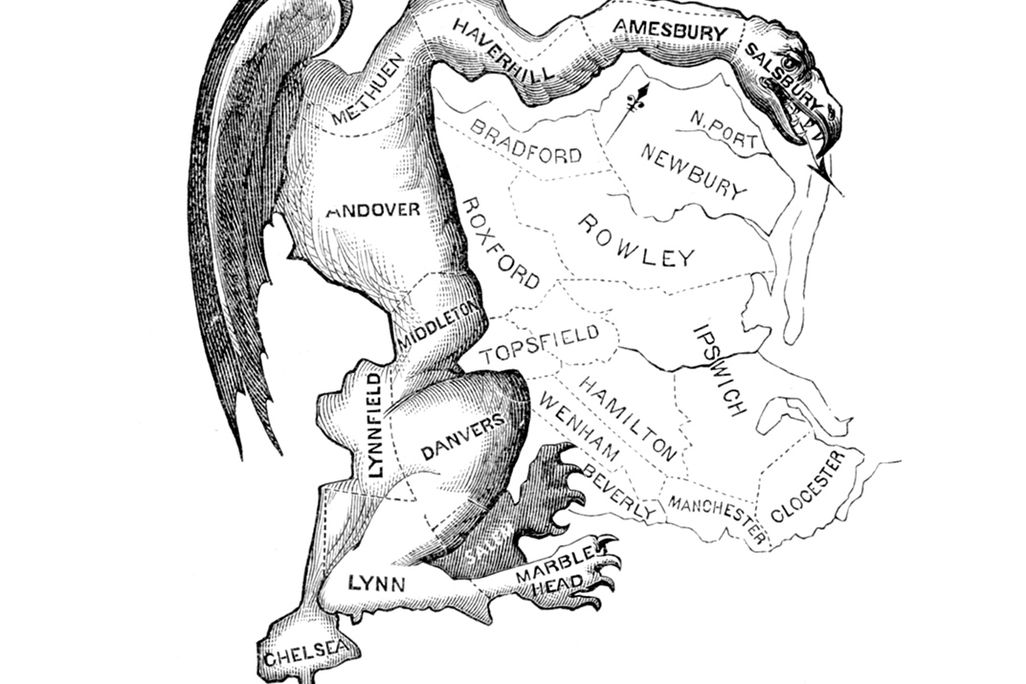
The term “gerrymander” was born in 1812 in Massachusetts. Governor Elbridge Gerry, a Democratic-Republican, signed a redistricting bill that heavily favored his party. One contorted state senate district in Essex County looked so bizarre that a Federalist cartoonist in the Boston Gazette (March 26, 1812) drew it as a mythical salamander monster and dubbed it the “Gerry-mander.” The portmanteau stuck. Ever since, the deliberate manipulation of district lines for partisan advantage has been known as gerrymandering, a practice as old as the republic itself.
On Tuesday, Virginia voters narrowly approved a constitutional amendment allowing the Democratic-controlled General Assembly to enact a mid-decade congressional map (HB 29) on a temporary basis until after the 2030 census. The vote was 1,574,538 Yes (51.45%) to 1,485,785 No (48.55%), a razor-thin margin of about 2.9 percentage points. This was not a vote reflecting a balanced 6-5 partisan split. It was a process question that unlocked a map projected to deliver Democrats something closer to a 10D-1R delegation in a state that remains modestly blue-leaning overall.

The visuals tell the story better than any spreadsheet. The new map has a grotesque “lobster”. Its body and claws are rooted deep in Fairfax County and the dense, wealthy Northern Virginia suburbs, the ultimate Democratic base. From there, long, skinny tentacles stretch far into central and western Virginia, carving up rural and conservative areas to dilute Republican strength without “wasting” too many urban Democratic votes. Fairfax itself gets split across five different congressional districts, letting one small but populous enclave exert control over vast swaths of the state. This is classic efficiency gerrymandering: a modest statewide edge turned into overwhelming seat dominance.
Compare the numbers coldly. The current commission-drawn map produces a roughly 6D-5R delegation (a 54.55%-45.45% seat split, or 1.2:1 ratio). The referendum itself was tighter: 51.45:48.55 (about 1.06:1). Yet the new lines would widen the gap dramatically. A near-even popular vote on the process does not justify (or even approximate) lopsided outcomes. That’s the power of how you draw the districts.
This isn’t “restoring fairness,” as the ballot language euphemistically claimed. It’s raw institutional power. Democrats in Virginia watched the national arms race and refused to sit idle.
The Redistricting Wars: Timeline of Escalation
Redistricting has always been a blood sport, but 2025–2026 turned it into an unprecedented mid-decade arms race, the largest coordinated effort between censuses in modern history. Here’s the full timeline of the key players:
- New York (2022 precursor): Democrats, holding unified control, drew an aggressive map explicitly engineered to maximize seats. State courts struck it down as an unconstitutional partisan gerrymander, forcing a special master redraw. Overreach met guardrails, a warning the other side ignored at its peril.
- Texas (July–August 2025): Republicans fired the first major shot of the current cycle. Responding to sustained Biden-era DOJ lawsuits under the Voting Rights Act (filed in 2021) and later coalition-district concerns, they redrew congressional lines mid-decade. The resulting map was projected to net up to five additional GOP-friendly seats. The U.S. Supreme Court cleared it for use, turning defensive legal pressure into partisan advantage.
- Missouri (September 2025): GOP legislators followed Texas’s lead, calling a special session to dismantle Democratic Rep. Emanuel Cleaver’s Kansas City district. The new map gave Republicans a clear edge in seven of eight seats, a net gain of roughly one seat.
- North Carolina (October 2025): Republicans redrew their map to flip the Democratic-held 1st District, netting another one to two seats for the GOP.
- Ohio (October 31, 2025): Ohio’s constitution required a redraw because the prior map lacked bipartisan support from the Redistricting Commission. The commission unanimously approved a new map that boosted Republican chances, shifting the delegation from 10R-5D toward a potential 12R-3D advantage, a net gain of one to two seats without triggering the full “mid-decade” label, but achieving the same power-maximizing result.
- Utah (November 2025): A rare court-forced intervention. After years of litigation over Proposition 4 (the 2018 voter-approved anti-gerrymandering initiative), a state judge struck down the Republican legislature’s proposed map as an “extreme partisan outlier.” The court imposed a plaintiff-submitted alternative creating a new Democratic-leaning district anchored in Salt Lake County, flipping one seat toward Democrats despite Utah’s deep-red tilt. Appeals failed; the map stands for 2026.
- California (November 2025): Democrats countered the Republican wave. Facing Texas’s gains and the national stakes, voters approved a mid-decade redraw via ballot measure, projected to net Democrats several seats and blunt GOP momentum.
Virginia Democrats simply joined the fray in April 2026, using their narrow referendum victory to activate the lobster map with its Fairfax head and rural tentacles. For now, they appear to have won this round.
The Indiana Failure: Unilateral Disarmament That Deserves Harsh Criticism
The sharpest contrast, and the one that should draw the most criticism, comes from Indiana. Here was a solidly Republican state with full GOP control of the governorship and both legislative chambers. President Trump personally pushed for mid-decade redistricting that would have netted two additional safe GOP seats, following the exact playbook Texas had used. It was a layup: clear strategic need, national House implications, and the votes in hand.
Yet in December 2025, the Indiana Senate voted it down 31-19, with more than 20 Republican senators joining Democrats to kill the effort. Some cited process concerns or “popular sovereignty.” Others simply folded despite intense White House pressure.
This wasn’t prudent restraint. It was self-inflicted weakness: unilateral disarmament at the worst possible moment. While Democrats in Virginia were rewriting their constitution on a 51-49 knife-edge to lock in a massive seat advantage, and while Texas, Missouri, North Carolina, and Ohio had already turned opportunity into concrete gains, Indiana Republicans had every tool available and chose not to use them. In a deadly-ground fight, hesitation isn’t wisdom; it’s surrender. That failure handed Democrats a free offset in the national balance exactly when the other side was accelerating the arms race. Strategic malpractice. If you’re going to invoke “The Rules,” you don’t get to sit out the inning when it’s your turn at bat.
Up Next: Florida Revisits the Maps — Again
Florida is the next flashpoint. Republican Gov. Ron DeSantis has called a special legislative session on congressional redistricting for April 2026, explicitly responding to the broader national wave and potential shifts from pending U.S. Supreme Court rulings on the Voting Rights Act. Florida already redrew its maps aggressively after the 2020 census, producing a heavily Republican-favorable delegation. Now Republicans are poised to revisit and refine them mid-decade, potentially netting additional GOP seats — analysts have floated gains of up to several districts depending on how far the Legislature pushes.
This move comes despite Florida’s own Fair Districts Amendments, which explicitly ban maps drawn with the intent to favor or disfavor a political party or incumbent. Democrats and good-government groups are already crying foul and filing challenges, while polls show a majority of Florida voters (including some Republicans) view mid-decade redistricting as a “bad idea.” DeSantis frames it as necessary to reflect population realities and comply with federal legal developments, not pure partisanship.
Whether Florida succeeds where Indiana failed will be telling. With unified Republican control, the tools are there. If they execute cleanly and turn the session into concrete gains, it reinforces the new rules: respond aggressively when you hold power, as Virginia Democrats just did, or risk ceding ground as with Indiana. If internal hesitation or court pushback stalls it, it becomes another missed opportunity in the arms race.
These Are The Rules
Until one party achieves clear dominance or voters demand stronger structural barriers (state independent commissions with real teeth that can’t be bypassed), power maximization is the only rational response. Virginia’s lobster map (Fairfax tentacles reaching deep into rural Virginia) is the latest exhibit. Rural and central Virginia voices aren’t just outnumbered; they’re being structurally tethered to politicians whose base and priorities lie 50+ miles away in the D.C. suburbs.
These are The Rules now. Play by them aggressively, without apology, and without unilateral disarmament, or watch the other side redraw the map, and the country, in its image.
(The visuals of the Virginia “lobster district” and Fairfax carve-up make the point more powerfully than words alone. This isn’t abstract theory; it’s how one dense enclave now dominates an entire state’s congressional delegation, and why the fight in Florida matters next.)
