
A Flawed Bid Doomed by Timing
Introduction
Virginia Democrats are barreling toward a high-stakes political maneuver that could reshape the state’s congressional map ahead of the 2026 midterms. With House Minority Leader Hakeem Jeffries desperate to blunt Republican redistricting gains and Virginia Democrats eager to keep Lieutenant Governor Winsome Sears off the campaign trail, the party is pushing for a special session starting October 27 to amend the state constitution and redraw districts. Yet, this audacious plan is poised to fail-not due to lack of ambition, but because Virginia has been in a general election for the past 45 days, rendering the effort legally and logistically unworkable under current law.
Dual Motivations Driving the Effort
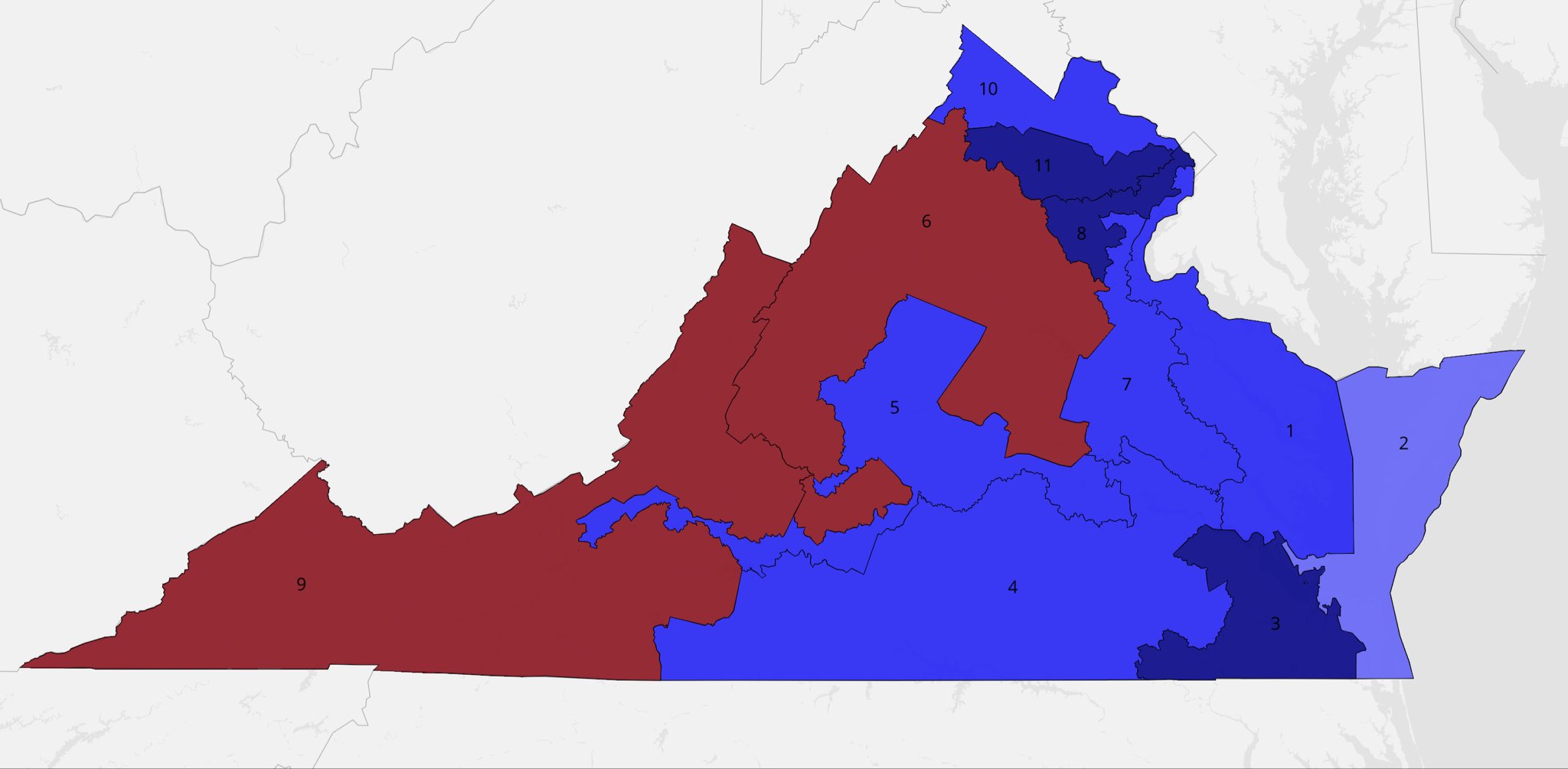
The Democratic initiative is fueled by two intertwined motivations, each reflecting the party’s precarious position. First, Hakeem Jeffries faces mounting pressure to counter Republican redistricting successes in states like North Carolina, Texas, and Missouri, where GOP efforts-encouraged by President Trump-could net 3–5 House seats, widening their 220–215 majority. With the government shutdown entering its third week, polls (e.g., Quinnipiac, October 20, 2025) show 54% of voters blaming Democrats, and Trump is capitalizing on the chaos to push spending cuts. A redistricting win in Virginia, potentially flipping the state’s 6D–5R congressional split to 8D–3R or 9D–2R, would offer Jeffries a much-needed legislative victory to shift the narrative and shore up his leadership ahead of 2026.
Second, Virginia Democrats are laser-focused on neutralizing Winsome Sears, the dynamic Republican Lieutenant Governor and Senate President. Sears, a key tie-breaker in the 21D–19R Senate, is campaigning vigorously for governor against Abigail Spanberger, energizing GOP voters with ads tying Spanberger to AG candidate Jay Jones’ scandal. Convening a special session would force Sears back to Richmond, sidelining her from the campaign trail during the critical final 12 days before the November 4 election. This move could dampen Republican momentum in suburban districts where Spanberger leads narrowly, while also preventing Sears from rallying the Senate against the redistricting amendment.
Democrats in Virginia call a special session to try and change the constitution to reinstate partisan redistricting…oh and to get Winsome Sears off the campaign trail
Can't wait to see you guys next week. Might have some things to say on the floor…or will you shut down debate?
— Nick Freitas (@NickJFreitas) October 23, 2025
The Fatal Flaw: An Election Already Underway
Despite these strategic imperatives, the plan is doomed by a fundamental legal reality: Virginia has been in a general election for the past 45 days. Early in-person voting began on September 19, 2025, per the Virginia Department of Elections, with over 300,000 ballots cast by October 23. This marks the start of the general election cycle for the November 4 gubernatorial and statewide races, including the pivotal Attorney General contest featuring Jason Miyares (R). Under Article II, § 1 of the Virginia Constitution, the “general election” encompasses early voting, absentee voting, and Election Day, a definition reinforced by the Washington Post’s reporting on the 45-day campaign overdrive.
There is precisely one legal argument that could save us from political armageddon in Virginia.
Early voting began in September. Hundreds of thousands of ballots have already been cast. With an election currently underway, one could argue that Democrats have missed the deadline… https://t.co/dtIDoBJVzc pic.twitter.com/Hm8NtzaVMy
— Christian Heiens 🏛 (@ChristianHeiens) October 23, 2025
This ongoing election triggers a critical constraint in Article XI, § 1, which governs constitutional amendments. The section mandates that amendments be proposed and passed by the General Assembly before the “next general election” and ratified no sooner than 90 days post-passage. With voting already underway since September 19, any amendment proposed during the October 27 special session falls outside this window. Christian Heiens astutely argues that this timing renders the effort unconstitutional, a view supported by a 2018 federal court ruling in North Carolina that paused mid-decade map changes during an active filing period. The Virginia Supreme Court, with its current 4D–3R majority after 2025 appointments, would likely uphold this interpretation if challenged-especially if Miyares, who has pledged to prioritize election integrity, wins the AG race and files suit.
Legal and Logistical Barriers
The 2020 constitutional amendment (Article II, § 6-A) further complicates Democrats’ plans by vesting redistricting authority in the Virginia Redistricting Commission (VRC), tied to the decennial census cycle. The 2021 maps, based on the 2020 Census, are valid through 2030 unless a court invalidates them-a trigger absent here. Bypassing the VRC requires a constitutional amendment, which demands passage by two successive General Assemblies (e.g., 2025–26 and 2026–27) and voter ratification, likely delaying implementation to 2028 at the earliest. Even if the special session convenes-contingent on Gov. Youngkin’s approval by early next week, which he’s signaled he’ll deny-the 90-day ratification window post-January 2026 lands in April 2026, too late for 2026 candidate filings (due June 2026).
This timeline aligns with the assertion that redistricting must wait until the next general election cycle, post-2027. The Democratic rationale-claiming the 2021 maps are “outdated” due to population shifts or a need to preempt federal interference-lacks legal grounding without a court ruling, as noted in the NYT article. Past attempts, like California’s blocked 2024 mid-decade redraw, underscore the courts’ reluctance to permit such moves mid-cycle.
Political Risks and Backlash
Beyond legality, the timing risks a political misfire. Internal Democratic splits, highlighted by the Washington Post, show moderates fearing suburban backlash, while the shutdown’s unpopularity could amplify perceptions of desperation. If Youngkin denies the session, forcing a 3/5 self-convene vote (barely achievable with 51D–49R in the House and 21D–19R in the Senate), the delay could render the effort moot. Meanwhile, Sears could mitigate her absence with remote rallies, and Republicans are poised to sue, citing Equal Protection Clause violations. Nationally, this could escalate the “arms race” (per the Princeton Gerrymandering Project), inviting GOP counter-moves in 2026.
Conclusion
The dual motivations-Jeffries’ need for a shutdown distraction and Virginia Democrats’ bid to neutralize Sears-drive a bold but flawed strategy. With Virginia entrenched in an active election for 45 days, the legal framework ensures this redistricting push will fail. The earliest viable window for a redraw lies post-2025, likely 2028, aligning with the next amendment cycle. For now, this appears as political theater, unlikely to deliver the win Jeffries craves or keep Sears sidelined. Watch Youngkin’s decision by Monday, October 27, and any post-election lawsuits-those will seal this gambit’s fate. In the meantime, Democrats might be better served addressing the shutdown than chasing an unattainable map.
