
The Spectrum of Power: A Progression of Philosophies
Introduction
The pursuit of power and order has profoundly influenced the course of human societies throughout history, giving rise to a rich and varied array of philosophical perspectives that stretch across a broad spectrum, ranging from the realms of manipulation and authoritarian control to the more enlightened domains of rights-based governance, collective will, and meticulously balanced authority. This essay undertakes an in-depth exploration of this expansive continuum, employing the structured framework provided by the “Nine Principles of Propaganda” as delineated in the accompanying poster. These foundational principles are meticulously outlined as follows:
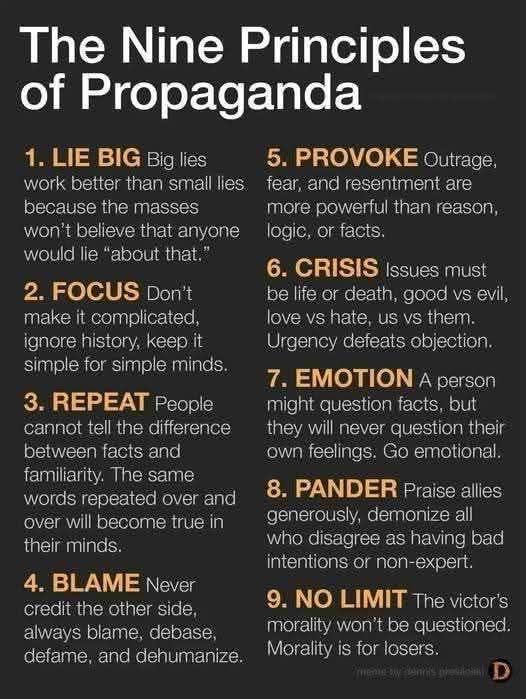 Lie Big-big lies work better than small lies because the masses won’t believe that anyone would lie “about that”.
- Focus-don’t make it complicated, ignore history, keep it simple for simple minds.
- Repeat-people cannot tell the difference between facts and familiarity, the same words repeated over and over will become true in their minds.
- Blame-never credit the other side, always blame, debase, defame, and dehumanize.
- Provoke-outrage, fear, and resentment are more powerful than reason, logic, or facts.
- Crisis-issues must be life or death, good vs. evil, love vs. hate, us vs. them, urgency defeats objection.
- Emotion-a person might question facts, but they will never question their own feelings, go emotional.
- Pander-praise allies generously, demonize all who disagree as having bad intentions or non-expert.
- No Limit-the victor’s morality won’t be questioned, morality is for losers.
Cast within this meticulously crafted framework, this narrative embarks on a comprehensive comparison of the timeless strategies presented in Sun Tzu’s *The Art of War*, the political pragmatism of Niccolò Machiavelli’s *The Prince*, the modern manipulative maxims of Robert Greene’s *48 Laws of Power*, the pervasive techniques encapsulated in the principles of propaganda, the authoritarian philosophy of Thomas Hobbes’ *Leviathan*, the rights-centric social contract theory of John Locke, the collective sovereignty vision of Jean-Jacques Rousseau’s *The Social Contract*, and the balanced governance model of Montesquieu’s separation of powers. This analysis reflects the diverse and multifaceted approaches these thinkers and frameworks have contributed to the understanding and exercise of influence and governance.
Synopsis of Frameworks
Sun Tzu’s *The Art of War* (5th century BCE) stands as a seminal and enduring military treatise, meticulously crafted by an illustrious Chinese general, offering a wealth of tactical wisdom that places a premium on the art of deception, the strategic deployment of psychological dominance, and an unwavering focus on achieving victory on the battlefield. This ancient text provides a timeless repository of principles designed for outmaneuvering opponents with finesse, such as the ingenious tactic of winning without engaging in direct combat and the astute exploitation of the enemy’s inherent weaknesses, thereby establishing itself as an indispensable cornerstone for military strategy and broader strategic thought across centuries.
Machiavelli’s *The Prince* (1513), authored by the astute Italian diplomat and philosopher Niccolò Machiavelli, emerges as a profoundly pragmatic and influential guide tailored specifically for rulers, advocating with remarkable clarity the strategic use of fear as a governing tool, the calculated application of ruthless tactics when necessary, and an adaptable moral flexibility to steadfastly maintain power. Drawing richly from the intricate political landscape of Renaissance Italy, this work counsels that a prince must adeptly adapt to the exigencies of necessity, decisively eliminate any rivals who pose a threat, and skillfully project an image of virtuous leadership, irrespective of the morally ambiguous means employed to achieve such ends.
Robert Greene’s *48 Laws of Power* (1998), penned by the insightful American author Robert Greene, represents a modern and meticulously compiled manual for achieving personal ascendancy, distilling a vast array of historical examples into a series of actionable maxims such as “crush your enemy totally” and “never outshine the master.” This work draws profound lessons from the lives of iconic figures like Napoleon and Cleopatra, placing a strong emphasis on the art of opportunism, the subtle craft of manipulation, and the intricate maneuvering within social contexts to secure and sustain dominance in highly competitive environments.
The “Nine Principles of Propaganda,” credited to the enigmatic @jeremy_g_smithID, presents a comprehensive and systematic set of techniques meticulously designed for the purpose of mass manipulation, encompassing the strategic use of big lies, the deliberate provocation of emotions, and the persistent application of repetition. This framework, which appears to be a contemporary reinterpretation of historical propaganda strategies-potentially influenced by thinkers like Anne Morelli-is expressly formulated to shape and mold public perception with precision, as vividly demonstrated in the contexts of political campaigns and wartime messaging, where the prioritization of control supersedes any commitment to absolute truth.
Thomas Hobbes’ *Leviathan* (1651), authored by the distinguished English philosopher amidst the tumultuous backdrop of the English Civil War, provides a robust philosophical justification for the establishment of absolute sovereignty as the definitive solution to the inherent state of war that characterizes humanity’s natural condition. Hobbes passionately argues that the presence of a strong, centralized ruler is absolutely essential to impose a stringent order, enforce binding covenants, and effectively prevent the pervasive chaos that arises from the deep-seated selfishness ingrained in human nature, thereby laying a formidable foundation for the advocacy of authoritarian governance.
John Locke’s social contract theory, elaborately detailed in his seminal work *Second Treatise of Government* (1689), originates from the enlightened perspective of the English philosopher in response to the transformative events of the Glorious Revolution, passionately advocating for a government that derives its legitimacy from the explicit consent of the governed, the safeguarding of individual rights to life, liberty, and property, and the inherent right of the populace to rise in revolution against any tyrannical oppression. Locke’s profound emphasis on the power of reason and the principle of mutual benefit has played a pivotal role in shaping the foundations of modern liberalism and the core principles underpinning democratic governance.
Jean-Jacques Rousseau’s *The Social Contract* (1762), crafted with great intellectual rigor by the Swiss-French philosopher, places its central focus on the concept of the general will as the true and authentic source of sovereignty, passionately promoting the ideals of equality, the cultivation of civic virtue, and the practice of collective decision-making. Rousseau envisions an idealized society where the individual interests of each citizen are harmoniously aligned with the overarching common good, standing in stark contrast to traditional hierarchical models and exerting a significant influence on the ideological currents that fueled revolutionary movements.
Montesquieu’s separation of powers, eloquently articulated in his magnum opus *The Spirit of the Laws* (1748) by the esteemed French philosopher, proposes a visionary framework that divides the functions of government into three distinct branches-legislative, executive, and judicial-specifically designed to prevent the emergence of tyranny and to steadfastly ensure the preservation of liberty. Inspired by the evolutionary governmental system of Britain following the Glorious Revolution of 1688, this framework, which was later wholeheartedly adopted and implemented in the U.S. Constitution, underscores the critical importance of checks and balances, the virtue of transparency, and the guiding principle of moderation as the essential pillars that uphold effective and just governance.
Lie Big
Sun Tzu’s timeless maxim that “all warfare is based on deception” serves as a clarion call for the employment of audacious and bold misdirections on the battlefield, such as orchestrating a feigned retreat to cunningly trap unsuspecting enemies, thereby establishing a sophisticated tactical tone that prioritizes the art of outwitting opponents through the deployment of grand and elaborate illusions designed to confound and conquer with unparalleled ingenuity.
Machiavelli significantly escalates this deceptive strategy, passionately urging rulers to project an impeccable image of virtue to the public while simultaneously engaging in acts of calculated cruelty behind the scenes-such as claiming the absolute necessity for the implementation of harsh laws to maintain societal order-meticulously crafting big lies of such monumental scale that the unsuspecting masses are rendered incapable of questioning their veracity due to the sheer magnitude and audacity of the deception being perpetrated.
Greene’s provocative directive to “court attention at all costs” takes this concept to new and exhilarating heights by advocating for the creation and projection of exaggerated personas, exemplified by leaders who might stage grand and ostentatious public works projects to overwhelmingly dominate public perception, thereby reflecting a highly personalized and meticulously crafted brand of deceit that operates on a grand and theatrical stage to captivate and enthrall vast audiences with its spectacle.
Propaganda’s foundational principle that big lies possess an unparalleled effectiveness because their audacious nature overwhelms the natural skepticism of the masses finds vivid and compelling historical validation in notorious campaigns such as the Nazi fabrications of racial superiority, which were deliberately designed with the explicit and calculated intention of reshaping and fundamentally altering the deeply held societal beliefs of entire populations on an immense and transformative scale that left an indelible mark on history.
Hobbes lends his authoritative and unwavering support to this deceptive narrative by championing the sovereign’s absolute and unassailable narrative, presenting the establishment of centralized rule as the singular and incontrovertible truth deemed essential to escape the pervasive and unrelenting chaos of the natural state, such as justifying the issuance of sweeping and absolute decrees that brook no opposition or dissent from any quarter.
In stark and principled contrast, Locke vehemently rejects the reliance on lies with a resolute determination, firmly grounding the legitimacy of governance in the transparent and freely given consent of the governed, ensuring that the mechanisms of power reflect an unvarnished and authentic reality rather than being built upon the shaky and unstable foundations of fabricated and misleading narratives that deceive the populace.
Rousseau intricately and philosophically ties the concept of truth to the unifying and cohesive force of the general will, insistently maintaining with great conviction that any collective agreement must steadfastly avoid the pitfalls and temptations of fabrication, as vividly illustrated in the conduct of open assemblies that are deliberately kept free from the taint of deceit and manipulation to preserve their integrity and moral standing.
Montesquieu demands an unwavering and steadfast commitment to transparency as a robust bulwark to prevent the abuse of power, envisioning a governmental system where the legitimacy of authority is firmly rooted in the practice of openness and full disclosure to the public, rather than being sustained by the insidious practices of deceitful manipulation, as strikingly demonstrated in the public legislative debates that expose all governmental actions to the rigorous scrutiny of an informed and engaged populace.
Focus
Sun Tzu’s conceptualization of the leader as the ultimate arbiter of the people’s fate underscores with great emphasis the critical and indispensable importance of focusing military efforts on the execution of clear and uncomplicated strategies, such as the strategic and deliberate concentration of forces on a singular and well-defined point of attack to overwhelm the enemy with a level of minimal complexity that maximizes efficiency, effectiveness, and the potential for decisive victory on the battlefield.
Machiavelli offers sage and well-considered advice to rulers, counseling them with profound wisdom to keep the mechanisms of their rule deliberately simple and straightforward to effectively avoid the pitfalls and dangers of widespread hatred among the governed, focusing with laser-like precision on the consistent implementation of public actions such as the generous provision of tax relief to maintain the enduring favor of subjects without entangling them in the confusing and burdensome web of convoluted and overly complex policies.
Greene’s insightful and strategically astute maxim to “get others to do the work for you, but always take the credit” provides a highly streamlined and efficient approach to the management of personal effort, placing a strong and unwavering emphasis on the strategic and thoughtful delegation of complex tasks while retaining ultimate and authoritative control, a practice that is vividly and frequently observed in the calculated actions of leaders who outsource intricate responsibilities to capable underlings to significantly simplify and lighten their own operational roles and responsibilities.
Propaganda adheres with unwavering dedication to the guiding principle of ignoring the intricate complexities of historical context and eschewing the entanglement of intricate details, opting instead to deliver simple, concise, and easily digestible slogans such as the paradoxical “war is peace” to effectively captivate and engage the minds of the simpler and less discerning segments of the population, a tactic that has been masterfully and repeatedly employed in the oppressive regimes of totalitarian governments to unify thought patterns with messages that require minimal intellectual effort to comprehend and internalize.
Hobbes seeks to unify the diverse and fragmented fabric of society under the singular and unassailable will of a sovereign authority, focusing with unrelenting determination all available power into the capable hands of this central figure to ensure the maintenance of order and stability amidst the pervasive and threatening anarchy that looms large, such as the rigorous enforcement of a singular and comprehensive legal code designed to eliminate any potential for confusion, dissent, or disorder within the societal structure.
Locke introduces a transformative and revolutionary shift by advocating with passionate conviction for the establishment of clear and sharply focused laws that are expressly and meticulously designed to protect the fundamental and inalienable rights to life, liberty, and property, ensuring that the intricate processes of governance remain accessible, understandable, and approachable to the general populace, as exemplified in the creation of meticulously codified rights documents that simplify legal comprehension and empower all citizens with a clear understanding of their entitlements.
Rousseau places the noble and altruistic concept of the common good at the very heart and soul of the general will, centering his visionary approach to governance on the simplification of administrative processes to prioritize and advance the collective welfare and prosperity of the entire community, as vividly and poignantly illustrated in the practice of communal decision-making processes that are deliberately and thoughtfully structured to emphasize and promote the achievement of shared goals and objectives for the betterment of all.
Montesquieu champions with eloquent fervor the advocacy of balanced powers, advocating for the division of the governmental structure into three distinct and well-defined branches-legislative, executive, and judicial-each endowed with a specifically focused and specialized role to safeguard the precious and hard-won ideal of liberty without risking the overwhelming and potentially destabilizing complexity of the system, a principle that is brilliantly and effectively embodied in the structured and meticulously organized branches outlined within the U.S. Constitution that maintain a commendable and enduring clarity in the administration and execution of governance.
Repeat
Sun Tzu masterfully and with great strategic acumen employs the potent tactic of repeated psychological pressure, utilizing consistent and unrelenting displays of formidable military strength to methodically and systematically condition enemy forces into a state of eventual surrender without the necessity of engaging in the rigors of direct and protracted battle, wearing down their resolve over an extended and grueling period through the relentless and unceasing application of these powerful and intimidating demonstrations of power and prowess.
Machiavelli reinforces the enduring and indelible image of a ruler with meticulous care through the repeated and deliberate execution of specific acts that alternate between acts of generosity and moments of severity, skillfully and purposefully embedding the profound concept of authoritative rule deep within the public consciousness, a process that is strikingly exemplified by the ruler’s constant and highly visible public appearances designed to reinforce the unwavering and steadfast loyalty of their subjects with every repeated encounter.
Greene’s strategically astute and visionary directive to “play on people’s need to believe to create a cultlike following” hinges with remarkable precision on the continuous and deliberate repetition of persuasive and compelling narratives, such as the persistent and rhythmic reiteration of a leader’s inspirational and motivating mantra, to successfully cultivate and sustain a devoted and fanatically loyal base, a phenomenon that is strikingly and powerfully observed in the meteoric rise of charismatic leadership cults that echo these same ideals with fervor and dedication.
Propaganda adheres with an almost mechanical and unwavering precision to the guiding principle of relentless repetition, transforming the mere and superficial familiarity of repeatedly delivered messages into a deeply ingrained and perceived truth within the minds and hearts of the broader populace, a tactic that is vividly and powerfully illustrated by the constant and unceasing reiteration of state-approved ideological messages in the context of Soviet propaganda, which succeeded with remarkable effectiveness in embedding these beliefs deeply and permanently into the collective psyche of the nation.
Hobbes demands with authoritative insistence the repeated and unwavering obedience to the sacred and binding terms of the social covenant, effectively and systematically embedding the sovereign’s supreme and unchallenged authority through the establishment of habitual and ingrained compliance among the governed, a practice that is poignantly exemplified by the rigorous enforcement of curfews across multiple generations to instill a deep-seated and enduring discipline and an unquestioning acceptance of the established authority.
Locke places significant and unwavering reliance on the repetition of reason as a transformative pedagogical tool delivered through the enriching medium of education, with the explicit and noble intention of fostering a well-informed, enlightened, and critically thinking populace capable of providing meaningful and considered consent to governance, a goal that is passionately pursued through the widespread and sustained implementation of literacy campaigns that offer repeated and diverse opportunities for learning and intellectual empowerment to citizens from all walks of life.
Rousseau envisions with great philosophical depth the general will as a powerful and dynamic educational force that is reinforced and perpetuated through the repeated and meaningful engagement in civic participation, such as the regular and inclusive convening of assemblies, to harmoniously and effectively align the individual interests and aspirations of citizens with the broader and more encompassing collective interests, thereby reinforcing with each repetition the communal values that serve as the bedrock of this societal structure over an extended and evolving timeframe.
Montesquieu ensures with meticulous care the long-term stability and resilience of the governmental system through the consistent and repeated application of well-crafted laws, a process whereby their repeated and diligent enforcement serves to reinforce with unwavering strength the establishment of enduring legal norms within the fabric of society, as strikingly and convincingly demonstrated in the progressive development of judicial precedents that shape and mold societal expectations through the consistent, predictable, and fair delivery of judicial rulings across generations.
Blame
Sun Tzu strategically and with great tactical foresight advocates for the aggressive and targeted disruption of the enemy’s overarching and meticulously devised strategy, placing the blame with unerring precision squarely on the flawed and poorly conceived tactical plans formulated by their leadership, such as directing concerted efforts to undermine a general’s misguided and ineffective strategies to sow widespread confusion and significantly weaken the enemy’s overall resolve and cohesion on the tumultuous battlefield.
Machiavelli passionately and with unrelenting determination urges the complete and thorough elimination of any rivals who might dare to pose a threat to the stability and security of the ruling regime, attributing blame with calculated intent to these individuals for any perceived or actual dangers that could destabilize the established order, such as the dramatic and public execution of suspected plotters to secure the throne and effectively shift the public’s focus and outrage onto the alleged treachery and perfidy of these adversaries.
Greene’s uncompromising and boldly articulated directive to “crush your enemy totally” involves the deliberate and systematic act of blaming adversaries for any perceived wrongdoing or transgression, employing a range of sophisticated tactics such as the methodical and relentless blackening of a rival’s once-sterling reputation to rally widespread and enthusiastic support among the populace and justify the complete and utter elimination of any opposition that might challenge or threaten personal dominance within the competitive arena.
Propaganda engages in the ruthless and systematic dehumanization and the unyielding blaming of the opposing side with a fervor that borders on fanaticism, a practice that is vividly and powerfully illustrated in the context of wartime vilification campaigns where enemies are depicted with grotesque exaggeration as monstrous and subhuman entities, with the explicit and calculated intention of uniting the populace against a common and vilified foe to strengthen national resolve and solidarity in times of conflict.
Hobbes provides a compelling and philosophically grounded justification for the authoritative use of force against the inherent and ever-present threats posed by the chaotic state of nature, attributing blame with a sweeping generality to the pervasive and deeply ingrained selfishness that characterizes the fundamental behavior of humanity for the perpetuation of a state of perpetual and destructive war, thereby necessitating the presence of a strong and authoritative ruler to impose order and administer justice by punishing those deemed guilty of disrupting the peace.
Locke introduces a pivotal and transformative shift in perspective by pivoting with resolute conviction to the advocacy of a sacred and inalienable right to revolution, placing the blame with righteous indignation squarely on a tyrannical and oppressive government for its egregious and unforgivable breach of the hallowed social contract, a stance that is powerfully exemplified by the American Revolution which was waged with fierce determination against the overreach of British colonial rule that blatantly and systematically violated the cherished rights of the colonial populace.
Rousseau seeks to unite the diverse and fragmented collective against the insidious scourge of corruption that threatens to undermine societal integrity, attributing blame with a critical eye to the internal decay caused by nefarious factors such as the unbridled greed and avarice of the elite, rallying the community with a shared purpose to undertake a concerted and determined effort to purify the mechanisms of governance through the collective accountability and unified action of all enlightened citizens.
Montesquieu ingeniously and with great foresight employs the sophisticated system of checks and balances to prevent with resolute determination the dangerous concentration of blame within any single governmental branch, ensuring with meticulous care that no entity can unfairly or unjustly accuse another of wrongdoing or misconduct, as strikingly and convincingly demonstrated in the historic instance of Congress overriding a presidential veto with a unified voice to maintain a delicate and equitable equilibrium and distribute responsibility in a fair, balanced, and just manner across the governmental structure.
Provoke
Sun Tzu employs with cunning and strategic brilliance the deft tactic of provoking enemies to reveal their deeply hidden and closely guarded weaknesses, utilizing ingenious bait such as the execution of feigned retreats to expose critical vulnerabilities, thereby forcing a reactive and often ill-considered response from the adversary that can be strategically and decisively exploited to gain a significant and lasting advantage on the ever-shifting battlefield.
Machiavelli skillfully and with Machiavellian cunning stirs the seeds of division among the ranks of enemy factions, provoking with deliberate intent the outbreak of internal conflict to significantly and irrevocably weaken their collective opposition, such as sowing the insidious seeds of discord among rival groups to fracture their unity and create fertile opportunities for the ruler to assert a dominant and unassailable position of power.
Greene’s insightful and psychologically astute “discover each man’s thumbscrew” involves the deliberate and calculated act of provoking individuals with surgical precision to uncover and exploit their deepest and most vulnerable emotional triggers, employing sophisticated tactics like the judicious use of calculated flattery to expose hidden insecurities, thereby tailoring the intricate art of manipulation to align perfectly with each person’s unique and sensitive emotional breaking point with remarkable accuracy.
Propaganda unleashes with unrestrained fervor a torrential and overwhelming cascade of outrage, fear, and deep-seated resentment among the masses, as vividly and powerfully observed in the inflammatory and provocative rhetoric that was so effectively deployed during the tense and divisive years of the Cold War to mobilize widespread and enthusiastic support against the perceived and omnipresent threat of communism, effectively stirring the public’s passions to a fever pitch of emotional intensity.
Hobbes maintains with iron resolve the fragile fabric of order within the complex tapestry of society through the strategic and deliberate use of fear as a governing tool, provoking with unrelenting determination the compliance of the governed through the ever-present and looming threat of descending into the abyss of anarchy, a practice exemplified by the imposition of harsh and punitive punishments designed to deter any hint of rebellion and enforce an unwavering and submissive obedience.
Locke issues a stern and principled warning against the insidious dangers of unjust provocation, advocating with unwavering conviction for the supremacy of reason as the guiding light to effectively avoid the treacherous pitfalls of emotional manipulation, as powerfully demonstrated in the reasoned and measured debates over the equitable implementation of fair taxation policies to prevent the outbreak of unrest and preserve a rational and enlightened discourse among the citizenry.
Rousseau’s enlightened concept of the general will stands as a bulwark against factionalism, resolutely and with great moral fortitude rejecting any form of provocation that might serve to divide the cohesive collective, such as the careful and diplomatic mediation of simmering class tensions to preserve a state of unity and maintain a harmonious and balanced emotional equilibrium within the fabric of the community.
Montesquieu seeks with visionary intent to reduce the potential for conflict and discord through the enlightened implementation of balanced powers within the governmental structure, minimizing with great care the occurrence of emotional provocation between the various branches, as exemplified in the judicious judicial reviews that serve to calm and mitigate instances of legislative overreach and maintain a stable, serene, and well-regulated emotional climate within the broader administration.
Crisis
Sun Tzu astutely and with remarkable foresight creates the necessary and critical conditions for achieving a resounding victory, skillfully and adeptly utilizing crises such as the sudden and unexpected onset of supply shortages to gain a decisive and strategic advantage over the adversary, thereby forcing the beleaguered enemy into a position of inevitable surrender under the intense and unrelenting pressure of these dire circumstances, and transforming moments of desperation into golden and unparalleled opportunities for triumphant success.
Machiavelli leverages with masterful cunning the inherent and unpredictable chaos of crises to consolidate and significantly strengthen his iron grip on power, turning tumultuous and disruptive events such as a widespread and violent rebellion into a unique and transformative opportunity to reinforce his rule with decisive, authoritative, and far-reaching actions that centralize control firmly in his capable hands.
Greene appeals with persuasive eloquence to the self-interest of individuals during the turbulent periods of crisis, aligning their pragmatic actions with lucrative opportunities for personal gain, such as capitalizing on the economic turmoil of devastating downturns by shrewdly hoarding valuable and scarce resources to significantly enhance their personal status, wealth, and influence within the societal hierarchy.
Propaganda heightens with dramatic intensity the perceived severity of crises by framing critical issues in stark and uncompromising terms of life or death, good versus the forces of evil, to effectively and resolutely defeat any lingering objections or resistance, as vividly and powerfully illustrated in the wartime calls to arms that portray the enemy as existential and imminent threats to the very survival of the nation, overriding any dissent with urgent and emotionally charged rallying cries that demand immediate action.
Hobbes perceives with philosophical depth the omnipresent and ever-threatening crisis of the state of war as an inherent and inescapable condition of human existence, justifying with compelling logic the establishment of a sovereign authority to escape this perilous and destructive state, such as the decisive imposition of martial law to swiftly restore order and address with urgency the immediate and pressing threats that imperil the stability of the social order.
Locke permits with principled resolve the dissolution of governmental structures during the most trying times of crisis, attributing blame with righteous indignation to the catastrophic failure of the ruling authority to fulfill its obligations, as poignantly and historically demonstrated in the English Civil War’s bold and defiant challenge to the legitimacy of the monarchy when it failed with abject negligence to adequately protect the rights, welfare, and security of the people it was sworn to serve.
Rousseau tests with philosophical rigor the resilience and adaptability of the general will in the face of the most challenging crises, strengthening with unwavering determination the collective resolve and unity of the community, such as rallying the resilient populace during the devastating and disruptive impact of natural disasters to reinforce the unbreakable and enduring bonds of community and enhance the collective strength and spirit of the society as a whole.
Montesquieu stabilizes with visionary foresight the intricate framework of governmental operations through the enduring principle of separation, ensuring with meticulous care that each distinct branch is robustly equipped and sufficiently empowered to withstand the formidable pressures imposed by crises, as strikingly and convincingly evidenced in the U.S. government’s coordinated yet balanced and decentralized response to the catastrophic and transformative events of the 9/11 attacks, managing the crisis with a unified yet carefully calibrated approach that preserved governmental integrity.
Emotion
Sun Tzu strategically and with great psychological insight boosts the morale and fosters a profound sense of unity among his dedicated troops, harnessing with masterful precision the raw and unbridled power of emotion to inspire them with resounding and heartfelt rallying cries delivered with passion before the onset of the climactic battle, igniting a deep-seated and burning courage within their hearts and cultivating a profound and unifying sense of purpose that binds them together as a formidable force.
Machiavelli seeks with calculated intent to exert a commanding control over the emotional spirit of the people, skillfully and with deft manipulation harnessing their feelings to secure their unwavering and steadfast loyalty, as powerfully exemplified by the dramatic and public staging of executions designed to instill a pervasive and lingering sense of fear and ensure the absolute and unquestioning obedience of the broader populace under his rule.
Greene advises with strategic foresight against the perilous act of outshining the master, meticulously and with great care managing the intricate and delicate emotional dynamics that underpin alliances to preserve their integrity and strength, such as deferring praise with humility to a superior figure to maintain their favor and skillfully avoid the destructive and corrosive pitfalls of jealousy that could undermine the alliance.
Propaganda wholeheartedly and with unrestrained enthusiasm embraces an intensely emotional approach, deliberately and with calculated intent bypassing the faculty of cold and detached reason with an overwhelming and infectious surge of passionate fervor, as vividly and powerfully portrayed in the patriotic zeal and emotional fervor whipped up with great skill during times of war to unite the diverse populace and stir a deep and abiding sense of national pride that resonates across the nation.
Hobbes governs with a delicate and finely tuned balance of fear and hopeful aspiration, skillfully and with masterful manipulation harnessing these powerful emotions to maintain a semblance of order within the complex tapestry of society, as strikingly seen in the solemn promises of lasting peace offered under the protective and benevolent umbrella of a strong and capable ruler, designed with precision to quell the flames of unrest and inspire a hopeful and optimistic vision for a stable and prosperous future.
Locke prioritizes with unwavering conviction the supremacy of reason as the guiding beacon over the tumultuous and unpredictable waves of passion, advocating with passionate eloquence for the tempering of raw emotion with the steady and rational hand of logic, as powerfully and convincingly demonstrated in the reasoned and measured debates over the sacred establishment of individual rights, aimed with determination at avoiding the chaos and anarchy of mob rule and preserving an intellectual and enlightened foundation for the practice of governance.
Rousseau places a significant and transformative emphasis on the deliberate cultivation of civic virtue, channeling with great purpose the raw and untamed energy of emotion into the noble pursuit of the collective good, such as fostering a profound and unifying national pride in the cherished principle of equality to build a strong and resilient sense of solidarity and an emotional commitment that binds the community to the welfare and prosperity of all its members.
Montesquieu advocates with eloquent and persuasive fervor for the guiding and ennobling principle of moderation, steering the intricate course of governance with a commendable degree of emotional restraint and composure, as powerfully exemplified in the judicial practice of steadfast impartiality that serves with dedication to prevent the insidious intrusion of bias and maintain a calm, rational, and equitable administration of justice that benefits the entire society.
Pander
Sun Tzu engages with remarkable strategic acumen in the thoughtful and calculated practice of allying with those individuals and entities deemed to be useful and advantageous, pandering with meticulous precision to secure valuable and critical resources, such as forging a strategic and mutually beneficial friendship with a neighboring state to gain essential military support that provides significant and lasting tactical advantages on the ever-evolving battlefield.
Machiavelli demonstrates with generous and calculated intent a profound generosity towards his trusted friends, rewarding their steadfast loyalty with lavish and prestigious gifts such as expansive tracts of land or coveted titles of nobility to maintain a loyal and dependable base of support, a practice that is vividly and historically observed among the influential Renaissance patrons who received such favors in direct exchange for their unwavering allegiance and support.
Greene adheres with disciplined resolve to the prudent principle of never outshining the master, employing with great skill the refined art of flattery towards his superiors to preserve and enhance their favor, such as offering effusive and sincere praise for a mentor’s profound wisdom to secure ongoing mentorship and significantly advance his own personal standing and influence within the established hierarchy of power.
Propaganda engages with unrestrained enthusiasm in the generous and lavish praise of its allies while simultaneously and with equal vigor demonizing their adversaries, as strikingly and powerfully illustrated in the heartfelt tributes paid to the valorous and heroic soldiers during the heat of conflict, contrasted sharply with the vitriolic vilification of enemies to strengthen the bonds of alliances and bolster the morale and emotional resilience of the supportive and loyal populace.
Hobbes rewards with calculated generosity the loyalty of his steadfast supporters, pandering to their allegiance with the bestowal of exclusive privileges, such as the granting of noble titles and other prestigious honors, to ensure their continued and unwavering support and to reinforce with deliberate intent the established and hierarchical social structure that underpins his rule with authority.
Locke ensures with principled dedication the principle of mutual benefit within the enlightened framework of the social contract, promoting with great care a fair and equitable exchange that benefits all parties involved in a balanced and just manner, as exemplified in the thoughtful negotiation of trade agreements designed to avoid the manipulative pitfalls of undue flattery and foster a genuine and cooperative spirit of collaboration among the participants.
Rousseau stresses with philosophical conviction the paramount importance of equality as a guiding ideal, steadfastly and with resolute determination avoiding the hierarchical and divisive implications of flattery, and promoting with unwavering commitment the visionary concept of a classless and egalitarian society where every individual contributes equally and meaningfully without the need for preferential treatment or manipulative praise to gain favor.
Montesquieu fosters with visionary intent a spirit of genuine and productive collaboration among the various branches of government, striking with great skill a delicate and harmonious balance between offering well-deserved praise and maintaining a steadfast independence, as observed with admiration in the cooperative and synergistic efforts of Congress and the judiciary working together without resorting to undue or excessive flattery, thereby preserving with integrity the mutual respect and institutional autonomy of these critical governmental entities.
No Limit
Sun Tzu pursues with unrelenting determination the innovative strategy of subduing the enemy without engaging in the direct and often brutal combat, implying with philosophical depth the absence of any moral or ethical limit if it ultimately secures a decisive and triumphant victory, such as employing cunning and intricate outmaneuvers that avoid the shedding of blood to preserve valuable resources and achieve an unchallenged and supreme dominance on the field of battle.
Machiavelli justifies with bold and unapologetic conviction the employment of any means necessary, including the most extreme and controversial measures such as the cold-blooded act of assassination, if it serves with unwavering resolve to preserve and protect the ruler’s coveted power, boldly and persuasively arguing that the noble ends achieved through these actions validate and sanctify the methods employed, regardless of the ethical constraints that might be transgressed in the process.
Greene advocates with fierce and uncompromising determination for the total and absolute crushing of enemies, leaving no potential threat or vestige of opposition intact, as powerfully exemplified in the ruthless and methodical elimination of all competitors to ensure an unassailable and enduring dominance that removes with finality all possible challenges and secures an impregnable position of power within the competitive arena.
Propaganda boldly and with audacious confidence claims that the morality of the victorious party remains beyond the reach of question or criticism, asserting with defiant pride that such considerations of morality are reserved exclusively for the vanquished and the weak, as vividly and triumphantly portrayed in the post-war narratives that absolve the triumphant party of any scrutiny or accountability and celebrate their hard-won victory without the burdensome weight of moral reflection or self-doubt.
Hobbes places with philosophical authority the sovereign entity above the constraining shackles of moral law, justifying with compelling logic the exercise of absolute and unbridled rule to maintain order and stability within the complex fabric of society, irrespective of any ethical limitations or moral boundaries that might be imposed by external forces or traditional frameworks of moral conduct.
Locke imposes with resolute determination stringent and well-defined limits on the exercise of power, advocating with passionate conviction for the sacred and inalienable right to revolution as a critical and essential check against any excess or abuse of authority, serving as a powerful and transformative mechanism to prevent the unchecked and oppressive dominance of a tyrannical regime and restore a just and equitable balance to the practice of governance.
Rousseau perceives with profound philosophical insight the general will as the ultimate and supreme sovereign authority, operating with disciplined restraint within the collective bounds established by the enlightened community, effectively and purposefully limiting the potential for individual overreach or abuse of power in favor of the overarching common good and establishing a robust and morally grounded framework to guide and direct the actions of society.
Montesquieu ensures with meticulous and visionary foresight that the very structure of power is ingeniously designed to limit itself with precision, as brilliantly embodied in the constitutional checks and balances that prevent with resolute determination any single branch from achieving an unchecked or oppressive dominance, reflecting a balanced and equitable morality that actively and effectively curbs the inherent dangers of unlimited control and promotes a harmonious and well-regulated governmental structure for the benefit of all.
Conclusion: A Narrative of Evolution
Cast through the illuminating and multifaceted lens of the propaganda poster’s thoughtfully constructed framework, this expansive and richly detailed spectrum narrates with great eloquence the profound and dynamic evolution of the timeless concept of power, tracing with meticulous care its remarkable development from the manipulative and authoritarian strategies so passionately espoused by the likes of Sun Tzu, whose tactical brilliance laid the groundwork for deception in warfare.
Machiavelli’s pragmatic and ruthless political counsel further advanced this authoritarian tradition, offering rulers a blueprint for maintaining power through fear and moral flexibility, building upon the manipulative foundations established by earlier thinkers.
Greene’s modern synthesis in the *48 Laws of Power* refined these ideas into personal strategies of opportunism, providing individuals with a toolkit for dominance that echoes the manipulative ethos of his predecessors.
The principles of propaganda extend this manipulation to the masses, employing bold lies and emotional appeals to shape public perception on a grand scale, representing a collective application of authoritarian control.
Hobbes’ *Leviathan* provides a philosophical anchor for this end of the spectrum, justifying absolute sovereignty as the antidote to human chaos, solidifying the case for centralized authority with a moral indifference that aligns with the “no limit” principle.
In counterpoint, Locke’s rights-centric social contract theory introduces a transformative shift, advocating for governance by consent and imposing limits on power, drawing from the Enlightenment’s emphasis on individual liberty to challenge the authoritarian model.
Rousseau’s *The Social Contract* builds on this with a collectivist vision, centering power in the general will and promoting equality and civic virtue, offering a moral and communal alternative to the manipulative strategies of the past.
Montesquieu’s separation of powers completes this evolution, instituting checks and balances to prevent tyranny, drawing from historical precedents like the U.S. Constitution to create a balanced governance model that harmonizes control with freedom.
Each of the nine foundational principles-lie big, blame, and no limit-serves as a potent and driving fuel for the relentless engine of domination and control, while the complementary and synergistic principles of focus, repeat, and crisis refine and hone these strategies with unparalleled precision and adaptability, and the additional and nuanced elements of provoke, emotion, and pander adapt and tailor these approaches to suit the diverse and ever-changing contexts of human society.
As we stand at this pivotal moment in our collective journey, this ongoing and vibrant dialogue continues to shape with profound impact the evolving landscape of modern governance, skillfully and harmoniously blending these diverse and richly textured philosophical perspectives to adeptly navigate the enduring and complex challenge of balancing the imperatives of control with the cherished and fundamental ideals of freedom that define our shared humanity.
