
Appeals Court Stay Allows Trump Tariffs
Introduction: A Summary Judgement Stayed
It has been a hot minute since I’ve done a Quick Takes post, so without further ado let’s get into them. The book’s lackluster sales and Tapper’s declining viewership are attributed to public backlash over his perceived hypocrisy, as he previously dismissed claims of Biden’s cognitive decline while now profiting from exposing it. Critics argue that Tapper’s credibility has been damaged, with some suggesting his audience feels betrayed by his earlier defense of Biden, contributing to the sharp drop in ratings.Self actualization in real time. To manage the fallout, Tapper hired a crisis PR firm and has emphasized “humility” in interviews regarding his past coverage. Social media reactions mock this as an insincere attempt to deflect accountability without admitting fault, labeling him a partisan propagandist and highlighting a perceived pattern of media complicity in covering up Biden’s health issues, damaging his credibility. Cut four, Sneardly. Go! Jake Tapper hires crisis PR firm. Jake Tapper suddenly discovers “Humility.” pic.twitter.com/DGGCqePY75 – Western Lensman (@WesternLensman) May 27, 2025 In a world where truth often hides behind carefully crafted façades, Original Sin and My Prison Without Bars by Pete Rose tell parallel tales of public figures unraveling long-held secrets. Both stories center on delayed confessions, where the truth-Joe Biden’s cognitive decline and Pete Rose’s betting on baseball-was concealed for years until undeniable evidence forced it into the open. Biden’s inner circle, like Rose, clung to denial, with aides shielding his limitations until a disastrous 2024 debate laid them bare, much as Rose denied gambling until his 2004 book admitted bets on the Reds. These revelations were not purely altruistic; they were strategic moves-Biden’s team pivoting to salvage political credibility, Rose angling for reinstatement in baseball’s good graces. Yet, both paid a price: Biden’s campaign collapsed, paving the way for Trump’s return, while Rose’s confession failed to lift his MLB ban until after his death in 2025. In these narratives, the struggle to maintain a public image clashes with the weight of truth, leaving lasting scars on their legacies. It recalls the rise and fall of Milli Vanilli and Vanilla Ice. They were built up with smoke and mirrors as well and were torn down just as fast. The comparison between the façades in Original Sin and My Prison Without Bars and the rise and fall of Milli Vanilli and Vanilla Ice is strikingly apt-each case reveals a carefully constructed image shattered by undeniable truths, with parallels in deception, strategic motives, and public fallout. Like Biden’s team concealing his cognitive decline until the 2024 debate and Rose denying his gambling until his 2004 confession, Milli Vanilli and Vanilla Ice thrived on fabricated personas. Milli Vanilli, the German R&B duo of Fab Morvan and Rob Pilatus, skyrocketed to fame in the late 1980s with hits like “Girl You Know It’s True,” only to be exposed in 1990 for lip-syncing vocals actually sung by studio artists. Their Grammy for Best New Artist was revoked, and their career collapsed under the weight of the scandal. Similarly, Vanilla Ice, born Robert Van Winkle, crafted a street-cred persona as a white rapper with “Ice Ice Baby” in 1990, claiming a tough Miami background. When it was revealed he grew up in a middle-class Dallas suburb, his authenticity crumbled, and his career faded rapidly. The strategic motives mirror each other. Biden’s aides propped up his image to sustain his 2024 campaign, and Rose admitted his betting to chase MLB reinstatement. Milli Vanilli’s producer, Frank Farian, orchestrated their lip-syncing to capitalize on their marketable image, while Vanilla Ice leaned into a fabricated backstory to appeal to hip-hop’s gritty ethos. Each façade was a calculated gamble to maintain fame or power, unraveling when the truth-Biden’s debate performance, Rose’s betting evidence, Milli Vanilli’s vocal fraud, and Vanilla Ice’s exaggerated origins-could no longer be hidden. The fallout was swift and brutal. Biden’s withdrawal reshaped the 2024 election, and Rose’s delayed confession left his legacy tainted until his posthumous MLB reinstatement in 2025. Milli Vanilli faced lawsuits, public ridicule, and a fall from stardom, with Rob Pilatus’s death in 1998 underscoring the personal toll. Vanilla Ice became a punchline, his credibility eroded, though he later found niche success in real estate and reality TV. In all cases, the public’s trust, once broken, proved nearly impossible to restore, leaving legacies defined as much by their façades as their talents or achievements. Democrats are grappling with their significant losses in the November 2024 election, particularly their eroding support among working-class voters, especially young men. In response, they have launched a $20 million initiative titled “Speaking with American Men: A Strategic Plan,” led by Ilyse Hogue and John Della Volpe, aimed at understanding and reconnecting with this demographic. The project involves studying the syntax, language, and content that resonate in male-dominated online spaces such as video games, cryptocurrency platforms, fitness communities, and DIY forums. Strategies include purchasing video game ads and creating meme-friendly content to foster authentic engagement, moving away from the moralizing tone that has alienated some voters. However, critics, including some within the Democratic Party, argue that this approach risks treating voters as subjects for academic study rather than addressing fundamental issues like economic concerns or rebuilding trust with communities that feel neglected. The initiative, with a two-year budget, supports extensive research, outreach, and organizing to bridge the cultural and communication gaps that have driven working-class and young male voters away from the Democratic Party. Data highlights a notable shift in the “Obama coalition,” with significant portions of men and people of color moving toward Trump, underscoring the urgency of the Democrats’ challenge. Supporters of the plan view it as a necessary, albeit modest, step to counter the growing influence of right-wing narratives in online spaces. Critics, however, contend that the approach-marked by meetings in luxury hotels and a focus on data-driven analysis-appears out-of-touch and may fail to resonate without genuine, unfiltered dialogue. The debate reflects broader tensions within the party about whether such strategic initiatives can effectively rebuild trust or if they merely highlight Democrats’ disconnect from the voters they aim to win back. On Wednesday this week, FBI Director Kash Patel appeared on Fox News’ Special Report with Bret Baier and addressed former FBI Director James Comey’s Instagram post of seashells arranged to form “8647,” which has been investigated as a threat against President Donald Trump. Patel expressed frustration, stating that the post led to a surge in “copycat” threats, forcing him to divert FBI resources from investigating serious crimes. He said, “Do you know how many copycats we’ve had to investigate as a result of that beachside venture from the former director? … Do you know how many agents I’ve had to take offline from chasing down child sex predators, fentanyl traffickers, terrorists because everywhere across this country, people are popping up on social media and think that a threat to the life of the president of the United States is a joke and they can do it because he did it?” Patel emphasized the strain on FBI resources due to these incidents, criticizing Comey’s actions as irresponsible. In a Townhall article this week, Matt Vespa discusses newly released footage from a BBC documentary, Implosion: The Titanic Sub Disaster, showing the moment the OceanGate Titan submersible imploded on June 18, 2023, killing all five passengers: CEO Stockton Rush, Hamish Harding, Paul-Henri Nargeolet, Shahzada Dawood, and his son Suleman Dawood. The footage captures Wendy Rush, Stockton’s wife, and Gary Foss, part of the communications team, monitoring the submersible from the support ship Polar Prince. At a depth of about 3,300 meters, Wendy hears a “bang” and asks, “What was that bang?” unaware it was the sound of the submersible imploding due to extreme ocean pressure. A text from the sub about dropping weights, sent just before the implosion, initially misled the crew into thinking the dive was proceeding normally. The article notes the sub’s carbon fiber hull, criticized for its unreliability under deep-sea pressure, likely contributed to the disaster, with prior warnings from experts and former OceanGate employees about safety issues. The passengers were likely crushed in less than a millisecond before they had any awareness of any problem, which is cold comfort to the horrifying thought of perishing in the dark abyss. The U.S. Coast Guard is still investigating, with a final report pending, and lawsuits, including one from Nargeolet’s family, have been filed. Led by Speaker Mike Johnson, the House of Representatives last week narrowly passed by a 215-214 vote H.R. 1, the One Big Beautiful Bill Act (BBB). The comprehensive legislation includes significant tax cuts, such as eliminating taxes on tips and overtime, deductions for American-made vehicle purchases, enhanced border security, pay raises for ICE and Border Patrol agents, funding for the Golden Dome, and “TRUMP Savings Accounts” for newborns. Johnson’s adept negotiations with the House Freedom Caucus, supported by House Majority Leader Steve Scalise, Rep. Andrew Garbarino, and President Trump’s influence, unified the GOP despite initial resistance. The bill now awaits Senate consideration. Navigating a slim 220-213 Republican majority, one of the narrowest in nearly a century, Johnson has demonstrated strategic leadership. In January 2025, he secured a procedural victory by raising the threshold to force a vote to oust the Speaker from one to nine GOP members, passing 215-209. This reform, critical after the 2023 ousting of former Speaker Kevin McCarthy, stabilized his leadership despite early opposition from three Republicans during his re-election, which he secured with the minimum 218 votes. Johnson’s legislative achievements extend beyond the BBB, including a continuing resolution to avoid a government shutdown and advancing conservative priorities like border security. By leveraging Trump’s influence and occasionally securing bipartisan support, he has managed internal GOP dissent and a fractious caucus. These successes underscore his ability to lead in a challenging political environment, though ongoing tensions with hardline conservatives and the razor-thin majority continue to test his tenure. President Donald Trump and Elon Musk conducted a joint press conference to address the future of the Department of Government Efficiency (DOGE), a federal initiative established by executive order in January 2025 to streamline government operations and eliminate waste, fraud, and abuse. Trump lauded Musk’s leadership during his 130-day tenure as a special government appointee, crediting him with driving significant progress in reducing bureaucratic inefficiencies. Musk, in turn, highlighted DOGE’s achievements, noting that the initiative has cultivated a culture of fiscal responsibility within the government. He emphasized that DOGE’s mission will persist, with its team expanding and its principles becoming deeply embedded in federal operations, ensuring long-term impact. As Musk prepares to step back from his direct role to focus on his private ventures, including Tesla and SpaceX, he reaffirmed his commitment to advising Trump and supporting DOGE’s objectives. The press conference also served to dispel rumors of a falling-out between Trump and Musk or claims that DOGE had failed to meet its goals. Both leaders underscored their unified vision for a leaner, more effective government, with Trump presenting Musk a ceremonial golden key as a gesture of appreciation. The event underscored the ongoing collaboration between the administration and Musk, with DOGE positioned to continue its work in cutting government spending and enhancing efficiency. Elon Musk has been vocal about his concerns regarding H.R. 1, referred to as the “One Big Beautiful Bill Act,” primarily focusing on its fiscal implications. He criticized the bill for adding over $3 trillion to the federal deficit, according to Congressional Budget Office estimates, arguing that it contradicts the objectives of the Department of Government Efficiency (DOGE), which he supports to streamline government spending. Musk’s remarks on X, including a humorous quip that a bill can be “big or beautiful, but not both,” underscore his broader push for fiscal responsibility and skepticism toward legislation that significantly increases federal expenditure. In addition to his critique of H.R. 1, Musk has expressed strong support for the concept of rescission as a mechanism to curb federal spending. He was reportedly “elated” about a proposal by Senator Rand Paul to rescind up to $500 billion in previously approved federal funds, a process requiring only a simple majority of 51 Senate votes, as highlighted in web reports and X posts from March 2025. Musk’s disappointment with the absence of a rescissions package in H.R. 1, further reflects his advocacy for aggressive spending cuts and his alignment with initiatives like DOGE to reduce the federal budget without relying on bipartisan support. Am Yisrael Chai. Like this post? Become a Citizen Producer! Friday Quick Takes
Fake Jake Takes a Fall
 Jake Tapper’s CNN show, The Lead with Jake Tapper, has experienced a significant ratings decline, averaging 525,000 viewers from April 28 to May 25, 2025, marking a 25% drop from the previous year and the lowest ratings in nearly a decade. This downturn coincides with the release of his book, Original Sin: President Biden’s Decline, Its Cover-Up, and His Disastrous Choice to Run Again, co-authored with Alex Thompson. Despite extensive promotion on CNN and a wide-ranging media tour, the book has sold only 53,737 print units in its first week, a disappointing figure compared to other high-profile political books like Bob Woodward’s Fear, which sold 1.1 million copies in its same period.
Democrats Relate to Men at the Ritz-Carlton
Sea Shells He Sells Ourselves Out
Comfortingly Horrifying
One Big Beautiful Bill
Elon Steps Away
Quote of the Day


 .png”>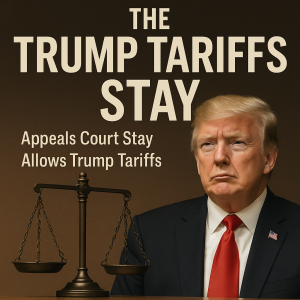
The CIT summary judgement against the President Trump’s use of IEEPA was stayed on Thursday by the Court of Appeals for the Federal Circuit before its ink could dry. That’s because the CIT is simply wrong on the law and ugly wrong by omission. First, let’s look at the sections of the law that give the president authority to implement tariffs under a declared national emergency. The CIT spends a lot of time belaboring the phrase “unusual and extraordinary threat” (23 citations!) to the point where one would surmise the court means to have the judiciary determine that meaning. Second, we will make a detailed originalist critique.
IEEPA §§ 1701 & 1702
50 U.S. Code § 1701 – Unusual and extraordinary threat; declaration of national emergency; exercise of Presidential authorities
(a) Any authority granted to the President by section 1702 of this title may be exercised to deal with any unusual and extraordinary threat, which has its source in whole or substantial part outside the United States, to the national security, foreign policy, or economy of the United States, if the President declares a national emergency with respect to such threat.
(b) The authorities granted to the President by section 1702 of this title may only be exercised to deal with an unusual and extraordinary threat with respect to which a national emergency has been declared for purposes of this chapter and may not be exercised for any other purpose. Any exercise of such authorities to deal with any new threat shall be based on a new declaration of national emergency which must be with respect to such threat.
(Pub. L. 95–223, title II, § 202, Dec. 28, 1977, 91 Stat. 1626.)
50 U.S. Code § 1702 – Presidential authorities
(a)In general
(1)At the times and to the extent specified in section 1701 of this title, the President may, under such regulations as he may prescribe, by means of instructions, licenses, or otherwise-
(A)investigate, regulate, or prohibit-
(i) any transactions in foreign exchange,
(ii) transfers of credit or payments between, by, through, or to any banking institution, to the extent that such transfers or payments involve any interest of any foreign country or a national thereof,
(iii) the importing or exporting of currency or securities,
by any person, or with respect to any property, subject to the jurisdiction of the United States;(B) investigate, block during the pendency of an investigation, regulate, direct and compel, nullify, void, prevent or prohibit, any acquisition, holding, withholding, use, transfer, withdrawal, transportation, importation or exportation of, or dealing in, or exercising any right, power, or privilege with respect to, or transactions involving, any property in which any foreign country or a national thereof has any interest by any person, or with respect to any property, subject to the jurisdiction of the United States; and.[1]
(C) when the United States is engaged in armed hostilities or has been attacked by a foreign country or foreign nationals, confiscate any property, subject to the jurisdiction of the United States, of any foreign person, foreign organization, or foreign country that he determines has planned, authorized, aided, or engaged in such hostilities or attacks against the United States; and all right, title, and interest in any property so confiscated shall vest, when, as, and upon the terms directed by the President, in such agency or person as the President may designate from time to time, and upon such terms and conditions as the President may prescribe, such interest or property shall be held, used, administered, liquidated, sold, or otherwise dealt with in the interest of and for the benefit of the United States, and such designated agency or person may perform any and all acts incident to the accomplishment or furtherance of these purposes.
(2) In exercising the authorities granted by paragraph (1), the President may require any person to keep a full record of, and to furnish under oath, in the form of reports or otherwise, complete information relative to any act or transaction referred to in paragraph (1) either before, during, or after the completion thereof, or relative to any interest in foreign property, or relative to any property in which any foreign country or any national thereof has or has had any interest, or as may be otherwise necessary to enforce the provisions of such paragraph. In any case in which a report by a person could be required under this paragraph, the President may require the production of any books of account, records, contracts, letters, memoranda, or other papers, in the custody or control of such person.
(3) Compliance with any regulation, instruction, or direction issued under this chapter shall to the extent thereof be a full acquittance and discharge for all purposes of the obligation of the person making the same. No person shall be held liable in any court for or with respect to anything done or omitted in good faith in connection with the administration of, or pursuant to and in reliance on, this chapter, or any regulation, instruction, or direction issued under this chapter.
(b)Exceptions to grant of authority
The authority granted to the President by this section does not include the authority to regulate or prohibit, directly or indirectly-
(1) any postal, telegraphic, telephonic, or other personal communication, which does not involve a transfer of anything of value;
(2) donations, by persons subject to the jurisdiction of the United States, of articles, such as food, clothing, and medicine, intended to be used to relieve human suffering, except to the extent that the President determines that such donations (A) would seriously impair his ability to deal with any national emergency declared under section 1701 of this title, (B) are in response to coercion against the proposed recipient or donor, or (C) would endanger Armed Forces of the United States which are engaged in hostilities or are in a situation where imminent involvement in hostilities is clearly indicated by the circumstances; or [2]
(3) the importation from any country, or the exportation to any country, whether commercial or otherwise, regardless of format or medium of transmission, of any information or informational materials, including but not limited to, publications, films, posters, phonograph records, photographs, microfilms, microfiche, tapes, compact disks, CD ROMs, artworks, and news wire feeds. The exports exempted from regulation or prohibition by this paragraph do not include those which are otherwise controlled for export under section 4604 [3] of this title, or under section 4605 [3] of this title to the extent that such controls promote the nonproliferation or antiterrorism policies of the United States, or with respect to which acts are prohibited by chapter 37 of title 18; or
(4) any transactions ordinarily incident to travel to or from any country, including importation of accompanied baggage for personal use, maintenance within any country including payment of living expenses and acquisition of goods or services for personal use, and arrangement or facilitation of such travel including nonscheduled air, sea, or land voyages.
(c) Classified information
In any judicial review of a determination made under this section, if the determination was based on classified information (as defined in section 1(a) of the Classified Information Procedures Act) such information may be submitted to the reviewing court ex parte and in camera. This subsection does not confer or imply any right to judicial review.
(Pub. L. 95–223, title II, § 203, Dec. 28, 1977, 91 Stat. 1626; Pub. L. 100–418, title II, § 2502(b)(1), Aug. 23, 1988, 102 Stat. 1371; Pub. L. 103–236, title V, § 525(c)(1), Apr. 30, 1994, 108 Stat. 474; Pub. L. 107–56, title I, § 106, Oct. 26, 2001, 115 Stat. 277.)
The court quotes § 1702 beginning at subsection (A) and ignores the language from (a)(1) immediately above it that says “under such regulations as he may prescribe” (my emphasis above). That’s the phrase that renders their summary judgement moot and why it should fail the rest of the way. They plaintiffs and the court may not like it but Congress indeed did grant this authority to the president. The court could have ruled the law itself unconstitutional, but they didn’t do that–they ruled that the president exceeded his authority under the law. Bzzzt. Wrong! This is the reason we quoted the entirety of both sections so you can see the breadth of the authority and the exceptions to Congress’s grant of authority to the president. The court makes sweeping separation of powers wavy hand motions to distract you from its sin of omission because “under such regulations as he may prescribe” trumps them, pun intended.
The court claims that it’s unconstitutional for the president to “impose unlimited tariffs”, but the tariffs imposed by President Trump are clearly limited by IEEPA under § 1702 and the court ignores his power to determine the regulations of his declaration. They dance around the issue using what is called the Major Questions Doctrine, which limits the scope of authority that federal agencies or the executive branch can exercise under ambiguous statutes. The statute is no more ambiguous than endless reams of federal law that cedes power from Congress to the president through phrases like, “by such rules as the Secretary adopts” or as “such as the Secretary determines”. Here, though, the declaration is personal to the president and not a Cabinet secretary’s authority under the Executive branch.
Originalist Critique
This critique evaluates whether the CIT’s interpretation aligns with that original meaning and whether its application of the nondelegation and major questions doctrines, as well as its reading of IEEPA’s scope, adheres to the statute’s text, structure, and legislative history as understood in 1977.
1. Misapplication of the Major Questions Doctrine
The CIT heavily relies on the major questions doctrine to conclude that IEEPA does not authorize the President to impose broad tariffs due to their “vast economic and political significance” (Page 27). An originalist critique would argue that this doctrine, as articulated in cases like West Virginia v. EPA (2022), is a modern judicial construct that postdates IEEPA’s enactment by decades. In 1977, the major questions doctrine did not exist in its current form. The controlling precedent for delegation was the nondelegation doctrine, which required only an “intelligible principle” to guide executive action (J.W. Hampton, Jr., & Co. v. United States, 276 U.S. 394, 409 (1928)). The CIT’s application of the major questions doctrine imposes a requirement for “clear congressional authorization” (Page 27) that was not part of the legal framework when IEEPA was enacted.
An originalist reading would focus on whether IEEPA’s text provides an intelligible principle, not whether Congress “spoke clearly” on a matter of vast significance. Section 1702(a)(1)(B) grants the President authority to “regulate … importation … of … any property in which any foreign country or a national thereof has any interest,” conditioned on a declared national emergency under § 1701. This language, drawn from the Trading with the Enemy Act (TWEA), was understood in 1977 to include broad powers to impose economic measures, including tariffs, as evidenced by United States v. Yoshida Int’l, Inc. (526 F.2d 560, 576 (C.C.P.A. 1975)), which upheld a 10% import surcharge under TWEA. The CIT acknowledges Yoshida II but distinguishes it by emphasizing the “limited” nature of Nixon’s tariffs (Page 30). However, an originalist would argue that the CIT’s insistence on “clear” authorization misaligns with the 1977 understanding that broad delegations were permissible if guided by an intelligible principle, such as responding to an “unusual and extraordinary threat” (§ 1701).
2. Overly Narrow Interpretation of “Regulate … Importation”
The CIT holds that the phrase “regulate … importation” in § 1702(a)(1)(B) does not confer “unlimited tariff authority” because such a reading would be unconstitutional (Page 28–30). An originalist critique would argue that this interpretation unduly narrows the plain meaning of the text as understood in 1977. The term “regulate” in the context of commerce was historically broad, encompassing measures like tariffs, quotas, or embargoes to control trade. The Yoshida II court, interpreting identical language in TWEA, found that “regulate … importation” included imposing a tariff surcharge as a reasonable means to address a national emergency (526 F.2d at 576). IEEPA’s legislative history confirms that Congress adopted TWEA’s language intentionally, suggesting continuity in the scope of authority (H.R. Rep. No. 95-459, at 2 (1977)).
The CIT’s conclusion that IEEPA’s tariff authority is narrower than TWEA’s (Page 31) relies on legislative history indicating Congress’s intent to limit presidential power. However, an originalist would prioritize the text over legislative history unless the text is ambiguous. Section 1702(a)(1)(B) uses the same “regulate … importation” language as TWEA, without explicit textual limits on tariff authority beyond the emergency declaration requirements in § 1701. The CIT’s assertion that unlimited tariffs are unconstitutional ignores the 1977 context, where broad delegations were upheld unless they lacked any guiding principle (Mistretta v. United States, 488 U.S. 361, 372 (1989)). The requirement of an “unusual and extraordinary threat” and a declared national emergency provides such a principle, suggesting the CIT’s narrow reading departs from the original meaning.
3. Misconstruction of § 1701’s “Deal With” Requirement
The CIT rules that the Trafficking Tariffs do not “deal with” the declared threats (e.g., drug trafficking and border security) because they lack a direct connection to the stated emergencies, instead serving as “leverage” to pressure foreign governments (Page 44–46). An originalist critique would argue that the court’s interpretation of “deal with” is overly restrictive and inconsistent with the 1977 understanding of IEEPA’s purpose. The phrase “deal with” is broad and not defined in the statute, but its ordinary meaning in 1977 would include actions intended to address or mitigate a threat, even indirectly. The Yoshida II court upheld tariffs under TWEA because they had a “direct effect” on the balance-of-payments deficit (526 F.2d at 580), but it did not require a direct causal link between the action and the elimination of the threat. Similarly, Regan v. Wald (468 U.S. 222, 243 (1984)) upheld travel restrictions under IEEPA to curtail currency flows to Cuba, even though the restrictions did not directly stop Cuban activities.
In 1977, Congress intended IEEPA to grant the President flexible tools to address international economic threats, as seen in its use of TWEA’s broad language and the House report’s acknowledgment of IEEPA’s role in peacetime emergencies (H.R. Rep. No. 95-459, at 2). The CIT’s requirement that tariffs directly address the threat (e.g., by targeting smuggled drugs) ignores the statute’s purpose of enabling economic pressure tactics, such as tariffs, to influence foreign behavior. The Trafficking Tariffs, aimed at pressuring Canada, Mexico, and China to combat trafficking, fit within this original understanding of “deal with” as encompassing measures to influence foreign conduct, not just direct interventions.
4. Overreliance on Section 122 of the Trade Act of 1974
The CIT argues that the Worldwide and Retaliatory Tariffs, imposed to address trade deficits, fall under Section 122 of the Trade Act of 1974 (19 U.S.C. § 2132), which limits presidential tariff authority for balance-of-payments deficits to a 15% cap and 150-day duration (Page 33–35). An originalist critique would question this conclusion, as Section 122 does not explicitly preclude IEEPA’s use for trade-related emergencies. In 1977, Congress was aware of Yoshida II’s approval of tariffs under TWEA for balance-of-payments issues and adopted similar language in IEEPA without excluding trade deficits from its scope. The CIT’s reliance on Section 122 assumes that Congress intended to cabin all trade-related tariffs to non-emergency statutes, but the legislative history cited (H.R. Rep. No. 95-459, at 7, 10–11) only generally calls for transferring “routine” economic regulation to other laws, not emergencies involving trade deficits.
An originalist would argue that the CIT’s reading creates a conflict between statutes that the 1977 Congress did not intend. Section 122 addresses specific, non-emergency balance-of-payments issues, while IEEPA covers broader, emergency-based actions. The Worldwide and Retaliatory Tariffs, tied to a declared emergency over trade imbalances as threats to national security and the economy (Executive Order 14257, 90 Fed. Reg. 15041), fit within IEEPA’s textual scope. The CIT’s conclusion that Section 122 exclusively governs trade deficits lacks textual support in IEEPA and imposes a limitation not clearly present in 1977.
5. Neglect of IEEPA’s Emergency Context
The CIT’s analysis underemphasizes the emergency context of IEEPA, which an originalist would view as central to its 1977 meaning. Section 1701 requires an “unusual and extraordinary threat” and a declared national emergency, reflecting Congress’s intent to grant the President broad but conditional authority to act swiftly in crises. The CIT’s concern about “unlimited” tariff authority (Page 28) overlooks the statutory constraints: the President must identify a specific threat, declare an emergency, and report to Congress (50 U.S.C. §§ 1701, 1703). These requirements, combined with the NEA’s biannual review (50 U.S.C. § 1622), were understood in 1977 as sufficient checks on executive power, as seen in the legislative history emphasizing procedural limits over substantive ones (H.R. Rep. No. 95-459, at 2).
The CIT’s ruling that the tariffs are “ultra vires” (Page 36) because they exceed IEEPA’s scope ignores the statute’s design to allow flexible responses to emergencies. For example, the Yoshida II court upheld tariffs under TWEA because they were “reasonably related” to the emergency (526 F.2d at 578–79), a standard the CIT applies inconsistently by demanding a direct link for the Trafficking Tariffs. An originalist would argue that the President’s declarations of emergencies (e.g., drug trafficking, trade deficits) satisfy § 1701’s conditions, and the tariffs, as economic pressure tools, fall within the original meaning of “regulate … importation.”
6. Judicial Overreach in Reviewing Statutory Compliance
The CIT rejects the Government’s argument that the political question doctrine bars review of whether the tariffs “deal with” the declared threats, asserting that § 1701’s conditions are justiciable (Page 37–43). An originalist critique would argue that this approach risks judicial overreach by second-guessing the President’s emergency powers. In 1977, Congress enacted IEEPA against the backdrop of cases like Yoshida II, which deferred to the President’s determination of a national emergency’s existence and the means to address it (526 F.2d at 581 n.32). The CIT cites Youngstown Sheet & Tube Co. v. Sawyer (343 U.S. 579 (1952)) to frame its role as determining statutory authority (Page 40), but an originalist would note that IEEPA’s text does not explicitly authorize courts to scrutinize the “deal with” requirement beyond ensuring a declared emergency exists.
The CIT’s reliance on cases like Japan Whaling Ass’n v. Am. Cetacean Soc’y (478 U.S. 221, 230 (1986)) to justify statutory interpretation (Page 39) is anachronistic, as that case postdates IEEPA and reflects a modern view of judicial review. In 1977, courts were more deferential to executive emergency actions, as seen in Yoshida II’s reluctance to probe the President’s rationale (526 F.2d at 583). The CIT’s detailed scrutiny of the tariffs’ connection to the stated threats (Page 44–46) exceeds the original understanding of IEEPA’s judicial role, which was limited to ensuring compliance with procedural requirements like emergency declarations and congressional reporting.
Conclusion
From an originalist perspective, the CIT’s opinion misinterprets IEEPA by:
-
Applying the anachronistic major questions doctrine instead of the 1977 nondelegation standard.
-
Narrowing “regulate … importation” beyond its broad 1977 meaning, as informed by Yoshida II.
-
Construing “deal with” too restrictively, ignoring IEEPA’s purpose of enabling flexible emergency responses.
-
Overrelying on Section 122 to limit IEEPA’s scope without clear textual or historical support.
-
Underemphasizing IEEPA’s emergency context and its procedural checks.
-
Engaging in excessive judicial review of the President’s emergency powers, contrary to 1977 deference standards.
An originalist would argue that IEEPA’s text, as understood in 1977, permits the President to impose tariffs as a means to “regulate … importation” in response to declared national emergencies, provided they meet § 1701’s conditions. The CIT’s ruling, by imposing modern doctrinal constraints and a narrow reading of the statute, departs from the original public meaning and undermines the flexibility Congress intended for the President in addressing international economic threats.
