
Ending the Federal Reserve and Exploring Alternatives
Like this post? Become a Citizen Producer!


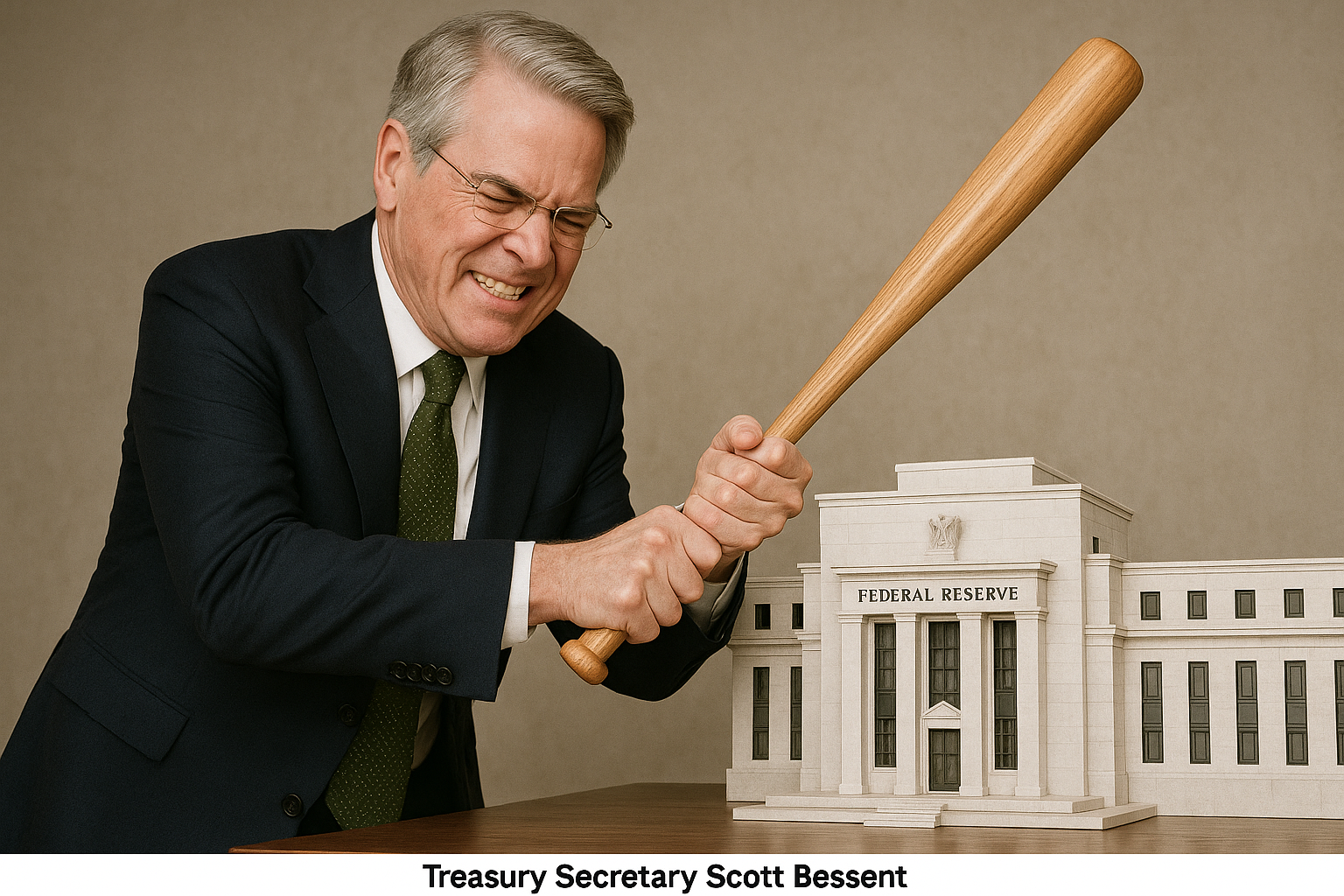
This thought exercise explores whether Treasury Secretary Scott Bessent’s remarks could spark the end of the Federal Reserve, alongside a hypothetical scenario of its dissolution, potential positive outcomes, alternative systems Congress might consider, and the relevance of the GENIUS Act. The exercise imagines the Fed’s hypothetical end driven by Congressional and presidential action, delving into economic, political, and global implications based on available web insights and economic theories.
Today in a CNBC interview, I called for a review of the Federal Reserve. It is my belief that the central bank should conduct an exhaustive internal review of its non-monetary policy operations. Significant mission creep and institutional growth have taken the Fed into areas that…
– Treasury Secretary Scott Bessent (@SecScottBessent) July 21, 2025
Plausibility of Ending the Federal Reserve
Bessent’s remarks, delivered at the Federal Reserve Capital Conference on Monday, call for a review of the Federal Reserve’s non-monetary operations, citing mission creep and a $2.5 billion renovation amid $100 billion losses. His intent seems reformist, aiming to safeguard monetary policy independence while questioning expansions into areas like climate policy. A standout quote from his speech declares, “The Fed’s conduct of monetary policy ‘is a jewel box’ that should be walled off to preserve its independence.” The president’s power to dismiss the Fed Chairman “for cause” (Federal Reserve Act, Section 10) adds a potential trigger. Should a review reveal misconduct-such as mismanagement of the renovation-it might justify removal, heightening scrutiny and supporting Senator Rand Paul’s Federal Reserve Transparency Act. However, legal safeguards and market resistance make an immediate end unlikely. Over the long haul, persistent criticism and a shift in economic ideology might open the door, though it demands Congressional action and a solid alternative, making it plausible yet difficult.
Hypothetical Scenario: Ending the Fed and a Vacuum
Imagine Congress and the president dissolving the Fed through legislation, leaving an immediate vacuum. The impact would be profound. Currency oversight would shift to the Treasury, but the collapse of payment systems and liquidity support could spark market volatility and bank runs. In the initial weeks to months, without a centralized monetary authority, financial institutions might independently adjust lending practices and interest rates, potentially causing localized economic imbalances as markets strive for balance without Federal Reserve oversight. Over 6-24 months, this could lead to economic contraction and global trade disruptions, threatening the dollar’s reserve status. Long-term, a new system might emerge, but ongoing instability could undermine U.S. financial leadership unless the Treasury steps in or private solutions adapt.
Positive Outcomes: Short-Lived Chaos
Suppose the chaos from this scenario fades quickly, much like the volatility after President Trump’s Liberation Day in April, which settled within weeks thanks to swift policy adjustments, trade deals, and ongoing negotiations for better U.S. trade agreements. Several benefits could arise. Removing monetary distortions might enable market-driven interest rates, boosting efficiency. Greater transparency could build public trust if a new system is swiftly established. Decentralized financial innovation might democratize access to finance. Reducing debt reliance could enforce fiscal discipline, tackling the $35 trillion debt, while a free market revival and economic reset might redirect capital to productive sectors. These gains depend on rapid stabilization, enhanced trade frameworks, and public resilience.
Alternative Systems: Congressional Options
Congress could explore various alternatives to replace the Fed, each with unique trade-offs:
- Treasury-Managed Central Bank: The Treasury would oversee policy and payments, aligning with Bessent’s vision, but risks politicization. Feasibility is high.
- Gold Standard: Tying the dollar to gold (e.g., $3,351.18/oz) would enforce discipline but limit growth, risking deflation. Moderate feasibility, backed by Paul.
- Free Banking System: Private banks would issue currencies, fostering innovation, but instability looms without a lender of last resort. Low to moderate feasibility.
- Currency Board System: Currency backed by reserves would ensure stability but lack flexibility. Moderate feasibility, untested at U.S. scale.
- Decentralized Digital Currency System: A blockchain-based digital dollar, supported by Bessent’s digital agenda, could enhance inclusion but faces cybersecurity risks. High feasibility.
- Independent Monetary Commission: A new body with fixed terms would retain independence but might echo Fed issues. High feasibility, supported by Paul.
GENIUS Act Relevance
The GENIUS Act, where GENIUS stands for Guiding and Establishing National Innovation for US Stablecoins, enacted on July 18, 2025, introduces a robust regulatory framework for digital currencies, as outlined in the official fact sheet. This law mandates that stablecoins be fully backed by U.S. dollars or low-risk assets such as Treasury securities, with issuers required to submit monthly reserve disclosures and undergo annual audits for those managing assets exceeding $50 billion. Oversight has shifted from the Securities and Exchange Commission to the Commodity Futures Trading Commission (CFTC), aiming to spur innovation while safeguarding consumer interests and financial stability. Additionally, the Act prohibits U.S. financial institutions from engaging with foreign stablecoin issuers unless they comply with comparable regulations, a measure designed to bolster U.S. leadership in the global digital economy. This framework provides a solid foundation for a decentralized digital currency system, supporting a potential digital dollar for payment and stability functions post-Fed, and complements a Treasury-managed bank or currency board by utilizing existing Treasury resources. While it lacks broader monetary policy capabilities, its emphasis on transparency aligns with Paul’s accountability objectives and could help stabilize a post-Fed vacuum if promptly adopted.
Conclusion
Bessent’s remarks could plausibly kickstart a process to end the Fed, with a “for cause” firing and review as possible catalysts, though legal and economic hurdles suggest a gradual path. In a vacuum, short-term chaos might yield benefits-market efficiency, transparency, innovation, debt control, and a productivity reset-if stabilized quickly, bolstered by trade deals and ongoing negotiations for better U.S. trade agreements. Alternatives like a Treasury bank, digital currency, or commission offer stability and growth potential, while gold and free banking enforce discipline at the cost of flexibility. The GENIUS Act enhances this dialogue by supporting a digital currency transition, aligning with Bessent’s vision and Paul’s accountability push, though gaps in policy tools remain. Success depends on rapid execution, global coordination, and public acceptance.
