
The Arena and the Legacy of Bad Public Financing Deals
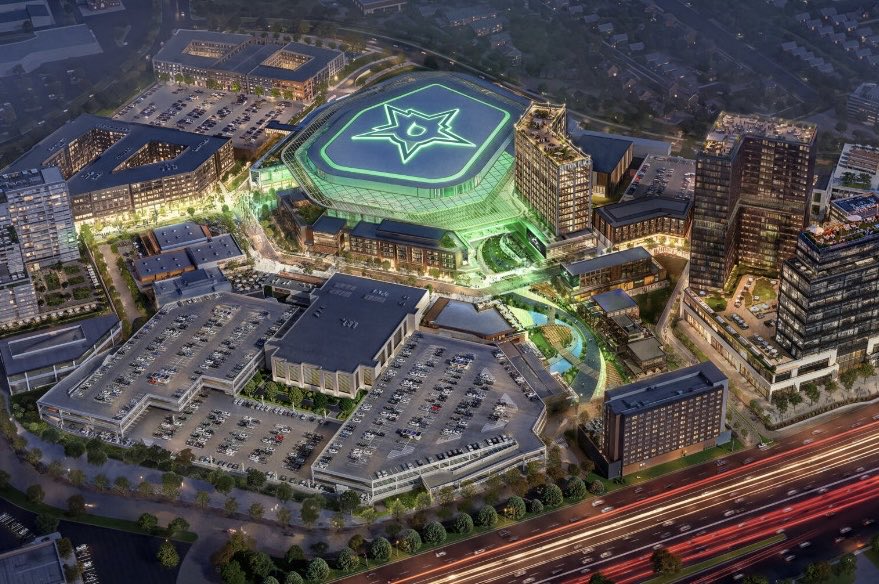
Plano ISD just locked up to $250 million of future school-tax growth for a Dallas Stars arena without a public vote.
Plano ISD just agreed to hand over up to $250 million of future school-tax growth to help build a new arena for the Dallas Stars at the site of the dying Willow Bend Mall on the city’s west side. . The board approved the deal. The city council signed off. No public vote was required. On paper the arrangement looks tidy. In practice it locks away money the schools could have used while the district runs a structural deficit, and it does so for a category of project that has failed to deliver the promised payoff for more than thirty years.
Texas school taxes come in two main pieces. Maintenance and Operations, or M&O, pays for the day-to-day work: teachers, classrooms, utilities. Interest and Sinking, or I&S, pays the debt service on bonds. M&O revenue runs through the state’s funding formula and is subject to recapture. I&S revenue is not. Recapture, still called Robin Hood by the people who write the checks, requires property-wealthy districts like Plano ISD to send a large share of the local M&O dollars they collect to the state for redistribution. Plano has ranked among the highest-recapture districts in Texas for years. A Tax Increment Reinvestment Zone works differently. The city freezes the baseline taxable value inside a defined area. Future growth inside that zone, the increment, is partially diverted into a special fund for public improvements rather than flowing to the normal taxing entities.
Under the participation agreement Plano ISD will contribute 50 percent of its captured commercial tax increment inside TIRZ No. 6, up to a hard cap of $250 million or 25 years, whichever comes first. District officials describe the move as a long-term tax-base strategy. They project a net financial benefit of roughly $188 million over the period, driven mainly by later I&S revenue from a larger commercial tax base and by a reduction in the amount of money that would otherwise leave the district through recapture. They also cite secondary benefits: access to the arena for graduations and possible career-and-technology partnerships. They state plainly that the arrangement is not designed to close the district’s current structural operating deficit of about $44.8 million.
Proposition A sits beside this deal as a separate funding stream. On November 3 Plano voters will decide whether to authorize a package of venue taxes: up to 5 percent on short-term car rentals, an additional 2 percent on hotel stays, $3 on event parking, 10 percent on tickets, and a per-game fee on major-league team members. City estimates put the potential yield at $700 million to $900 million over roughly thirty years. These taxes do not raise the property-tax rate. A no vote does not cancel the already-approved TIRZ or the Plano ISD commitment. Those pieces stand regardless of what happens on Proposition A.
The Plano structure follows a familiar pattern. First, it diverts future school-tax growth. The district forgoes a defined share of commercial increment that would otherwise have been available for operations or other local priorities. That is the core opportunity cost. Second, the claimed net benefit rests on models. Decades of post-opening studies show that the actual increment and tax revenue from sports venues routinely fall short of the projections used to justify the public commitment. Third, the recapture offset does not create new wealth for Plano students. It merely keeps local a portion of growth that would have been sent to the state. While that money sits in the TIRZ fund it is unavailable for classrooms. Fourth, the educational benefits remain secondary and largely undefined. Graduation access and possible internships do not scale to a $250 million diversion of school-tax capacity. Fifth, the public exposure is layered. The city’s own TIRZ commitment, the ISD contribution, and the venue taxes in Proposition A all support the same arena project. Sixth, the opportunity cost lands while the district already runs a structural deficit and enrollment continues to decline. The money given up in the next several years is capacity the district does not have to spare.
The broader record is consistent. A survey of more than 130 studies spanning three decades finds little to no measurable net gain in metropolitan employment, income, or tax revenue sufficient to cover typical public subsidies for stadiums and arenas. Most of the spending that appears near the venue is substitution. Local residents simply shift dollars they would have spent elsewhere in the region. Consultant studies commissioned for the deals regularly overstate the benefits. Clear examples in which a substantial public contribution was fully repaid by a surplus of new tax revenue are rare. Truist Park and The Battery in Cobb County, Georgia, were promoted as a transformative economic-development success. Independent analysis later found the complex running annual deficits for the county. Cleveland’s Gateway complex, financed in the 1990s with heavy public support, has required repeated additional public money for capital repairs long after the original promises of self-funding revenue. Better outcomes have almost always involved minimal or zero public construction subsidies.
Rising interest rates sharpen the problem. The 10-year Treasury yield sits near 5.2 to 5.3 percent. Higher rates raise the discount rate that should be applied to the district’s back-loaded projected benefits. Dollars the district forgoes in the near term, while it manages a structural deficit, are worth more than dollars projected to arrive years later and only if the commercial development performs as modeled. The time value of money widens the gap between the certain opportunity cost and the contingent return. The same rate environment makes any future bond issuance more expensive to service.
Expect a school bond or tax-rate election on a May ballot in the near future. Districts that carry multi-year operating deficits and then lock future commercial growth into non-operating uses commonly return to voters. The pitch will be framed as “for the children” or “for our schools”. In practice, large shares of Texas school bond packages have gone to administrative buildings, athletics facilities, fine-arts centers, and other non-classroom projects. I&S debt sits outside the recapture formula, which gives districts a strong incentive to seek it when they want additional local revenue capacity.
I oppose the Plano ISD participation agreement. It diverts future school-tax growth that could have addressed the district’s operating pressures. It does so for a project type that has a long record of under-delivering relative to the models used to sell it. The time value of money and the current interest-rate environment make the trade worse, not better. The board approved the commitment without a public vote.
I will vote against Proposition A. The measure authorizes new taxes dedicated to a professional sports venue rather than to unrestricted core city services such as roads, parks, police, and fire. Residents who rent cars, stay in hotels, park at events, or buy tickets will still pay them. The historical record of sports-venue subsidies does not support the claim that these taxes will produce a reliable public return. The ISD and city TIRZ commitments already exist whether Proposition A passes or fails.
