
Supreme Court Roundup for the 2024-2025 Term
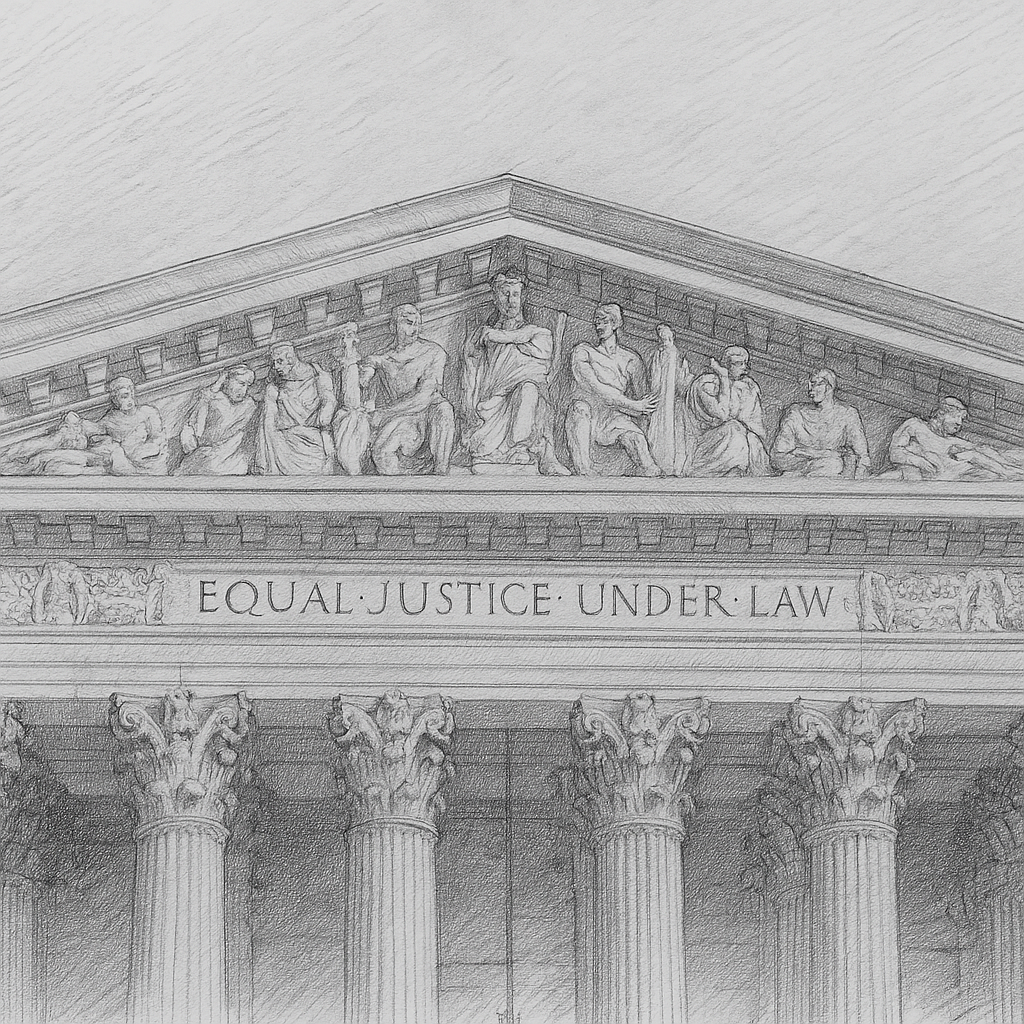 The Supreme Court’s 2025 term grappled with fundamental questions of constitutional structure, delegation, and equality, as evidenced by three pivotal cases: FCC v. Consumers’ Research, Kennedy v. Braidwood Management, Inc., and Louisiana v. Callais. These cases probe the boundaries of Congress’s authority to delegate power, the executive’s appointment processes, and the tension between statutory mandates and constitutional protections. Each decision reflects a clash between modern judicial deference and strict originalist interpretations, emphasizing the Framers’ intent to safeguard democratic accountability and equal protection under the law. The analyses below explore the majority, concurring, and dissenting opinions, prioritizing originalist perspectives to illuminate the constitutional principles at stake.
FCC v. Consumers’ Research
In FCC v. Consumers’ Research (2025), the Supreme Court addressed whether the universal-service contribution scheme under Section 254 of the Telecommunications Act of 1996 violates the nondelegation doctrine, a principle rooted in Article I, Section 1 of the Constitution, which vests “all legislative Powers” in Congress, and Article I, Section 8, granting Congress authority to “lay and collect Taxes.” From an originalist perspective, emphasizing the Constitution’s meaning at its adoption, this case probes whether Congress improperly delegated its taxing power to the Federal Communications Commission (FCC) and whether the FCC’s reliance on a private entity, the Universal Service Administrative Company, constitutes an unconstitutional subdelegation. This analysis summarizes the case, majority opinion, concurrences, and dissent, prioritizing the originalist view of the dissenters and using direct quotes for clarity.
Case Background
Section 254 mandates the FCC to ensure universal telecommunications access for rural areas, low-income consumers, schools, and libraries. The FCC sets a “contribution factor”-a percentage based on the Universal Service Fund’s projected quarterly expenses divided by carriers’ total projected revenue (47 CFR §54.709(a)). Carriers pay their revenue multiplied by this factor, set at 25.2% for Q1 2022. The FCC appointed the Universal Service Administrative Company, a private not-for-profit, to manage the Fund and provide financial projections (§54.701(a)). Consumers’ Research challenged this scheme in the Fifth Circuit, arguing it violated the nondelegation doctrine by granting the FCC excessive discretion and improperly delegating to a private entity. The Fifth Circuit held that the “combination” of Congress’s delegation to the FCC and the FCC’s “subdelegation” to the Administrator was unconstitutional (109 F. 4th 743, 778).
The Supreme Court reversed, with Justice Kagan’s majority opinion joined by Chief Justice Roberts, Justices Sotomayor, Kavanaugh, Barrett, and Jackson. Justices Kavanaugh and Jackson concurred separately. Justice Gorsuch dissented, joined by Justices Thomas and Alito, advocating a strict originalist interpretation.
Majority Opinion
Justice Kagan’s majority upheld the scheme, applying the “intelligible principle” test from J.W. Hampton, Jr., & Co. v. United States (1928), which allows delegation if Congress provides clear guidance. Section 254 sets a “floor and a ceiling,” as “the FCC cannot raise less than what is adequate or necessary to finance its universal-service programs, but it also cannot raise more than that amount” (606 U.S. at 4). The statute limits subsidies to services “subscribed to by a substantial majority of residential customers,” “affordable,” and “essential to education, public health, or safety” (§§254(b)(1), (c)(1)(A)-(B)), providing “determinate standards” (606 U.S. at 4).
The majority rejected claims of boundless authority. It clarified that Section 254(c)(1)’s criteria are “separately mandatory” (606 U.S. at 4), not optional. On the “evolving level of telecommunications services,” the Court noted the FCC “still may fund only essential, widely used, and affordable services, for the benefit of only designated recipients” (606 U.S. at 4). Section 254(b)(7)’s allowance for additional principles was deemed constrained, as they must be “consistent with” the statute (606 U.S. at 4).
On private nondelegation, the majority found the Administrator “broadly subordinate” to the FCC, which retains final authority over the contribution factor, subject to review and revision (§54.709(a)(3)). Citing Sunshine Anthracite Coal Co. v. Adkins (1940), the Court held the Administrator “function[ed] subordinately to” the FCC under its “authority and surveillance” (606 U.S. at 5). The Fifth Circuit’s “combination” theory was dismissed, as traditional and private nondelegation doctrines “do not operate on the same axis” (606 U.S. at 5-6).
Concurring Opinions
Justice Kavanaugh’s Concurrence: Kavanaugh emphasized historical precedent, noting “delegations to the President ‘have been a regular feature of American Government’ since the founding” (606 U.S. at 95). He cited early examples like embargoes and military pensions, suggesting Section 254 aligns with such practices (606 U.S. at 95). He supported limiting agency overreach via doctrines like the major questions doctrine, ensuring the FCC “act[s] within the confines set by Congress” (606 U.S. at 94).
Justice Jackson’s Concurrence: Jackson agreed with the majority but provided no separate reasoning in the provided document.
Dissenting Opinion
Justice Gorsuch, joined by Justices Thomas and Alito, dissented, arguing Section 254, especially subsections (c)(3) and (h)(2), lacks an intelligible principle. From an originalist view, Gorsuch stressed that taxation is a core legislative function requiring congressional control for accountability. Section 254(c)(1)’s lack of a “tax rate or a numerical cap” and vague criteria fail to provide a “qualitative” cap (606 U.S. at 82). The majority’s imposition of mandatory criteria rewrites the statute, which only requires the FCC to “consider” factors: “By interpreting ‘shall consider the extent to which,’ §254(c)(1), to mean ‘shall ensure that,’ the Court threatens chaos” (606 U.S. at 80).
Subsections (c)(3) and (h)(2), allowing “additional” and “advanced” services, lack even these constraints: “Even the Court is unwilling to say that these provisions impose a ‘qualitative’ cap” (606 U.S. at 81). Gorsuch cited the FCC’s funding of Wi-Fi hotspots, illustrating unchecked discretion (606 U.S. at 81). The majority’s failure to address these subsections leaves them open to future challenges, a “notable development” (606 U.S. at 82).
Gorsuch distinguished Section 254 contributions as taxes, not fees: “Section 254 creates a classic tax-and-spend scheme, not a fee” (606 U.S. at 87). Unlike fees, which offset specific costs or benefits, taxes require a rate or cap for constitutional legitimacy (606 U.S. at 84). He referenced the 1798 tax with a $2 million cap, underscoring historical limits (606 U.S. at 91). Broad delegations undermine the Framers’ design: “The framers divided power … to ensure ours would indeed be a Nation ruled by ‘We the People’” (606 U.S. at 93), risking a shift to “subjects of quadrennial kings and long-tenured bureaucrats” (606 U.S. at 94).
Originalist Perspective
The dissent aligns with originalist principles, emphasizing the Framers’ intent to vest taxation in Congress for accountability. The Constitution’s structure, particularly Article I, reflects colonial fears of unchecked taxation, requiring clear legislative limits. Gorsuch’s call for a “tax rate or numerical cap” ensures “the lines of accountability [remain] clear” (606 U.S. at 92). The majority’s reliance on the “intelligible principle” test is too permissive, as vague standards like “affordable” lack the specificity needed for taxation: “the FCC truly must blaze its own trail” (606 U.S. at 91).
On private nondelegation, the majority’s view that the Administrator is subordinate aligns with precedent but downplays originalist concerns about unaccountable entities influencing governance. The dissent’s focus on constitutional accountability resonates with the Framers’ vision.
Conclusion
FCC v. Consumers’ Research pits modern judicial deference against originalist fidelity to the Constitution’s separation of powers. The majority-Kagan, Roberts, Sotomayor, Kavanaugh, Barrett, and Jackson-upholds Section 254’s delegation. However, the dissent-Gorsuch, Thomas, and Alito-better reflects originalist principles, insisting on congressional control over taxation to preserve democratic accountability. The Court’s sidestepping of subsections (c)(3) and (h)(2) invites future challenges, aligning with the dissent’s call to enforce stricter constitutional limits.
Kennedy v. Braidwood Management, Inc.
On June 27, 2025, the Supreme Court decided Kennedy v. Braidwood Management, Inc. (606 U.S. (2025)), addressing a pivotal constitutional question under the Appointments Clause of Article II, Section 2, Clause 2, regarding the appointment of members to the U.S. Preventive Services Task Force. The Task Force, established under the Public Health Service Act and empowered by the Affordable Care Act (ACA) to issue binding preventive healthcare recommendations, was challenged by Braidwood Management, which argued that Task Force members are principal officers requiring Presidential appointment with Senate confirmation, rather than appointment by the Secretary of Health and Human Services (HHS). In a 6-3 decision, authored by Justice Kavanaugh and joined by Chief Justice Roberts, Justices Sotomayor, Kagan, Barrett, and Jackson, the Court held that Task Force members are inferior officers, constitutionally appointed by the Secretary due to their removability at will and the Secretary’s supervisory authority over their recommendations. Justice Kavanaugh wrote, “The Task Force members are removable at will by the Secretary of HHS, and their recommendations are reviewable by the Secretary before they take effect. So Task Force members are supervised and directed by the Secretary, who in turn answers to the President, preserving the chain of command in Article II.” From a strict originalist perspective, which interprets the Constitution according to its original public meaning, the dissent by Justice Thomas, joined by Justices Alito and Gorsuch, offers a more faithful adherence to the Framers’ intent, emphasizing the necessity of clear congressional authorization and executive accountability for officers wielding significant power.
The majority’s reasoning rests on two pillars: first, that Task Force members are inferior officers because they are subject to the Secretary’s supervision and removal, consistent with Edmond v. United States (520 U.S. 651, 1997); and second, that Congress vested appointment authority in the Secretary through the 1999 statute’s use of “convene” (interpreted as including appointment power) and Reorganization Plan No. 3 of 1966, which transfers the AHRQ Director’s functions to the Secretary. However, an originalist lens reveals weaknesses in this approach. The Framers crafted the Appointments Clause to ensure that officers wielding significant executive authority-such as the Task Force’s power to issue binding healthcare recommendations-are appointed by the President with Senate confirmation, unless Congress explicitly vests such authority elsewhere “by Law.” The majority’s interpretation of “convene” as implying appointment stretches the term beyond its historical meaning of assembling, not appointing. The dissent, led by Justice Thomas, argues, “The majority finds appointment power in the Director’s duty to ‘convene’ only by applying the wrong standard. … The Appointments Clause … specifically addresses how all inferior officers are to be appointed. Its default rule controls absent an ‘express enactment to the contrary.’” This strict reading underscores that the 1999 statute lacks the explicit vesting required by the Clause.
The dissent’s originalist approach emphasizes the Task Force’s statutory independence, as described in 42 U.S.C. §299b-4(a)(1) and (a)(6), indicating Congress’s intent to create a body free from HHS supervision, answerable directly to the President. This independence, combined with the Task Force’s authority to issue legally binding recommendations, suggests its members are principal officers under the original meaning of the Appointments Clause. The Framers prioritized accountability to the elected branches for such officers, ensuring significant executive power is not delegated to unconfirmed appointees. The majority’s reliance on the Reorganization Plan to transfer appointment power from the AHRQ Director to the Secretary deviates from originalist principles, as the Plan, issued in 1966, cannot constitutionally encompass functions created in 1999, per 5 U.S.C. §905(a)(4). The dissent persuasively argues that only Congress, not a presidential reorganization, can vest appointment power, reinforcing the constitutional requirement that such vesting occur “by Law.”
Furthermore, the dissent employs the canon of constitutional avoidance, a tool aligned with originalist interpretation, to argue that reading “convene” as “appoint” creates constitutional issues by implying that the AHRQ Director or Secretary could delegate appointment authority, which is impermissible for officers. The majority’s “empty-husk” theory-that the Reorganization Plan automatically transfers all AHRQ Director functions to the Secretary-undermines Congress’s detailed statutory scheme for the Task Force and AHRQ, rendering congressional allocations of authority meaningless. The dissent’s insistence that the Task Force is not part of AHRQ or the Public Health Service, based on clear statutory language and historical practice, aligns with the originalist commitment to textual fidelity. The majority’s finding of supervisory authority under 42 U.S.C. §202 and the Reorganization Plan relies on a strained reading that ignores the Task Force’s statutory independence and the government’s prior acknowledgment of its independent operation.
In conclusion, the dissent’s strict originalist perspective, articulated by Justices Thomas, Alito, and Gorsuch, offers a more compelling interpretation by upholding the Appointments Clause’s original purpose of ensuring democratic accountability for officers wielding significant executive power. The majority’s pragmatic approach, endorsed by Justices Kavanaugh, Roberts, Sotomayor, Kagan, Barrett, and Jackson, dilutes this safeguard by inferring appointment authority from ambiguous statutory terms and a reorganization plan, risking the erosion of the Framers’ careful balance of power. The Task Force’s ability to issue binding recommendations, coupled with its statutory independence, demands the heightened accountability of Presidential appointment and Senate confirmation. The dissent persuasively demonstrates that the majority’s decision fails to honor the constitutional structure designed to protect executive accountability, making it the more faithful interpretation for those prioritizing the Framers’ intent.
Louisiana v. Callais
Summary of Justice Thomas’s Dissent and the Underlying Case from an Originalist Perspective
Case Background
The consolidated cases involve a constitutional challenge to Louisiana’s congressional redistricting map, Senate Bill 8 (SB8), which was enacted to create a second majority-Black district in response to a now-vacated District Court order citing §2 of the Voting Rights Act (VRA). The plaintiffs argued that SB8’s second majority-Black district, stretching 250 miles to connect disparate Black populations, constituted an unconstitutional racial gerrymander under the Equal Protection Clause. A three-judge district court agreed, finding that SB8 violated the Equal Protection Clause. Louisiana and intervenors appealed directly to the Supreme Court, which has mandatory jurisdiction under 28 U.S.C. §2284(a). Instead of deciding the case, the Court scheduled it for reargument, prompting Justice Thomas’s dissent. (Louisiana v. Callais, Nos. 24-109 and 24-110).
Justice Thomas’s Dissent
Justice Thomas dissents from the Court’s decision to delay resolution by scheduling reargument, arguing that the Court has a duty to promptly resolve constitutional challenges to congressional redistricting, especially given the mandatory jurisdiction imposed by Congress. He contends that these cases highlight a fundamental conflict between the Court’s interpretation of §2 of the VRA and the Equal Protection Clause of the Fourteenth Amendment. Thomas argues that the Court’s precedent, particularly Allen v. Milligan (2023), has interpreted §2 to mandate race-based redistricting to achieve proportional representation, even absent evidence of specific past discrimination, which he sees as incompatible with the Constitution’s prohibition on racial classifications absent a compelling justification.
From an originalist perspective, Thomas emphasizes the supremacy of the Constitution over statutory law, citing Marbury v. Madison (1803). He argues that the Equal Protection Clause, as understood at the time of its adoption, prohibits racial classifications unless narrowly tailored to remedy specific, identified instances of discrimination. The Court’s §2 jurisprudence, particularly post-Milligan, effectively requires states to draw majority-minority districts proportional to population share whenever feasible, even if it results in racial gerrymandering. This, Thomas argues, lacks a constitutional basis and contradicts the original meaning of the Fourteenth Amendment, which demands equal treatment without regard to race unless strictly justified. He criticizes the Court’s VRA interpretation as a “disastrous misadventure” that entangles federal courts in political and racial engineering, urging a reassessment of §2 to align with constitutional principles.
Originalist Perspective on the Case
From an originalist viewpoint, the Equal Protection Clause, enacted as part of the Reconstruction Amendments, was intended to ensure equal legal treatment for all citizens, particularly to prevent discrimination against newly freed Black Americans. It was not meant to authorize or require race-based policies absent clear evidence of discriminatory intent or effects directly traceable to past state-sponsored discrimination. The VRA’s §2, as interpreted in cases like Milligan, mandates race-conscious districting to achieve proportional representation, which an originalist would argue exceeds the constitutional bounds of the Fourteenth Amendment. The original meaning of the Equal Protection Clause would demand strict scrutiny for any racial classification, requiring a compelling state interest and narrow tailoring-standards Thomas believes SB8 and the Court’s §2 framework fail to meet.
The underlying case thus presents a tension: Louisiana’s attempt to comply with §2 by drawing a racially gerrymandered district conflicts with the Equal Protection Clause’s prohibition on race-based classifications. An originalist would likely agree with Thomas that the Constitution’s original meaning prioritizes equal protection over statutory mandates like §2, especially when the latter promotes racial proportionality without evidence of specific constitutional violations. Delaying resolution, as the Court has done, only perpetuates uncertainty and undermines the Constitution’s supremacy.
Key Points
- Case: In Louisiana v. Callais, Louisiana’s SB8, creating a second majority-Black district, was ruled an unconstitutional racial gerrymander by a district court. The Supreme Court’s decision to delay resolution prompted Thomas’s dissent.
- Thomas’s Argument: The Court’s §2 jurisprudence, especially post-Milligan, mandates unconstitutional race-based redistricting, conflicting with the Equal Protection Clause. The Constitution’s supremacy requires immediate resolution.
- Originalist View: The Fourteenth Amendment’s original meaning prohibits racial classifications absent specific, proven discrimination. The VRA’s race-conscious mandates exceed constitutional limits, and the Court should prioritize equal protection over statutory requirements.
This summary reflects an originalist perspective, focusing on the Constitution’s text and historical meaning as the primary guide for judicial interpretation.
Conclusion
In FCC v. Consumers’ Research, the majority upheld the FCC’s universal-service scheme as guided by an intelligible principle, but the dissent (Gorsuch, Thomas, Alito) argued it lacks a clear tax cap, violating the nondelegation doctrine. In Kennedy v. Braidwood Management, Inc., the majority found Task Force members to be inferior officers validly appointed by the HHS Secretary, while the dissent (Thomas, Alito, Gorsuch) insisted their authority requires Presidential appointment under the Appointments Clause. In Louisiana v. Callais, Justice Thomas dissented, arguing the Court’s delay in addressing a racial gerrymander perpetuates a conflict between the Voting Rights Act and the Equal Protection Clause’s original prohibition on race-based classifications. The dissents consistently champion originalist principles, emphasizing constitutional limits and accountability.
