
Thursday Quick Takes
The Woke Church
 The Episcopal Church’s decision to terminate its nearly 40-year participation in the U.S. refugee resettlement program, prompted by the Trump administration’s directive to resettle 49 white South African Afrikaners (Boers), reveals a troubling departure from the Gospel’s universal call to love and serve all in need, regardless of race. The church, led by Presiding Bishop Sean Rowe, justified its withdrawal by framing the Afrikaners’ fast-tracked asylum as a violation of racial justice, given their historical ties to apartheid and the broader suspension of the refugee program serving mostly non-white applicants. This stance, however, elevates a “woke” ideology above the Gospel’s mandate to extend compassion to the persecuted, as seen in Jesus’ parable of the Good Samaritan, which prioritizes aid to the suffering over ethnic or historical grievances. By refusing to resettle these legally recognized refugees based on their race, the church risks betraying the Gospel’s impartiality, judging individuals not for their current persecution but for the sins of their ancestors-a posture that mirrors the exclusionary tribalism Christ’s teachings sought to transcend.
This race-based decision not only undermines the Gospel’s message of universal redemption but also jeopardizes the very refugees the church claims to champion. U.S. asylum law evaluates claims on individual merit, and the Afrikaners’ approval suggests they faced credible threats, yet the church dismissed their plight to uphold an ideological commitment to racial justice. This move, announced on May 12, 2025, may disrupt services for countless non-white refugees reliant on Episcopal Migration Ministries, sacrificing their welfare on the altar of political posturing. The Gospel calls for reconciliation and mercy, not selective compassion dictated by racial narratives. By prioritizing a “woke” lens over Christ’s command to love without distinction, the Episcopal Church risks alienating the persecuted and diluting its witness as a beacon of God’s indiscriminate grace.
Critics, including the Episcopal Church, who claim the 49 South African Afrikaners (Boers) received “special treatment” in their 2025 U.S. asylum approval misrepresent the asylum process while ignoring broader immigration patterns, such as the significant settlement of Haitian immigrants in Springfield, Ohio. U.S. asylum law evaluates claims based on a well-founded fear of persecution, not racial or political favoritism, and the Boers’ expedited processing likely stemmed from urgent, documented threats in South Africa, not racial bias. Asylum processing varies due to case urgency or evidence strength, not ethnicity. For instance, Springfield, with a population of about 58,000, has seen an estimated 12,000–15,000 Haitians settle since 2020, drawn by low living costs and jobs in manufacturing and services, many under Temporary Protected Status (TPS) or asylum applications, without similar accusations of “special treatment.” The Boers’ small group-49 individuals-pales in comparison, and claims of favoritism overlook that U.S. immigration law consistently processes diverse groups, including Haitians, under the same legal standards. Such accusations distract from the Gospel’s call to serve all persecuted people impartially, framing legal asylum as a zero-sum racial issue.
The U.S. Citizenship and Immigration Services (USCIS), under the Department of Homeland Security, primarily determines who gets asylum in the United States, including on an emergency basis. USCIS asylum officers evaluate applications based on eligibility criteria, such as a well-founded fear of persecution due to race, religion, nationality, political opinion, or membership in a particular social group. For emergency or expedited cases, USCIS may prioritize processing based on urgent circumstances, like imminent danger or severe hardship, but the core decision-making authority remains with USCIS. In some cases, Customs and Border Protection (CBP) or Immigration and Customs Enforcement (ICE) may be involved at the border or in initial screenings, but USCIS handles the formal asylum adjudication. Courts, including immigration judges, may also review cases if an applicant appeals a denial.
When Your Government Wants to Kill You
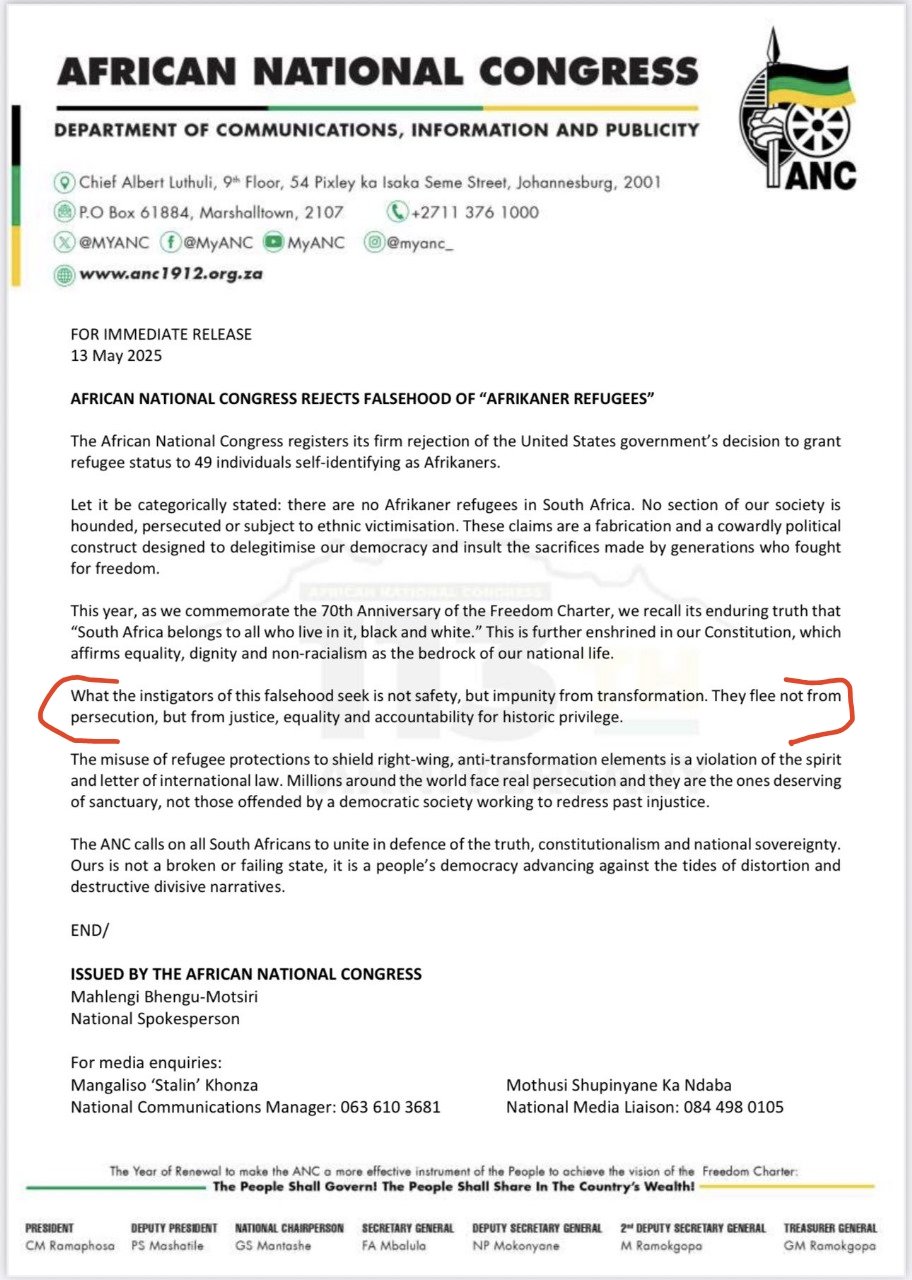
The granting of asylum to 49 Afrikaner (Boer) farmers by the United States in 2025, prompted by a culture of persecution and threat in South Africa, underscores the severe risks faced by this racial minority, driven by the Marxist-Leninist ideologies of the ANC and EFF, which echo Zimbabwe’s catastrophic land reforms under Robert Mugabe. The ANC’s neglect-95% of farm attack cases unsolved (2019–2022), 32 murders in 2024, and an underfunded Rural Protection Plan-coupled with their tolerance of the EFF’s incendiary “Dubul’ ibhunu” song, sung at 2023 and 2025 rallies, and Mangaliso “Stalin” Khonza’s provocative rhetoric, fosters a climate where Boers face targeted violence and fear dispossession under the 2024 Expropriation Act, reminiscent of Zimbabwe’s state-backed farm invasions (4,000 farmers evicted, 70 killed, 2000–2002). While South Africa’s democratic checks-robust judiciary, opposition, and press-distinguish it from Zimbabwe’s rapid collapse, the ANC’s complicity and EFF’s revolutionary zeal place it perilously close, potentially one crisis or power shift away from Mugabe-style persecution, justifying the Boers’ asylum as a response to real racial persecution.
No, the racists are these people, you assholes.
“Kill the Boer” meaning “Kill the white farmer” doesn’t get any more racist than that. pic.twitter.com/VyzWqm1Hco
– Just Jen R𝕏 🫡🇺🇸 (@JustJenRX) February 15, 2025
The man leading the “Kill the Boer” chants while wearing a red beret in a large stadium is Julius Malema, leader of South Africa’s Economic Freedom Fighters (EFF) party, which is openly Communist. The chant is a controversial historically branded anti-apartheid song, and Malema is known for singing it at EFF rallies, such as one at FNB Stadium on July 29, 2023 before a capacity crowd of 95,000 bloodthirsty minions.
The results have been as expected. History is always with us.
Today, the first refugees from South Africa will land in the United States.
Each cross in this video represents a white farmer in South Africa who was murdered.
While the mainstream media and world leaders ignore this, President Trump is shining a light on these atrocities. pic.twitter.com/6PIQiymNVG
– Christian Collins (@CollinsforTX) May 12, 2025
The Red Line of Amnesty
The Democrats’ immigration policies, marked by a steadfast commitment to “comprehensive immigration reform” and staunch opposition to mass deportations, weave a narrative that resonates with the Brezhnev Doctrine’s unyielding maxim: once a state turned socialist, it was socialist forever. In this tale, the Democrats’ unspoken creed-“once here, always here”-manifests in their vigorous defense of undocumented immigrants, as seen in their response to Kilmar Abrego Garcia’s deportation and Sen. Ruben Gallego’s 2025 plan, a modern echo of the 1986 Simpson-Mazzoli Act’s amnesty. This ideological rigidity, rooted in Biden’s open-border policies, stands in sharp contrast to Trump’s rapid border security measures in 2025, achieved without new legislation. The Democrats’ monolithic stance, amplified by aligned advocacy groups and judges issuing nationwide injunctions, solidifies the Brezhnev analogy, as their actions consistently prioritize irreversible migration over border control. The Supreme Court’s hearing on May 15, 2025, addressing the power of district judges to issue nationwide injunctions, adds a critical layer, threatening to curb the Democrats’ judicial strategy and further exposing their doctrinal entrenchment.
Biden’s tenure saw the border transform into a porous threshold, with policies dismantling Trump’s “Remain in Mexico” program and pausing border wall construction. U.S. Customs and Border Protection data charted a dramatic rise in encounters, from 458,088 in FY 2020 to 2.5 million in FY 2023, a surge critics linked to Biden’s rhetoric inviting migration. Democrats’ unified push to return Garcia, despite MS-13 ties, and Gallego’s citizenship pathway plan reflect a refusal to reverse this tide, mirroring Brezhnev’s defense of socialist permanence. In contrast, Trump’s 2025 return brought swift action: within 100 days, executive orders deployed troops, resumed wall construction, and ended catch-and-release, slashing crossings by over 90%. This stark divide underscores the Democrats’ ideological commitment, as their opposition to Trump’s measures highlights a “once here, always here” stance. The Supreme Court’s case today, Trump v. CASA, Inc., challenges three nationwide injunctions blocking Trump’s birthright citizenship order, with Acting Solicitor General Sarah Harris arguing that district judges lack authority to issue such sweeping rulings, having faced 15 in February 2025 alone compared to Biden’s 14 over four years. A ruling limiting these injunctions could dismantle a key Democratic tool, forcing narrower judicial remedies and weakening their ability to shield immigration policies from enforcement.
The Democrats’ narrative is further entrenched by their legal tactics, with groups like the ACLU and CHIRLA filing suits in liberal bastions like California’s Ninth Circuit, securing nationwide injunctions to halt Trump’s deportation plans. A February 2025 injunction paused mass removals, and Judge Paula Xinis’s order in the Garcia case demanded his return, illustrating this strategy. These efforts, synchronized across party leaders, advocacy networks, and progressive judges, evoke Brezhnev’s interventions to preserve socialism, ensuring undocumented immigrants remain woven into the U.S. fabric. Though Democrats occasionally gesture toward security-Gallego’s Laken Riley Act support or Harris’s 2024 border rhetoric-their monolithic resistance to Trump’s policies and reliance on judicial obstruction reveal their priority. The Supreme Court’s May 15 hearing, set to examine whether district judges can issue injunctions beyond their districts or plaintiffs, could reshape this landscape. Justices Gorsuch, Thomas, and Alito have signaled skepticism, with Gorsuch advocating remedies limited to named plaintiffs. If the Court restricts nationwide injunctions, as suggested by a 2024 Harvard Law Review study noting 92% of such rulings against Trump came from Democratic-appointed judges, Democrats’ ability to block enforcement via friendly jurisdictions would falter, exposing their ideological commitment to an irreversible migration status quo against Trump’s proven border control.
Buy our book!
The narrative surrounding Jake Tapper and Alex Thompson’s book, Original Sin: President Biden’s Decline, Its Cover-Up, and His Disastrous Choice to Run Again, published in May 2025, exposes a jarring contradiction between their current revelations and their earlier failure to challenge the Democratic narrative portraying Joe Biden as “sharp,” vibrant, active, and in control during the 2020 campaign and his presidency. The book, detailing Biden’s cognitive and physical decline through over 200 post-election interviews, has ignited accusations of hypocrisy, particularly from conservative critics who argue that Tapper and Thompson dismissed concerns about Biden’s mental fitness while Democrats, led by figures like White House Press Secretary Karine Jean-Pierre, propagated falsehoods about his condition. Jean-Pierre’s repeated denials from the podium, including her “cheap fakes” dismissal of videos showing Biden’s erratic behavior, crumbled after the June 2024 debate with Donald Trump, when Biden’s frailty became undeniable. Tapper’s acquiescence to the Democratic line, contrasted with his book’s exposé, underscores a profound inconsistency, though the charge of hypocrisy is tempered by the media constraints he faced.
2020: Joe Biden has a stutter.
2021: Joe Biden has a stutter.
2022: Joe Biden has a stutter.
2023: Joe Biden has a stutter.
2024: Joe Biden has a stutter.
2025: Buy my book on the cover-up of Biden’s mental decline!– Ian Haworth (@ighaworth) February 26, 2025
Throughout Biden’s presidency, Jean-Pierre consistently misrepresented his health, insisting he was robust despite visible signs of decline. In 2022 and 2023, she claimed Biden was “sharp as a tack” and “fully in command,” citing his packed schedules and global summits. When videos surfaced-showing Biden wandering off during events, freezing mid-speech, or struggling with stairs-she labeled them “cheap fakes” in June 2023, accusing critics of manipulating footage to smear him. These clips, recognizable to those familiar with elderly relatives’ cognitive struggles, were downplayed as isolated or misleading. For instance, at a G7 summit in 2022, Biden appeared disoriented, requiring aides to guide him; Jean-Pierre called it a “moment out of context.” In 2023, she dismissed a video of Biden stumbling at an Air Force Academy event as “doctored,” despite raw footage confirming the incident. Tapper, on CNN’s State of the Union and The Lead, rarely pressed Jean-Pierre or other officials on these contradictions, accepting vague assurances of Biden’s vigor in 2021–2023 interviews. His 2020 rebuke of Lara Trump for raising cognitive concerns, framing them as attacks on Biden’s stutter, and his soft 2022 questions about voter perceptions of Biden’s age, aligned with Jean-Pierre’s narrative, ignoring Biden’s limited campaign appearances and public gaffes, like confusing world leaders’ names. Thompson, at Politico, similarly avoided health scrutiny until 2024, when his Axios reporting hinted at White House stage-managing, but their book’s revelations-Biden’s “exhausted and confused” state, aides discussing wheelchair use, and a “Politburo” shielding him-validate the concerns they once sidestepped, implicating them in the cover-up they now expose.
The turning point came during the June 27, 2024, debate with Trump, when Biden’s faltering performance-marked by incoherent responses, vacant stares, and inability to counter Trump’s attacks-shattered the “sharp” narrative. Watched by 50 million viewers, the debate exposed what Jean-Pierre’s lies could no longer conceal: Biden’s cognitive frailty, evident to anyone familiar with aging relatives’ decline. Post-debate, even Democratic allies like Nancy Pelosi admitted concern, and Biden’s withdrawal from the 2024 race followed weeks later. Tapper’s post-debate CNN analysis called it a “disaster,” but his earlier failure to challenge Jean-Pierre’s “cheap fakes” claims or probe Biden’s 2020–2023 struggles-despite clips showing behaviors like a 2023 Delaware event where he appeared lost-fuels the hypocrisy charge. His book, detailing aides’ gaslighting and Biden’s shrinking vocabulary, contrasts starkly with his deference to Democratic spin. While Tapper’s May 2025 admission-“I did cover some of these issues, but not enough”-and Thompson’s late-2024 reporting suggest evolving skepticism, their silence during Jean-Pierre’s falsehoods, driven by access constraints or fear of amplifying partisan attacks, implicates them in a journalistic lapse. The undeniable reality post-debate, when Biden’s condition could no longer be lied about, underscores their failure to confront the truth when it mattered, making Original Sin a belated reckoning that validates critics they once dismissed.
Let’s go to the tape. Supercut!
SUPERCUT!
Before profiting off the media conspiracy to hide Biden’s decline, @jaketapper helped run it pic.twitter.com/j5m7h4JVA3
– Tom Elliott (@tomselliott) February 27, 2025
The Business of Peace
Finally, so great news for America. President Trump’s visit to Saudi Arabia reshaped U.S. foreign policy in the Middle East by embracing the business of peace, with the lifting of sanctions on Syria as a pivotal element. During his four-day tour across Riyadh, Qatar, and the United Arab Emirates, Trump, alongside Saudi Crown Prince Mohammed bin Salman, announced the sanctions’ removal to normalize ties with Syria’s new leader, Ahmed al-Sharaa, whom he met briefly in Riyadh. This shift, paired with a historic $142 billion arms deal, prioritized economic integration over confrontation, embodying Trump’s view of peace as a byproduct of commerce. The trip’s lavish trappings-Saudi F-15 jet escorts and a state dinner at the At-Turaif UNESCO site attended by figures like Elon Musk-highlighted this blend of diplomacy and deal-making, though it avoided thorny issues like Iran’s nuclear program and the Gaza conflict, focusing instead on economic leverage.
At the heart of the business of peace was a $600 billion Saudi investment commitment, potentially reaching $1 trillion, aimed at strengthening U.S. industries, infrastructure, and job creation while fostering regional cooperation. Speaking at the U.S.-Saudi Investment Forum in Riyadh, Trump presented the deal as a bedrock for mutual prosperity, with trade, energy, and defense as stabilizing forces. The Syria sanctions lift was framed as a catalyst for reconstruction, countering Russian and Chinese influence by integrating Syria into a Western economic sphere. Yet, the strategy faced scrutiny over Trump family business ties in the Gulf and strained U.S.-Israel relations, as Saudi Arabia tied normalization to Palestinian statehood, complicating Trump’s Abraham Accords goals. Critics questioned whether economic incentives could sustain peace amid unresolved regional tensions and Saudi Arabia’s human rights controversies.
Artificial intelligence (AI) emerged as a cornerstone of this vision, integrated into the investment framework to drive economic and strategic stability. Saudi Arabia’s Public Investment Fund dedicated $200 billion of the $600 billion package to AI innovation hubs in both countries, focusing on energy, defense, and urban planning for initiatives like NEOM. Trump cast AI as a tool for peace through innovation, strengthening alliances and deterring conflict, while Crown Prince Mohammed bin Salman aligned it with Saudi Vision 2030’s tech ambitions. However, concerns over data privacy, AI militarization, and lax U.S. oversight of technology transfers, combined with Saudi Arabia’s domestic policies, fueled ethical debates. By embedding AI in the business of peace, Trump’s visit positioned the Middle East as a testing ground for a tech-driven diplomatic model, wagering that shared economic and technological progress could forge enduring stability, though its viability depends on navigating the region’s entrenched rivalries and moral complexities.
Quote of the Day
The past is never dead. It’s not even past.
William Faulkner
