
A Winning Weekend
China Brought to Heel
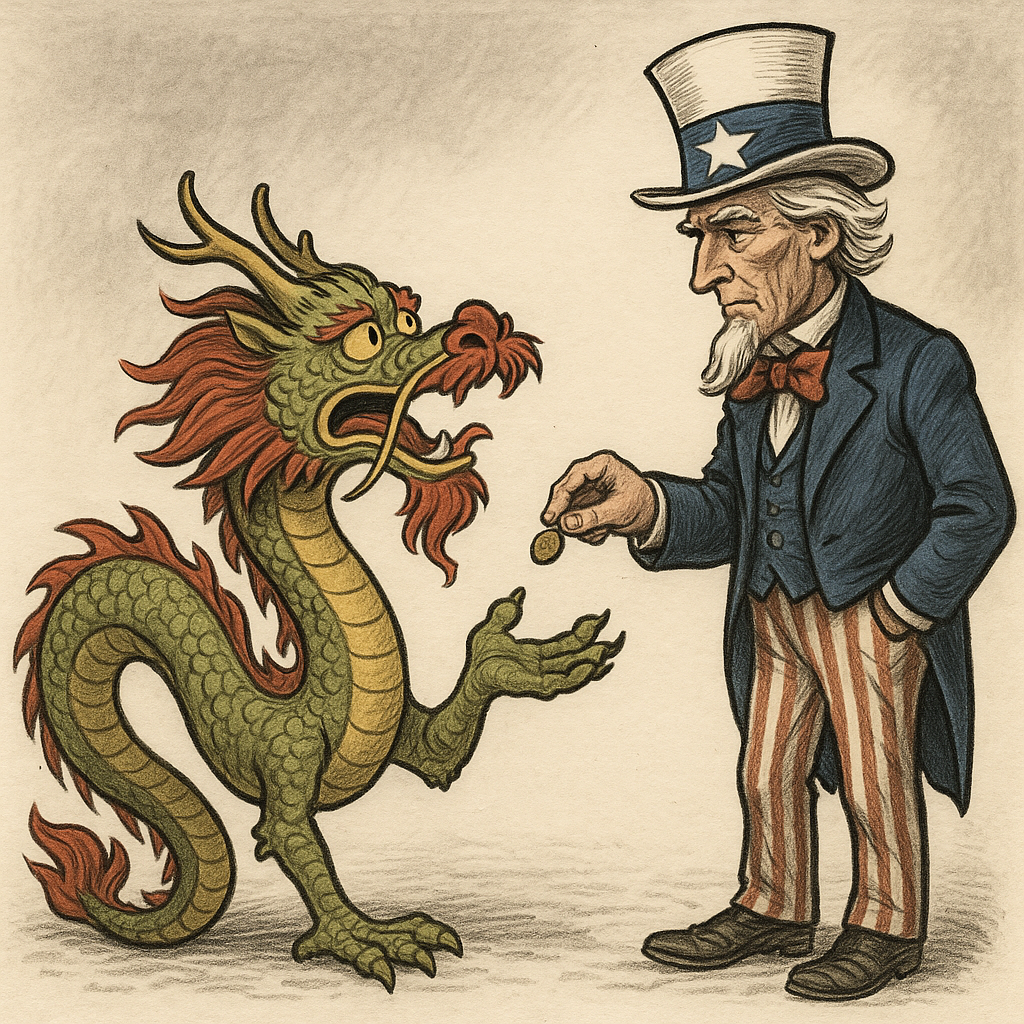 On Monday, the U.S. and China signed a temporary trade deal in Geneva, prompted by the 145% U.S. tariffs imposed on April 2 that slashed Chinese exports to the U.S. by 21% in a single month. China’s reliance on the U.S. consumer economy, which absorbed $427.2 billion of their exports in 2024, made this loss crippling, forcing them to the negotiating table. The deal lowers U.S. tariffs to 30% for 90 days, with a 10% baseline and 20% fentanyl-related duties, while China cuts its 125% retaliatory tariffs to 10% and lifts restrictions on rare earth minerals, effective May 14. A permanent deal opening China’s markets could shrink the $295.4 billion U.S.-China trade deficit by boosting U.S. exports, capitalizing on China’s need to regain access to American consumers. Markets rallied-Dow futures up 3.1%, Asian indexes rising-as the deal eased trade war tensions, and a consultation mechanism led by Vice Premier He Lifeng, Treasury Secretary Scott Bessent, and Trade Representative Jamieson Greer was established to pursue a lasting agreement.
China’s addiction to the U.S. consumer market, a cornerstone of their export-driven economy, has left them exposed, with April’s tariff hit showing how swiftly their exports collapse without U.S. demand. A permanent deal by August 2025, potentially including commitments to buy U.S. goods like the $200 billion targeted in the 2020 Phase One deal (missed by over 40%), could reduce the trade deficit by increasing U.S. exports in agriculture, energy, and manufacturing, addressing the $295.4 billion gap where U.S. imports ($427.2 billion) dwarf exports ($131.8 billion). The threat of renewed or higher tariffs, which could further block China’s access to American consumers, fuels their urgency to open markets. Businesses remain cautious, awaiting a permanent deal before adjusting supply chains, but China’s economic pressure strengthens the prospects for a lasting agreement that narrows the deficit over time.
President Trump’s foresight in resetting the global economy by harnessing the U.S. consumer economy’s leverage has proven effective, as China’s swift move to negotiate after April’s tariffs demonstrates. His strategy-using tariffs to exploit China’s dependence on American consumers-delivered a sharp blow, with the 21% export drop costing China billions and compelling them to seek restored market access. This approach validates his aim to rebalance trade and target the $295.4 billion deficit by forcing China to buy more U.S. goods. The 2020 Phase One deal’s failure, where China purchased only $121 billion of the $200 billion committed due to the Biden administration’s inaction in enforcing compliance through penalties, tariffs, or diplomatic pressure, underscores the need for ironclad, enforceable terms in any new agreement. Trump’s tariff-driven pressure has already shifted global trade dynamics, proving the potency of leveraging China’s addiction to the U.S. consumer market. With the August 2025 deadline approaching, the consultation mechanism offers a clear path to a permanent deal that could boost U.S. exports, reduce the trade deficit, and foster a more balanced, prosperous trade relationship for years to come.
Tariff Revenue
In April, U.S. tariff receipts reached a record $16.3 billion, an 86% increase from the $8.75 billion collected in March and more than double the $7.1 billion from April 2024. This surge was driven by new tariffs, including a 10% across-the-board import tariff implemented on April 2, alongside other targeted duties from President Trump’s trade policies. The year-to-date tariff total hit $63.3 billion, up 18% from the same period in 2024. These receipts contributed to a monthly budget surplus of $258.4 billion in April, a 23% increase from the previous year, partly due to the income tax filing deadline boosting revenues. This surplus reduced the fiscal year-to-date deficit to $1.05 trillion, though it remained 13% higher than the prior year. The tariff revenue helped offset the deficit by supplementing a 10% rise in overall receipts, while outlays dropped 4% compared to April 2024.
India-Pakistan Ceasefire
On Saturday, India and Pakistan agreed to a U.S.-mediated ceasefire, halting four days of intense cross-border strikes-the worst clash in decades-triggered by a deadly April 22 attack on Hindu tourists in Indian-administered Kashmir. Secretary of State Marco Rubio and Vice President J.D. Vance played pivotal roles, engaging with Indian Prime Minister Narendra Modi, Pakistani Prime Minister Shehbaz Sharif, and other senior officials over 48 hours to secure the truce, announced by President Trump on Truth Social. The agreement, effective from 5 p.m. IST, stopped all military actions, though initial violations-explosions in Srinagar and Jammu-saw both sides trading accusations. Rubio and Vance’s diplomacy, backed by the U.S.’s global influence and supported by China, Saudi Arabia, and others, bridged communication gaps, with Vance’s call to Modi on May 9, prompted by alarming intelligence, proving critical. Confirmed by Indian Foreign Secretary Vikram Misri and Pakistani Foreign Minister Ishaq Dar, the ceasefire paves the way for talks at a neutral site, offering hope for lasting de-escalation in the Kashmir dispute and a more stable South Asia.
A Hopeful Russia-Ukraine Ceasefire Deal
A promising opportunity has emerged with a proposed meeting on May 15, 2025, in Istanbul, where Ukrainian President Volodymyr Zelenskyy and Russian President Vladimir Putin could negotiate a ceasefire to halt the Russia-Ukraine war. Putin’s call for talks, met by Zelenskyy’s bold invitation for a face-to-face discussion, raises cautious hope for progress, despite Russia’s reluctance to commit to a prior 30-day truce. U.S. President Donald Trump’s suggestion that he might join the summit fuels optimism for a breakthrough, backed by Turkey’s eager role as host. As the date approaches, there’s a growing sense that this gathering could mark a vital step toward peace.
Medicaid
Last Friday, President Trump signed an executive order to redirect Medicaid funds, which were misused by the Biden administration to cover emergency services and expanded state programs for illegal immigrants, toward critical support for American veterans. Under Biden, the Congressional Budget Office estimated $16.2 billion in federal and state Medicaid spending since 2021 on illegal immigrants, a 124% rise from Trump’s prior term, driven by policies like catch and release for 1.4 million illegals and state expansions in places like California. Trump’s order aims to end such federal funding, targeting lax verification and Medicaid waivers that critics say cost taxpayers billions. By reallocating these resources, Trump is prioritizing veterans, with a flagship initiative to establish the National Center for Warrior Independence in Los Angeles, a facility designed to house and support 6,000 homeless veterans by 2028. This move leverages the U.S.’s economic might-its $821 billion Medicaid program-as a tool to restore fairness, much like Trump’s use of the consumer economy to pressure China into trade concessions, ensuring taxpayer dollars serve those who served the nation.
The benefits to veterans are immediate and far-reaching, offering a lifeline to those struggling with homelessness and inadequate healthcare. The Warrior Independence Center will provide housing, medical care, and job training, directly addressing the needs of veterans who have been underserved while funds were allegedly diverted to non-citizens. Trump’s broader plan includes a Presidential Memorandum from April 15, 2025, to combat Medicaid fraud through expanded prosecution programs, ensuring resources are protected for eligible Americans, including veterans with disabilities. By sunsetting Biden-era waivers and tightening eligibility, the administration projects savings of up to $630 billion, which could bolster veteran-focused programs and reduce the $1.05 trillion federal deficit. Echoing the optimism of the U.S.-China trade deal and the India-Pakistan ceasefire, this redirection of Medicaid funds sets a hopeful course, promising a stronger safety net for veterans and a renewed commitment to putting America’s heroes first, with the potential to transform lives and communities for generations.
MAHA Affordably
Finally, President Trump’s Most Favored Nation (MFN) executive order signed on Monday, was a gutsy strike against Big Pharma and Pharmacy Benefit Managers (PBMs), but it also implicitly calls out Europe’s free ride on drug costs shouldered by U.S. consumers for decades. By tying U.S. drug prices to the lowest prices paid by developed nations, Trump is effectively pressuring European countries, which benefit from government-negotiated low prices, to share the burden of global drug development costs. American patients have long subsidized innovation through higher prices, while Europe reaps the benefits without footing the bill. This bold move challenges not only domestic industry giants but also foreign allies to rethink their pricing models, risking diplomatic tensions and trade disputes alongside the inevitable legal pushback from pharma and PBMs.
PBMs inflate costs as middlemen through murky practices that prioritize profits over patients. They negotiate rebates with drugmakers but pocket a chunk of the savings or funnel them to insurers, leaving consumers stuck with sky-high list prices. Their formularies often favor pricier drugs with bigger rebates over cheaper options, and tactics like spread pricing-charging insurers more than they pay pharmacies-further jack up costs. By aiming to bypass PBMs and align U.S. prices with Europe’s, Trump’s MFN policy exposes these cost drivers while demanding Europe stop leaning on American wallets to fund drug innovation, a stance that could reshape global pricing dynamics.
Edan Alexander is Free
After 582 days in Hamas captivity, this is the most important news of the day.
We waited all day for this.
Edan Alexander hugs his parents for the first time 💛🥹 pic.twitter.com/CQWL1rzT3b
— Aviva Klompas (@AvivaKlompas) May 12, 2025
