
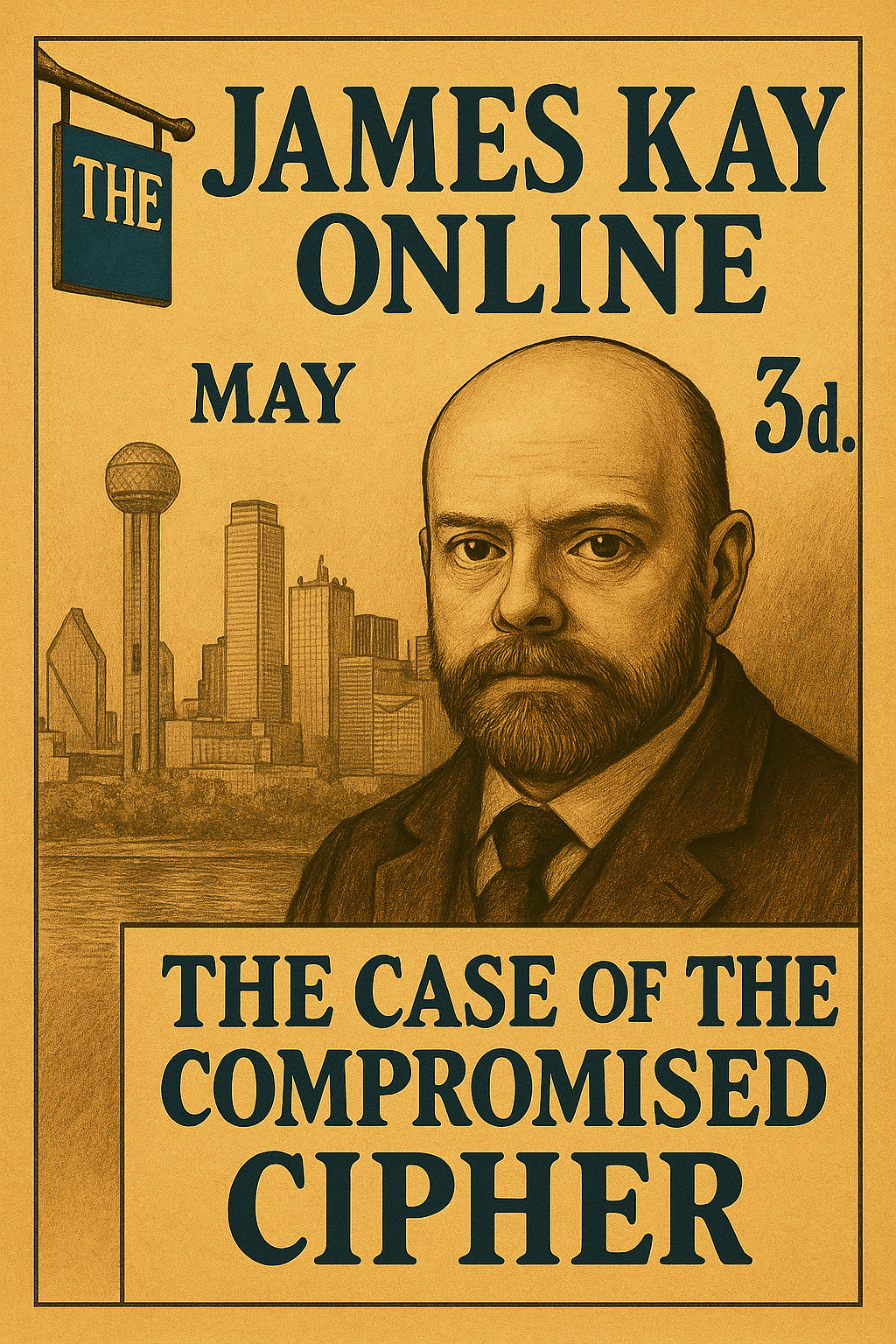
ACT I: The Visit to Bleeker Lane
It was upon a rain-drenched Tuesday in November of 1894 that I first made the acquaintance of Mr. James Kay, the consulting detective of Bleeker Lane, whose name I had encountered only in whispered tones among my former colleagues in the Cipher Bureau of the Foreign Office.
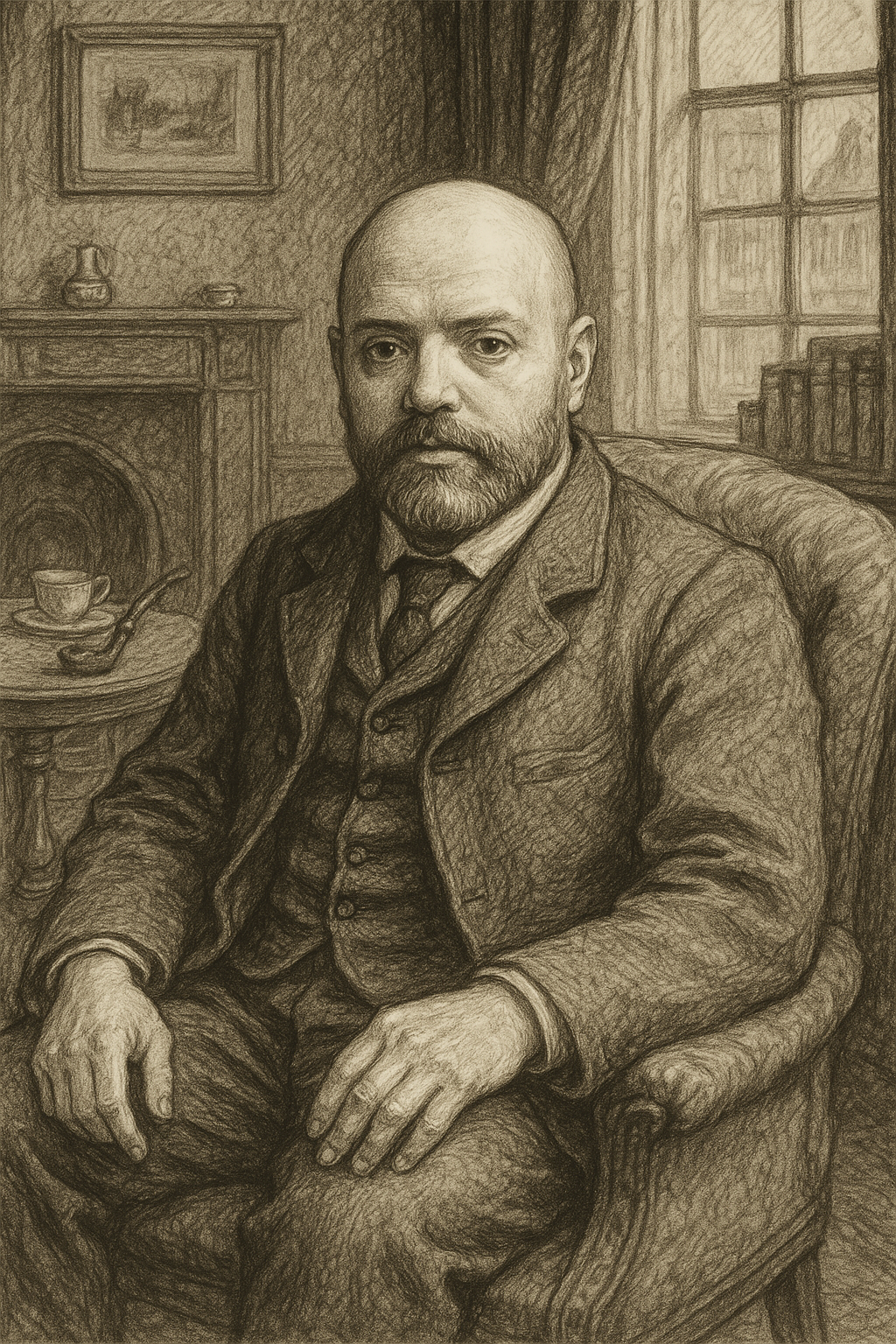 I had resigned my commission a fortnight earlier, worn thin by a matter that threatened national integrity. I came to Mr. Kay not with hope but as a last resort, for the matter was so delicate that even internal inquiry had been suppressed by order of the Home Secretary.
His rooms, though modest, bore the precise disarray of an analytical mind at work: brass cipher wheels lay beside strips of linen tape; the scent of lamp-black ink clung to the air; and a half-disassembled typewriting apparatus sat atop a Turkish rug. Mr. Kay himself reclined in a faded armchair, fingers steepled, his gaze fixed upon the embers as though they alone whispered the truth of the matter.
“You come from the Cipher Bureau,” he said without lifting his eyes.
I started. “That is not public knowledge.”
“No, but the worn left cuff of your coat betrays a clerical post, while the smudges of printer’s ink on your forefinger speak to the new double-keyboard Remington machine-used only by the Foreign Office and certain correspondents at The Times. The former, I believe, pays better.”
I admitted his deduction was sound.
“Then the matter concerns the diplomatic pouch lost en route from Constantinople,” he added, finally turning to me with an expression of grim amusement. “The one whose contents now appear to inform our adversaries in Vienna.”
“You astound me, sir,” I breathed.
“Not at all. I merely read the latest intelligence bulletin, which your man left at my door-unsealed, I might add.”
The heart of the case lay thus: a secure diplomatic cipher known as “Archer Code No. 7” had been presumed impervious-constructed by overlapping three classical methods: Vigenère, Playfair, and a personalized key matrix changed fortnightly. Yet two recent dispatches had evidently been read in full by hostile powers.
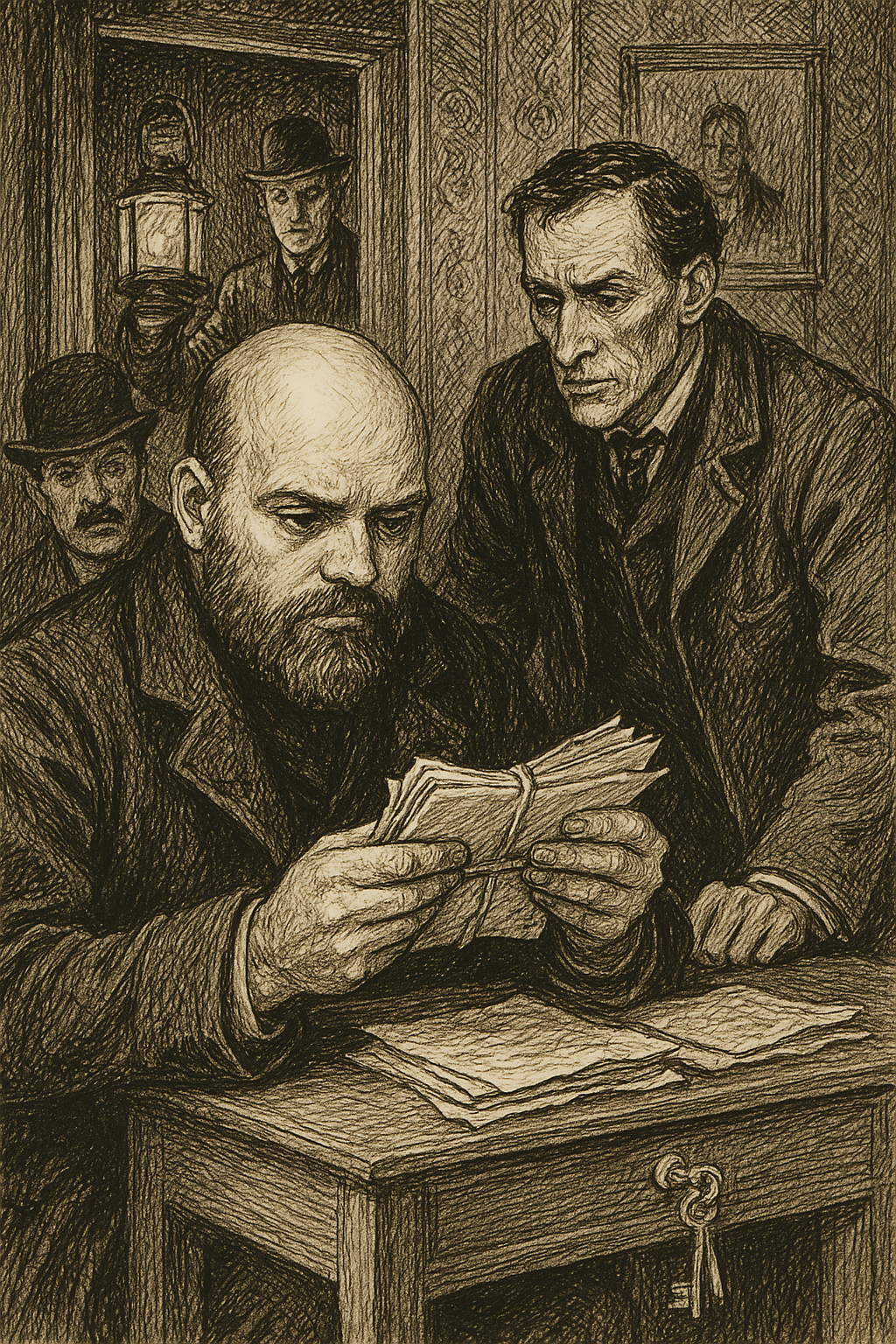 “I have reviewed your cipher,” said Mr. Kay, “and it is, in isolation, sound. But you err in presuming the enemy assaults the cipher. I contend instead that he has compromised the key. And keys, Mr. Trent, are men-fallible, frightened men.”
What followed was a pursuit through the teahouses of Soho, a steganographic puzzle hidden in a bookbinding, and an unassuming telegraph boy with an extraordinary memory. I shall spare the reader the full technical unraveling-for Mr. Kay’s monograph On the Preservation of State Secrets by Mechanical Means is available through Her Majesty’s Stationery Office.
Suffice it to say that the flaw had not been in Archer No. 7, but in the reuse of an identical cipher wheel by multiple embassies. A single intercepted dispatch, sent in haste from Alexandria using an older key variant, had offered just enough pattern overlap to expose the rest.
The boy, bribed with no more than the promise of employment and tea, had been copying the telegrams to his employer, a shadowy agent of the Austro-Hungarian crown posing as a bookseller.
ACT II: Cipher, Smoke, and Steam
The following morning, Mr. Kay and I called upon Sir Cedric Margrave, Undersecretary for Diplomatic Transmission, who received us stiffly in a vast chamber of mirrors and ormolu. Kay made quick work of formalities.
“Your staff utilizes a cipher known as Archer No. 7, an overlaid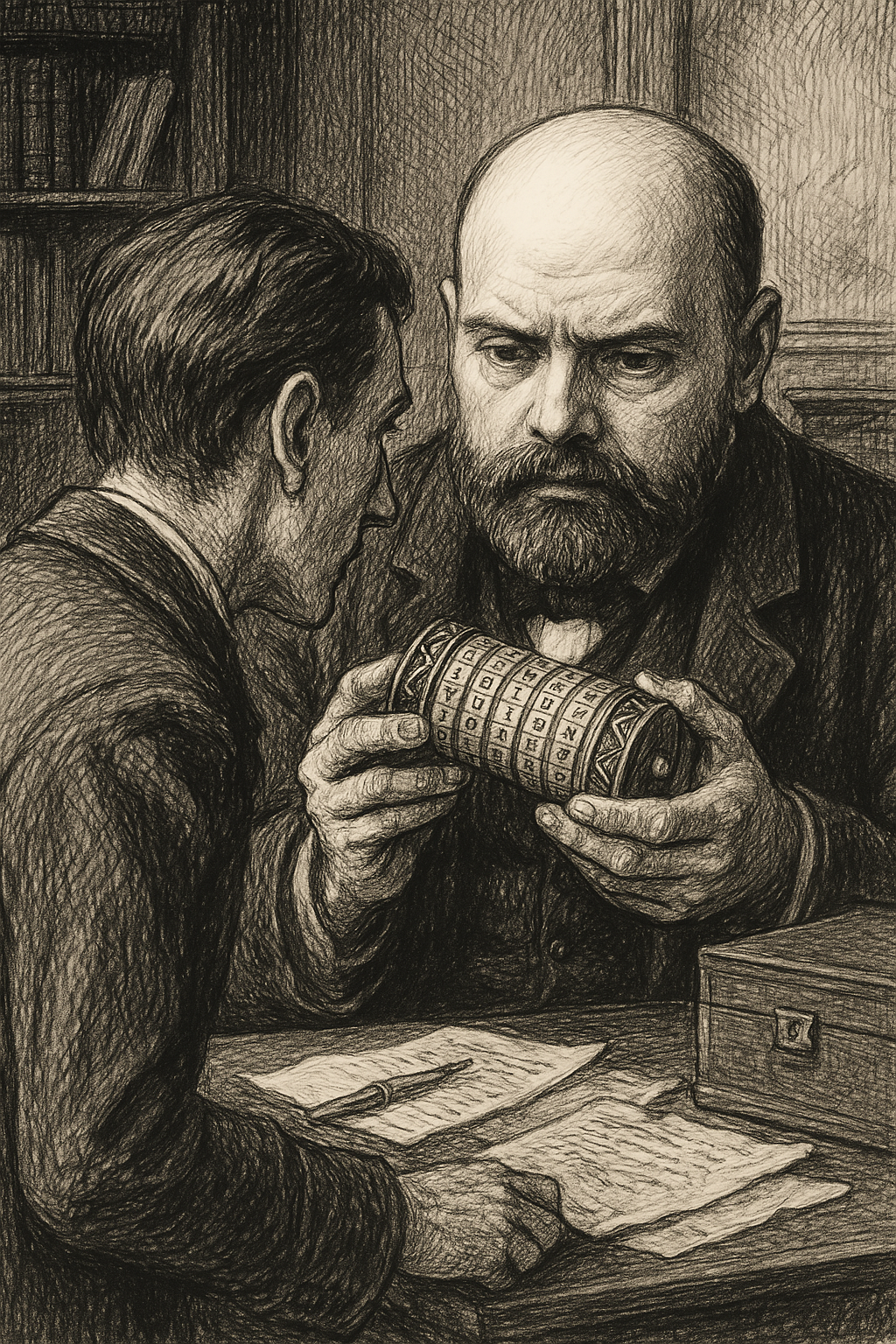 system involving Playfair and Vigenère components, keyed anew each fortnight.”
Sir Cedric nodded.
“Yet you duplicate the keys and issue them to all Crown stations simultaneously.”
“Naturally. Otherwise our embassies would be unable to decode Her Majesty’s orders.”
Kay sighed. “Then you have misunderstood the nature of secure communication. A cipher is not made safe by its complexity, but by the secrecy of its variables.”
We left without ceremony. That afternoon, Mr. Kay requested a visit to the telegraph office at Fleet Street, where he spoke with an unassuming telegraph boy named Lucas. The boy, after some tea and a promise of steady employment, admitted that he’d been paid to transcribe portions of foreign-bound telegrams.
“By whom?” asked Kay.
“Bookseller on Shoe Lane. Tall Austrian fellow. Called himself Mr. Groll. Said it was for a club that studied translation.”
By midnight, Kay and I-together with two plainclothes constables-had raided the shop. Inside, we found thousands of copied telegrams, a cracked Archer wheel, and a half-burned letter bearing the seal of the embassy in Alexandria.
ACT III: A Key of Flesh and Bone
Kay returned to his rooms with the cipher fragments and worked without rest. His conclusion was astonishing in its simplicity.
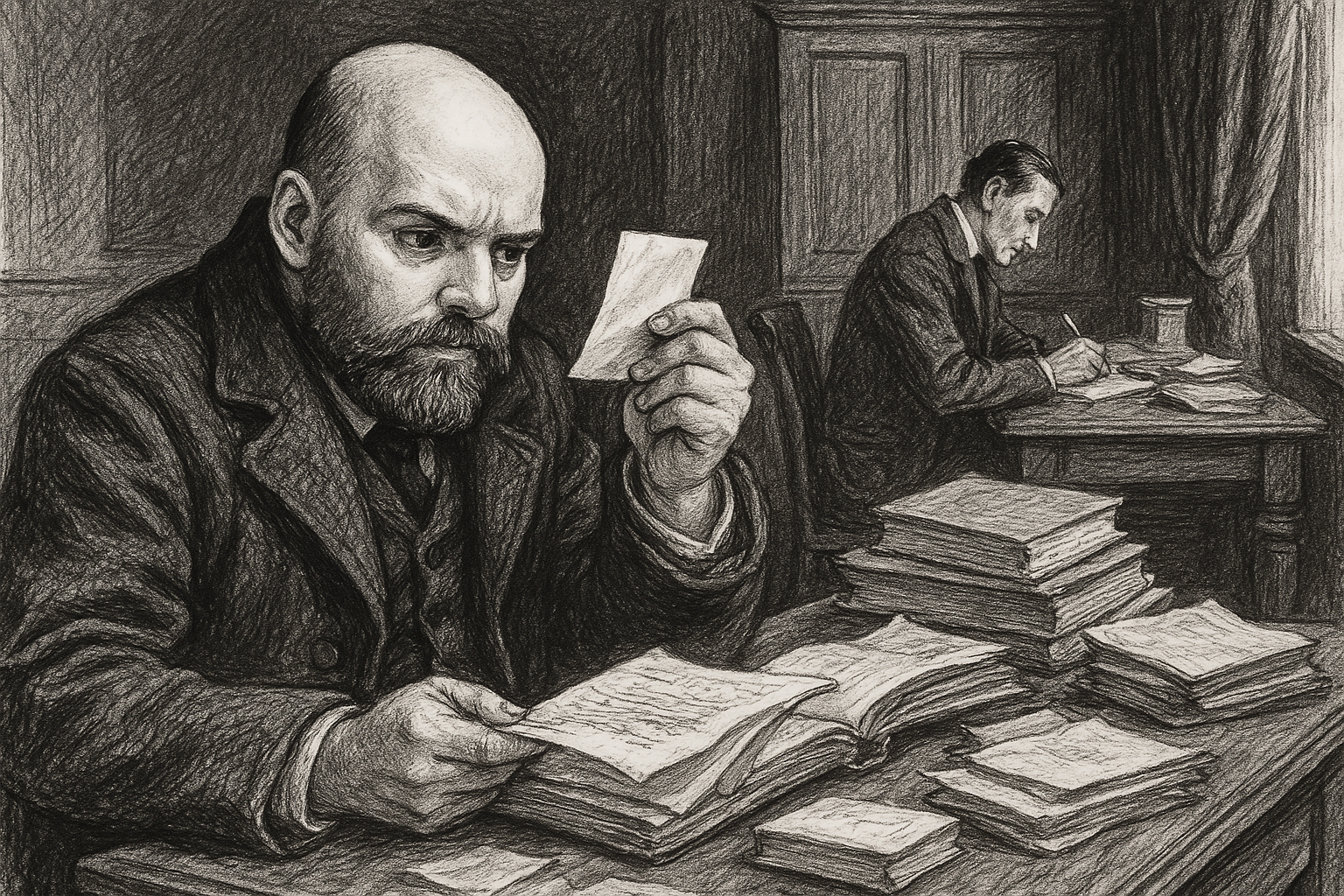 “The compromise was not mechanical, but human. By reusing identical cipher components and failing to audit message content, the Bureau created a pattern visible to even a modest intelligence service. The enemy needed only one partial key from one outdated dispatch to deduce the rest.”
When Sir Cedric returned the next day, Kay did not mince words.
“Your ministry’s failure to rotate keys independently has placed our empire at risk. The cipher is irrelevant. The key-like all things human-was corrupted.”
The scandal that followed saw several quiet resignations. Lucas, the telegraph boy, was placed in the employ of the Telegraph Office under a new identity. The Austrian “bookseller” was never apprehended, but he was last seen boarding a steamer bound for Trieste.
As for Mr. Kay, he returned to his fireside chair and resumed an essay on semaphore encryption. When I asked him if he would publish his conclusions, he merely raised an eyebrow.
“No, Mr. Trent. If I did, they would only be misunderstood. And misused.”
I have told this tale now only because its danger has passed-and because it illustrates what every modern office of state must remember: that secrets, even encoded ones, are never stronger than the men who guard them.
With Thanks to Sir Arthur Conan Doyle.
Images courtesy of ChatGPT.
