
How Senate Leadership Played the House and the Base for Suckers, and Why the Speaker’s Backbone Points the Way Forward
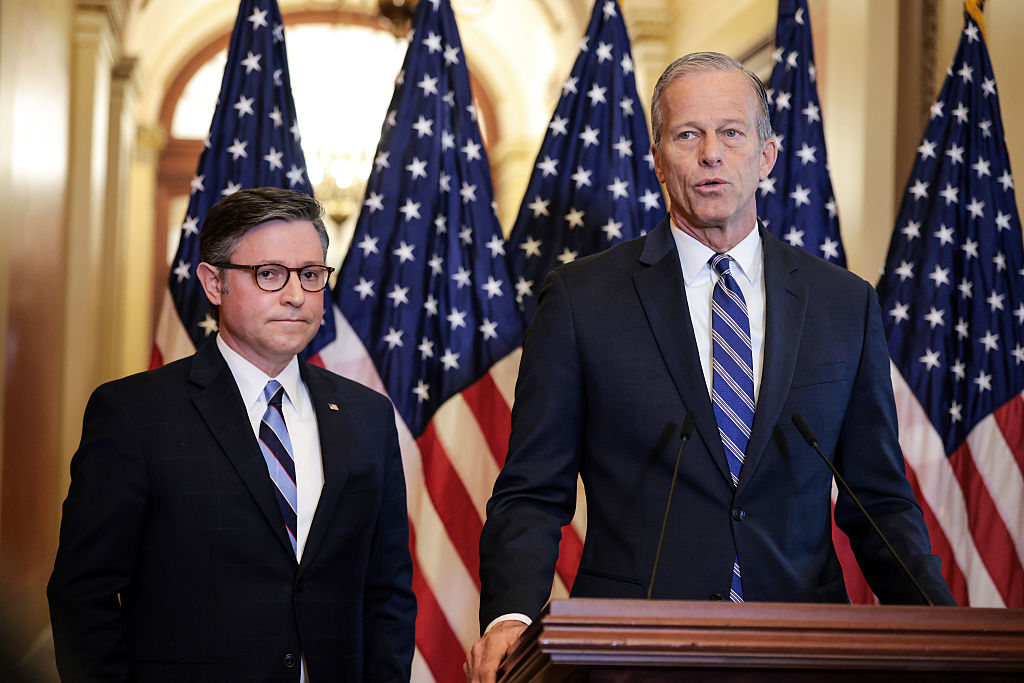
In the wee hours of March 27, 2026, around 2:30 to 3 a.m., the U.S. Senate passed a unanimous consent request to fund most of the Department of Homeland Security. Only about five senators were physically present on the floor: Republicans John Thune, Eric Schmitt, and Bernie Moreno (presiding), plus Democrats Brian Schatz and Andy Kim. The deal cleared funding for TSA, the Coast Guard, FEMA, CISA, and other non-enforcement functions while explicitly carving out full funding for Immigration and Customs Enforcement (ICE) and most of Customs and Border Patrol (CBP). It passed by voice vote with no objections after a hotline UC had been circulated. Senators then headed out for a two-week recess, leaving the partial DHS shutdown, now stretching beyond 40 days, unresolved for core enforcement operations.
Senate Majority Leader John Thune framed it as the realistic endpoint after Democrats blocked GOP reform offers. Defenders like Ed Morrissey at HotAir called it Democrats “throwing in the towel,” with “new momentum” for budget reconciliation supposedly making up the difference later. But the House wasn’t buying it. Speaker Mike Johnson called the Senate “gambit” a “joke,” questioned whether every Senate Republican had even read the language, and made clear the House would not participate in any plan that split off or defunded immigration enforcement agencies. Late Friday night, the House passed its own short-term continuing resolution (213-203) funding all of DHS, including full ICE and CBP operations, at current levels through mid-May. President Trump backed the House approach. The Senate’s partial bill went nowhere; the House CR is dead on arrival in the upper chamber. The shutdown for enforcement functions continues.
This wasn’t statesmanship. It was a classic Washington punt: use procedural tools to deliver Democrats their desired carve-out on border enforcement, assume the more Trump-aligned House would fold for the sake of easing TSA lines and airport chaos, clear the deck for recess, and then spin the outcome as strategic progress. Thune and a bloc of Senate “weak sisters” blinked under pressure, expected Speaker Johnson to play along, and left the conservative base holding the bag.
What Actually Happened: The Midnight “Exhaustion” Tactic
What makes this episode especially galling is the selective use of Senate procedure. The midnight UC effectively relied on an exhaustion mechanism, the standard parliamentary close of “I know of no further debate” after no one remained to object or speak. That is precisely how a genuine talking filibuster ends under existing rules: force continuous debate, exhaust the minority’s allotted speeches (two per senator per legislative day), and move to a simple-majority vote. No rule change or nuclear option required.
On DHS bill: Using a middle of the night rush to the floor tactic, there was no need for the 60 vote threshold.
It ended the SAME WAY a talking filibuster would end.
“I know of no further debate on the bill”
When everyone is exhausted, there’s no one left to debate.
And… https://t.co/XzfwmeQOIK pic.twitter.com/fqnDmABVUm
— Clint Brown (@DissidentClint) March 29, 2026
And yet, they tell you they can’t pass the SAVE America Act. But they sure can defund ICE!
Thune’s team and a small group of Senate Republicans pushed through the partial DHS package at roughly 2:30-3 a.m. on March 27, with only about five senators on the floor. It passed by voice vote after a “hotline” UC that had been circulated earlier. Thune framed it as the realistic endpoint after Democrats blocked reforms, but the move assumed, or at least hoped, the House would simply swallow it and move on so everyone could head to recess. That didn’t happen.
The House didn’t play along. Speaker Mike Johnson called the Senate’s “gambit” a “joke,” questioned whether every Senate Republican had even read the language, and made clear the House would not be a party to splitting off or defunding core enforcement agencies. Johnson accused Democrats (particularly Chuck Schumer) of engineering the carve-out. Late Friday night, the House passed its own eight-week continuing resolution by a 213-203 vote funding all of DHS, including full ICE and CBP, at current levels through May 22. President Trump backed the House approach. The Senate’s partial bill went nowhere; the House CR is dead on arrival in the Senate. Both chambers are on recess, with the fight deferred until mid-April.
The Double Standard on Senate Rules and the Talking Filibuster
Sen. Mike Lee (R-UT) and Rachel Bovard have explained this path repeatedly for the SAVE America Act, the House-passed bill requiring documentary proof of U.S. citizenship for voter registration and photo ID to vote in federal elections. An 80-85%+ popular issue. Bring the bill to the floor via simple-majority motion to proceed, refuse easy cloture, make Democrats hold the floor and own their obstruction in real time, exhaust them, and pass it by simple majority.
Thune’s team had no problem deploying the exhaustion tactic when it secured a recess-friendly deal that kneecapped Trump’s deportation priorities. Yet leadership has resisted truly employing it for SAVE, citing practicality, unknown outcomes, and internal resistance, even as Democrats continue blocking election integrity measures.
This double standard reveals the problem: Senate leadership will grind through the night when it rewards Democratic demands and secures vacation time, but suddenly finds the same process “too risky” or “not realistic” when it would force Democrats to defend unpopular stands on borders and elections on live television. Thune used the exhaustion process when it suited a recess-friendly partial deal that rewarded Democratic obstruction; he has resisted it when it would force Democrats to own blocking election integrity on live television.
Opportunity Costs and the Reconciliation Punt
Morrissey and Thune defenders highlight “new momentum” for reconciliation as the silver lining, the filibuster-proof vehicle that could supposedly backfill ICE and CBP funding later. This is dangerously short-sighted. Reconciliation offers limited slots per cycle, constrained by the Byrd Rule and parliamentarian scrutiny, all within a strict 10-year deficit window. By punting this year’s core enforcement funding into a future reconciliation package (likely late 2026 or 2027), Senate leadership is consuming scarce fiscal space on what should have been handled in regular order or the House’s clean CR.
CBO’s baseline budgeting compounds the damage. It assumes automatic spending growth and inflates future projections. Adding this year’s shortfall scores as new incremental spending above that rigged baseline, crowding out room for offensive, pro-growth reforms.
As outlined in the March 12 analysis “Better Get a Bucket,” reconciliation is the ideal vehicle for a bold supply-side and entitlement agenda that attacks real deficit drivers rather than merely papering over shortfalls. That blueprint includes full repeal of the punitive 3.8% Net Investment Income Tax (NIIT), the Obamacare surtax that hits dividends, capital gains, rental income, and passive earnings, discouraging investment and capital formation; full tax deductibility for privately purchased health insurance to promote portability, HSAs, high-deductible plans, and direct primary care models; Medicaid block grants or per-capita caps with work requirements and state flexibility, plus aggressive recovery of health-care fraud (hundreds of millions in states like Minnesota and billions nationwide in improper payments). These reforms, combined with codifying key Trump executive actions, would expand the economic base over time through dynamic scoring.
Yet loading defensive border funding into the same finite “bucket” risks forcing trade-offs, watered-down tax relief, or delayed entitlement restructuring. Thune’s approach didn’t just delay enforcement; it handcuffed the growth-oriented agenda the base expects from unified Republican government. “New momentum” sounds reassuring until you realize the bucket is finite and every defensive dollar spent today makes bold supply-side wins harder tomorrow.
“Keeping the Issue” vs. Go-Along-to-Get-Along
Democrats have mastered “keeping the issue” for decades: prolong fights on borders, elections, and spending; force visible pain on the public; then blame Republicans for any discomfort while shielding their own unpopular positions. Republicans too often take the early off-ramp in the name of comity and “adult in the room” optics, letting the media narrative shift and leverage evaporate.
This DHS episode is textbook. Thune prioritized clearing the deck for recess over forcing Democrats to own their blockade of deportations and border security amid Trump’s immigration crackdown. The base delivered unified GOP control expecting decisive action on America First priorities: secure borders, mass deportations, and clean elections, not midnight carve-outs that reward obstruction.
Speaker Mike Johnson has been the adult in the room. He was gracious toward Thune personally, giving a heads-up and directing primary blame at Chuck Schumer and Senate Democrats, while showing real backbone. He rejected the Senate’s half-measure outright, passed the full-funding House CR, and kept the enforcement fight alive rather than letting it be buried under a partial “win.” That political generosity deserves reciprocity from the Senate: provide the spine where a wet noodle was expected.
The Post-Recess Path: Move Toward Lee and Keep the Issue Alive
When senators return in mid-April, the smarter course is clear. Accept Johnson’s lead and shift toward Sen. Mike Lee’s procedural aggressiveness. Where rules permit, package full DHS enforcement language with SAVE America Act elements. Refuse easy cloture on high-polling measures. Force real, extended debate so Democrats must hold the floor and defend blocking voter integrity and border security. No more vacation-timed escapes or premature declarations of victory on half-measures.
The shutdown leverage isn’t gone. TSA relief is partial via executive action, but enforcement agencies remain hampered. Unified Republican government should deliver results on the voter mandate, not more incremental Washington deal-making that trades today’s enforcement and election security for tomorrow’s crowded reconciliation scraps.
Conclusion
Thune’s midnight maneuver exposed a willingness to play both the House and the conservative base for suckers in exchange for short-term calm and vacation time. Johnson’s firm rejection prevented the full cave and preserved leverage. Now the Senate must provide the backbone. The American people, and the southern border, cannot afford more wet-noodle leadership. It’s time to keep the issue, fight like the stakes demand, and stop trading principle for procedural mercy.
