
The Blue Slip: Last Bastion or Final Betrayal of the Framers’ Senate?
A Follow-Up to “Restore the Republican Soul of the Senate”
In the sweltering summer of 1787, as the delegates to the Constitutional Convention debated the bones of the new republic in Philadelphia, one institution emerged as the deliberate brake on the wheels of government: the Senate. It was not born of compromise alone but of a profound suspicion of unchecked majorities. James Madison, scribbling notes in the margins of his copy of Montesquieu, envisioned an upper house that would “refine and enlarge the public views” while tethering them to the sovereignty of the states. Elbridge Gerry of Massachusetts warned that without such a body, the federal government would devour the liberties of the smaller republics. The result was a chamber of equals-two senators per state, chosen not by the fleeting passions of the populace but by the deliberative wisdom of state legislatures. Six-year terms staggered the elections. And its powers, from confirming treaties to trying impeachments, were crafted to say “no” with quiet authority.
This Senate was no mere echo of the House of Representatives. It was the saucer to cool the tea of popular fervor, as George Washington is said to have quipped to Jefferson over cherries. The blue slip, a ritual that would not take shape for more than a century, is woven from the very threads of that design: a nod to federalism, a check on executive overreach, and a reminder that federal power, even in the appointment of judges and prosecutors, treads on state soil.
I. The Humble Birth of a Senate Custom
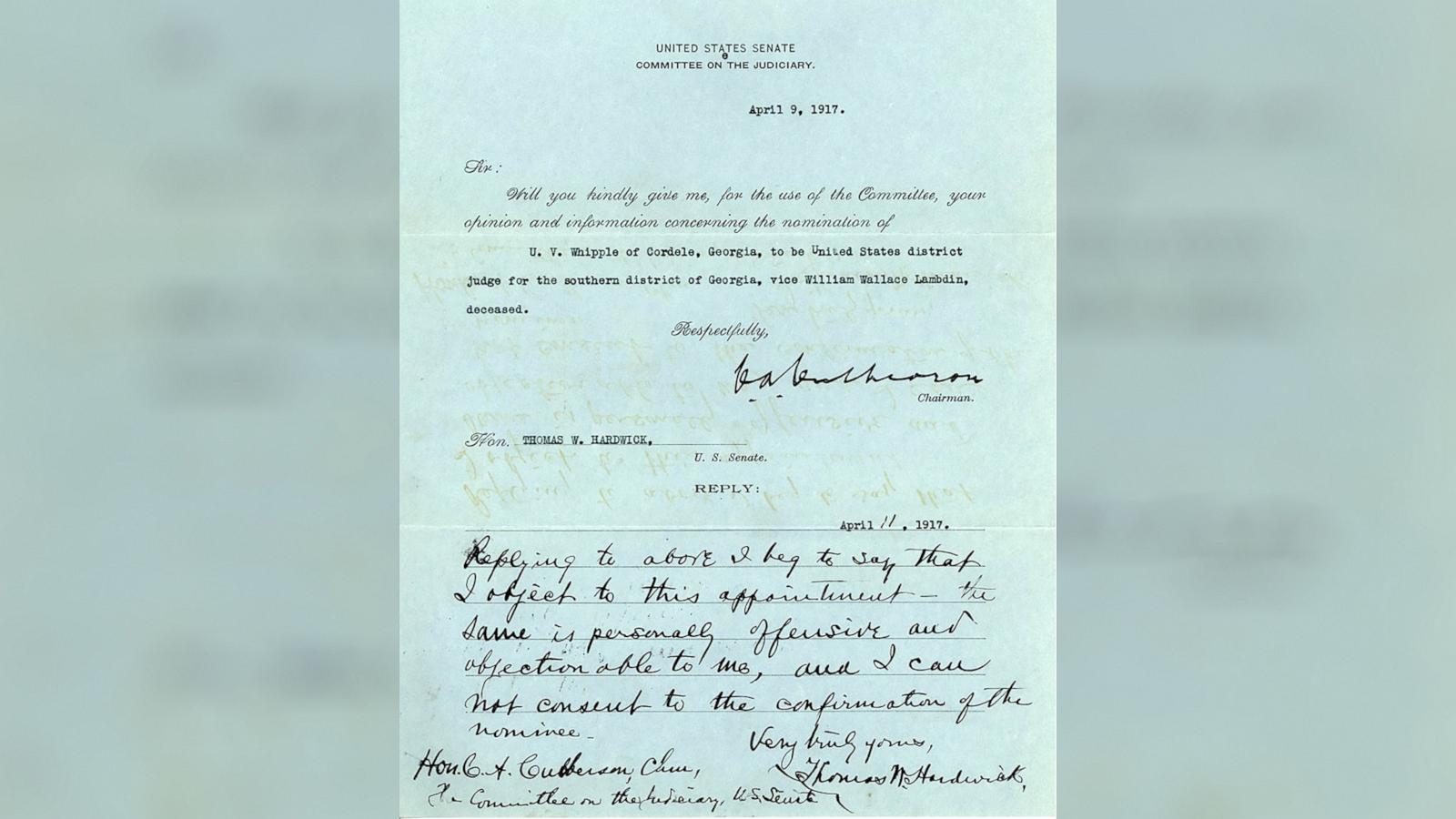
The blue slip’s origins are as unassuming as they are enduring. Picture the year 1913: Woodrow Wilson, fresh from his Progressive triumph, nominates a district judge for the Northern District of Georgia. The senior senator from that state, Hoke Smith, a former governor with a newspaperman’s grudge, withholds his approval-not over the nominee’s jurisprudence, but over a perceived slight from years past. The Senate Judiciary Committee, chaired by a Texan of old-school courtesy, pauses. No rule compelled the halt; only the weight of senatorial tradition did. By 1917, amid the shadow of war, Chairman Charles Culberson of Texas gave the practice form: two slips of blue paper dispatched to the home-state senators for any lower-court judicial nominee or U.S. attorney. Return it favorably, and the process hums along. Withhold it, or mark it with objection, and the committee typically demurs-no hearing, no vote, no fuss.
For its first generation, the blue slip was precisely what the Framers might have approved: a mechanism for local knowledge to inform national appointments. Between 1917 and the mid-1950s, it derailed fewer than two dozen nominations, often for cause-ethical lapses, partisan entanglements, or whispers of incompetence. Senators, still somewhat ambassadors of their states, used it sparingly, knowing the courtesy cut both ways. A Republican president in a Democratic state, or vice versa, consulted first or faced the quiet burial of his choice.
II. The Great Unraveling of the Senate’s Republican Soul
The unraveling came in waves, each eroding the Senate’s republican essence.
The first tremor struck in 1913 with the ratification of the 17th Amendment, which flung senators into the arena of direct popular election. No longer agents of state assemblies, they became players in a national spectacle, beholden to donors from coast to coast rather than legislatures in statehouses from Albany to Austin. Federalism, that delicate balance of union and independence, began to fray at the edges.
The second arrived in 1975, when a Democratic Congress, chastened by Watergate but emboldened by reformist zeal, lowered the cloture threshold from two-thirds to three-fifths-sixty votes to end debate. What had been an extraordinary tool for minority protection became the routine price of passage, turning deliberation into deadlock.
The blue slip, too, mutated. By the 1980s, it shed its cloak of courtesy for the armor of obstruction. Under Ronald Reagan, Democrats wielded it against conservative judges in blue states; under Bill Clinton, Republicans returned the favor. By the Obama years, the practice had calcified into an unwritten veto, with over a hundred nominees languishing in the judicial purgatory of withheld slips. Donald Trump’s first term saw Democrats mirror the tactic, and Joe Biden’s the same from the GOP side. Today, in the slim Republican majority of 2025, it stalls Trump’s enforcers-U.S. attorneys like Alina Habba in New Jersey-turning a tradition of input into a blockade of impunity.
III. Returning to First Principles: Federalism and the Advice-and-Consent Power
To judge the blue slip from first principles, we must return to the parchment of 1787, unmarred by the patina of partisanship.
The Constitution entrusts the president with the nomination of officers but vests “advice and consent” squarely in the Senate-not in a bare majority of it, nor in the haste of a single chamber’s whim. Article II, Section 2 is silent on speed or simplicity; Article I, Section 5 empowers the Senate to “determine the Rules of its Proceedings.” District judges and U.S. attorneys are not cosmic arbiters like Supreme Court justices; they are the federal government’s boots on the ground, interpreting laws and prosecuting crimes within the borders of a single state. The Framers, steeped in the Anti-Federalist fears of a distant tyranny, would have recoiled at a system where a president could impose such agents without a whisper from the sovereign whose people they serve.
The blue slip, in its pure form, embodies that residual sovereignty. It is federalism’s faint echo in a document that presumes states are not mere administrative districts but co-equal partners in the republic. To abolish it wholesale would not empower the majority; it would empower the executive, rendering the Senate a rubber stamp for national will. That is not separation of powers; it is its surrender.
IV. The Perverted Courtesy: From Consultation to Unilateral Veto
Yet first principles demand we confront the blue slip’s perversion, for a custom corrupted is no custom at all.
What began as a call for consultation has devolved into secrecy and absolutism. A senator may withhold a slip without explanation, without debate, without even the courtesy of a committee inquiry. In blue states under a red president, one Democratic voice can entomb a nominee indefinitely-Alina Habba’s limbo in 2025 a stark case in point, her interim status mocked by courts as “unfit” while deportations and election probes gather dust. This is not the Senate’s jealous guardianship; it is the veto of a tribune, evoking Rome’s intercessio more than Madison’s saucer. The Framers, who rejected absolute negative powers in the Convention, would see in it not protection but paralysis-a distortion that mocks the very counter-majoritarianism it claims to uphold.
V. A Program of Restoration, Not Destruction
Restoration, as I argued in “Restore the Republican Soul of the Senate,” is not demolition but repair: reclaiming the chamber’s original posture of deliberate restraint without the deformities of modern excess.
For the blue slip, let us pare it back to its 1917–1950s fidelity-a prompt for scrutiny, not a shroud for sabotage. A withheld slip should summon a hearing, not evade one; compel the objector to testify publicly, not hide in shadow. The Judiciary Committee, by simple majority or perhaps two-thirds vote, could then decide to proceed, ensuring the Senate’s voice is collective, not solitary. This preserves advice and consent as a shared burden, faithful to Article II’s plural “Senate.”
But true revival demands more. Repeal the 17th Amendment, returning senatorial selection to state legislatures. A senator answerable to Austin or Sacramento, not to MSNBC or Fox, would wield the blue slip as a statesman’s tool, not a partisan’s dagger. Federalism, long dormant, would stir anew: legislatures could recall wayward members, insulating the Senate from national money’s flood ($18 million per race in 2024 cycles alone) and realigning it with the communities it was meant to represent.
Such changes honor the Constitution’s silence on procedure by filling it with principle. They reject the siren call of the nuclear option-not because it fails Trump today, but because it fails the Framers tomorrow, when Democrats reclaim the levers and pack the courts with impunity.
VI. The Choice: A Senate That Remembers 1787, or One That Forgets
Critics decry these ideas as relics, “undemocratic” in an age of instant referenda and viral mandates. The indictment lands, but it misses the mark. The Senate was never designed for democracy’s raw pulse; it was forged for republicanism’s tempered wisdom-the representation not of individuals en masse, but of political societies enduring through time. To strip its traditions bare is to invite the very majority tyranny the Convention abhorred.
The blue slip, restored and restrained, stands as the Senate’s final bulwark: a threadbare but unbroken link to 1787. Sever it in haste, and we do not hasten governance; we hasten the Senate’s obsolescence, transforming it from guardian of the states into mere amplifier of the executive’s echo.
The choice before us is stark: a Senate that faintly recalls its constitutional soul, or one that has bartered it for the illusion of efficiency. In this season of divided mandates and urgent agendas, let us choose restoration-not for one man’s term, but for the republic’s endurance.
