
Orbital Compute and the Measure of Creaturehood
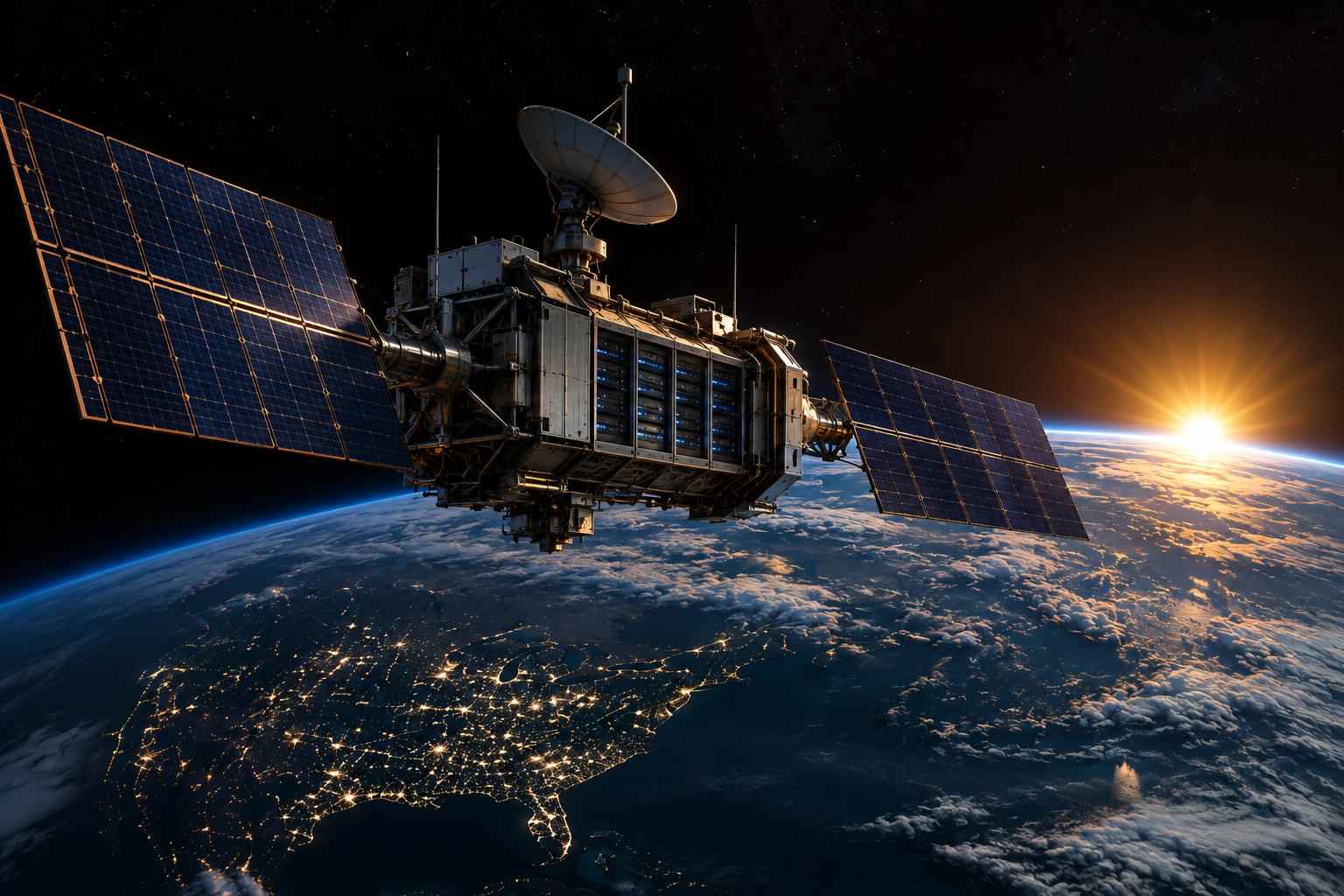
A million satellites clear the regulatory threshold. The people who still live next to the substations do not.
In August I wrote that I am not a futurist. George Allen meant the future is now when he refused to treat the present as a waiting room and traded future picks for veterans who could win immediately. I applied the same standard to artificial intelligence. The tool carries no moral charge. Character and incentives decide the outcomes. What shifted was the speed at which the physical conditions around the tool can change.
SpaceX put the compute in the filing: large solar arrays, radiators that reject heat into vacuum, laser links into the Starlink network, and a compensation structure that vests only if the company reaches extreme valuation and either plants a permanent city of a million people on Mars or operates orbital data centers drawing at least a hundred terawatts. The race includes energy and the physical substrate.
On November 25 the FCC Space Bureau authorized SpaceX to deploy up to one million satellites for that constellation. The milestones run from the first satellite by late 2033 to one hundred thousand by 2035 and the full million by 2040. Optical inter-satellite links. Continuous solar power. The order treats higher energy access as a strategic outcome and advances American leadership in both space and artificial intelligence. It clears the regulatory threshold I described in August.
Terrestrial infrastructure collides with real limits. Power draws compete with households. Cooling consumes water. Parcels sit near homes and schools. Local opposition has already produced hundreds of moratoriums. The former Landover Mall site in Maryland shows the pattern. The mall closed in 2002. Nearly ninety acres sat vacant. County planners approved a five-billion-dollar hyperscale campus in 2024. A petition gathered more than twenty-five thousand signatures. County freezes followed. The project remains stalled. Similar fights are underway in multiple states. The load is real. The local externalities are real.
Orbital placement removes several of those externalities for the power-intensive training and bulk inference that drive the current boom. Continuous sunlight supplies the power. The compute does not draw from the terrestrial grid. Cooling rejects heat into vacuum. No local water is consumed. No parcel sits next to homes or schools. Results return by optical links. At the authorized volumes this shifts where a large class of energy-intensive work occurs.
The positive effects follow from that shift. Continuous orbital solar takes a substantial fraction of AI training load off terrestrial grids. Households, hospitals, factories, and ordinary commercial users keep more of the existing generation and transmission capacity. Rate pressure eases in regions where large training halls would otherwise compete for the same electrons. Water systems that would have served cooling towers remain available for agriculture, industry, and residential use. Towns that would have faced multi-year fights over substations and wells retain the option to develop the land for other purposes or to leave it undeveloped. The zero-sum character of many current siting disputes declines for the workloads that move to orbit.
The same capacity supports tools that serve particular places and particular people. Materials scientists run larger simulations of alloys and catalysts. Biologists model protein interactions at scales that compress discovery timelines for therapies. Agricultural researchers optimize crop genetics and irrigation schedules against local soil and weather data. Logistics systems route freight with greater precision. Educational platforms deliver adaptive instruction that a single teacher cannot scale. These applications do not require every user to live next to a hyperscale hall. They require the compute to exist somewhere. Orbit supplies that somewhere without converting the local tax base into a capacity auction.
Longer-horizon scientific work benefits as well. Climate models incorporate higher-resolution physics. Fusion designs iterate faster. Drug candidates are screened against broader molecular libraries. None of these efforts erase the need for human judgment, laboratory confirmation, or clinical trials. They enlarge the set of options researchers and clinicians can examine. The abundance is instrumental. It serves the finite beings who still live in towns, raise children, and vote on local budgets.
Orbit does not dissolve the obligations I named in September. A substantial share of compute remains terrestrial. Latency-sensitive inference, edge functions, and ordinary cloud storage stay on the ground. Those facilities still have neighbors. Creaturehood remains the measure. Particular people in a particular place are owed a ledger and a vote. A town is not a queue position. A child is not a latency budget. Dependence on tools we did not forge is part of being a finite being. Gratitude for the rack that holds a medical record does not entitle the next pad to secrecy and a socialized bill. The hearing remains the event for every terrestrial interconnection. Orbit changes the volume that must be decided in those hearings. It does not cancel them.
The compensation structure that ties personal upside to a hundred-terawatt orbital outcome is extreme by ordinary standards. It also aligns incentives with solving the substrate problem at a scale current interconnection queues and local freezes do not deliver. Whether the effort produces durable American advantage or expensive spectacle remains a matter of engineering and sustained will. The tool does not decide that. We do.
I remain outside maximal futurism. The future arriving now is still the refusal to treat decisive capacity as permanently deferred. The measure is still the beings who live in particular places after the ribbon is cut, whether the ribbon is cut on a brownfield or, years from now, on a satellite that rejects heat into vacuum. Orbital compute can relieve pressure on the creaturely level. It does not replace the duty to that level. That is the civilizational effect that can be stated without forgetting who must still live on the ground.
