
What Hugh Hewitt Gets Wrong About Simpson-Mazzoli, Trump, and the Pardon Power
The Recurring Bargain
Every major immigration proposal since 1986 has followed the same script. Proponents promise a limited fix for a defined group. They pair it with tough-sounding enforcement language. They insist the measure is not amnesty. Then the regularization arrives, the enforcement fades, and the numbers grow.
The DIGNIDAD Act used “Dignity Status” and renewable work authorization to shield millions. SAWAl used temporary agricultural visas to reach the same result for a sector. Both recycled the Simpson-Mazzoli bargain: deliver the legalization now and trust that the limits will hold later.
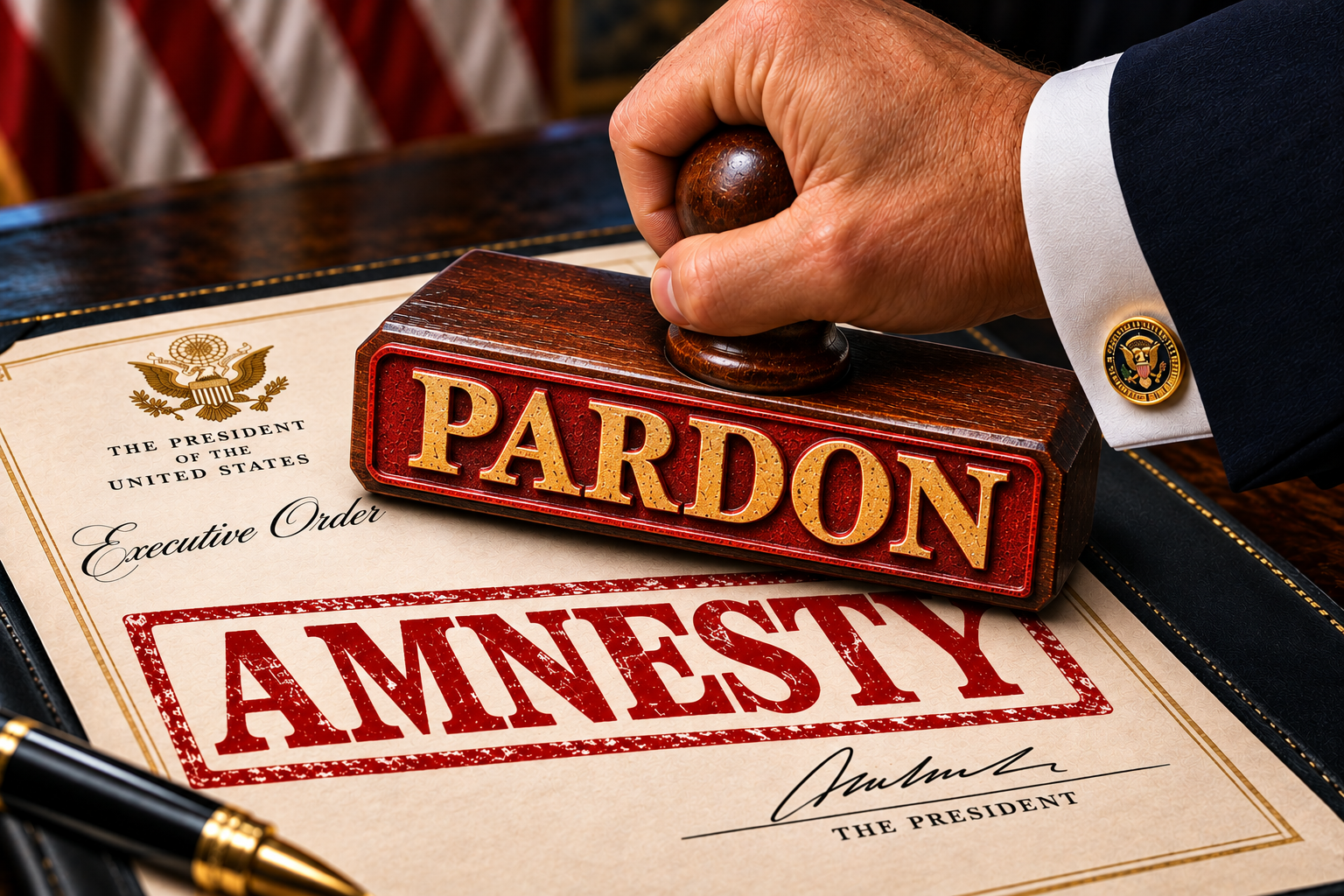
Hugh Hewitt’s November 24 Fox News op-ed offers the latest version of that bargain. He proposes that President Trump use the pardon power to shield a defined class of illegal immigrants from deportation. The proposal fails for the same reasons the earlier ones failed.
The Supermajority Claim and the 1986 Record
Hewitt opens with the claim that a carefully drawn pardon will deliver a “golden touch.” He says the act will enshrine Trump’s memory among the affected communities and rank among his greatest achievements. He asserts that supermajorities of Americans will approve it. The claim rests on assertion rather than evidence.
Americans have rejected large-scale regularization once the scale and the historical record become clear. After Congress passed the Immigration Reform and Control Act in 1986, the promised employer sanctions and border measures never operated at the scale the statute required. The illegal population grew.
California absorbed a disproportionate share of the newly legalized population and the subsequent inflows. The state’s Hispanic and Asian population shares roughly doubled between 1980 and 2000. The state became majority-minority. Large numbers of non-Hispanic white residents left. The political center of gravity shifted.
Proposition 187 in 1994 recorded the public reaction to the continued illegal presence and the fiscal costs. Court challenges and political mobilization followed. The state moved from competitive to solidly Democrat. That sequence is the record Hewitt’s supermajority claim must overcome.
Abstract support for “hard-working people who pay taxes” collapses when voters confront the actual numbers, the fraud risk, and the post-1986 outcome.
The Thanksgiving Premise
Hewitt suggests that families frame the issue at Thanksgiving as a pardon for “the 10 percent of the illegal immigrant population, people whom everyone here could agree ought to be left alone.” The premise does not hold.
Illegal entry and illegal re-entry are federal crimes. Unlawful presence is a civil violation. Subsequent employment, tax payment, or the birth of a U.S.-citizen child does not erase the original violation. The child is already a citizen. That fact creates no parental right to remain.
Large numbers of Americans, including a substantial share of the coalition that elected Trump, reject the idea that time and work convert an illegal presence into a protected one. Hewitt’s “everyone agrees” framing excludes that share of the public by definition.
Border Security Is Not a License for Categorical Clemency
Hewitt correctly notes that Trump sealed the southern border, built more than 750 miles of wall, and secured funding for additional miles. He treats that record as the necessary precondition that allows Trump alone to offer mercy. He points to Trump’s recent 60 Minutes comments that some removals of people with good jobs whose “one violation” was illegal entry were “too tough” and hurt midterm results.
A secure border is a reason to maintain prioritization. It is not a reason to issue a categorical pardon. Ordinary enforcement discretion already allows agencies to focus resources on criminals, recent arrivals, and gang members.
A formal pardon that neutralizes the consequences of unlawful presence for a large class is a different act. It signals that the original violation can be cured by the passage of time and the formation of a family. That signal is the one that undermined the 1986 statute.
The Limits of the Pardon Power
Hewitt treats the pardon power as complete and within the president’s sole control. He offers Jimmy Carter’s 1977 pardon of Vietnam-era draft evaders as the model.
Carter’s proclamation covered Selective Service violations committed in a closed historical window. It excluded cases that involved force or violence. It restored civil rights. It did not create an ongoing legal status or invite future applicants to claim the same relief.
Illegal entry is a crime. A pardon can extinguish a conviction for that crime and many of its collateral consequences. Unlawful presence is primarily civil. A pardon does not itself confer lawful permanent residence or work authorization under the Immigration and Nationality Act.
Hewitt’s proposal requires the pardon to function as de facto regularization so that the class remains free of the fear of deportation. That use converts clemency into immigration policy. The Carter analogy does not support it.
Nixon to China Does Not Fit
The Nixon-to-China framing supplies the political core of the argument. Hewitt says only the president who built the wall possesses the capital to offer limited mercy. He then sketches a later “Trump-Schumer-Jeffries Regularization Act” that would grant continued residence without a general amnesty or a pathway to citizenship.
Nixon’s opening to China involved a limited strategic concession with reciprocal effects. Unilateral regularization of a large class whose presence remains unlawful is not the same act.
Hewitt’s insistence that the measure is not amnesty because it lacks an immediate citizenship pathway repeats the linguistic dodge used in the DIGNIDAD Act and similar bills. Indefinite protection from removal combined with work authorization is the practical amnesty. Citizenship can arrive later through other statutes or subsequent legislation. The distinction collapses in practice.
Criteria That Look Clear and Prove Porous
Hewitt sketches criteria: exclusion of felons and anyone arrested for violent crimes, unbroken presence before a cutoff date (he floats January 21, 2020), proof of near-continuous employment and tax payments, and possible limitation to adults with U.S.-citizen children. He says critics will be loud but will represent only a tiny portion of the country. He adds that continued removal of long-term residents will block the return of Republican majorities.
The criteria are clear on paper and porous in administration. Continuous presence, employment records, and tax filings at the scale of hundreds of thousands invite fraud and protracted litigation. The presence of U.S.-citizen children creates additional pressure to expand the class.
Once any version is granted, later administrations face incentives to interpret the language broadly or to issue further grants. The claim that opposition represents only a tiny portion understates the size of the coalition that treated mass illegal presence as a core problem and that watched the post-1986 demographic shift.
Prioritizing criminals and recent arrivals does not require a formal pardon for everyone else. It requires sustained enforcement.
The Precedent That Follows
The larger danger is the precedent. A categorical pardon that clears the criminal consequences of illegal entry and directs agencies to treat a large class as not removable for the underlying presence violation establishes that the pardon power can serve as a tool of mass regularization.
A future Democrat president can reverse interior enforcement priorities, reduce removals, loosen asylum processing, and reopen effective border access through ordinary executive action. That president can then issue a broader categorical pardon that covers a larger class, a later cutoff date, fewer exclusions, or successive rounds of relief. The new administration can cite the earlier grant as political cover.
Legal limits remain. A pardon does not automatically confer green-card status. In practice, however, the clearance of criminal grounds and the administrative instruction to treat the class as protected will create immediate relief while litigation proceeds.
Once large numbers receive that relief, the constituency against future restriction grows. Chain-migration effects accumulate. The political cost of reversal rises. The 1986 statute showed the same dynamic under a different legal vehicle. A pardon-based version would be unilateral and harder for a subsequent Congress to unwind quickly.
The Pattern Holds
I have argued in earlier columns that the pattern is consistent. The regularization arrives. The enforcement does not hold. The numbers and the political incentives shift.
Hewitt’s proposal substitutes the pardon power for a statute. It does not escape the pattern. The cleaner responses remain ordinary prioritization of criminals and recent arrivals or legislation that sets the terms in statute rather than executive clemency.
A categorical immigration pardon collapses that distinction. It normalizes the idea that a president can unilaterally regularize large numbers of people who entered or remained in violation of the law. That is the precedent Hewitt’s op-ed would set.
