
Harold Macmillan Arrives in Time for the Midterms
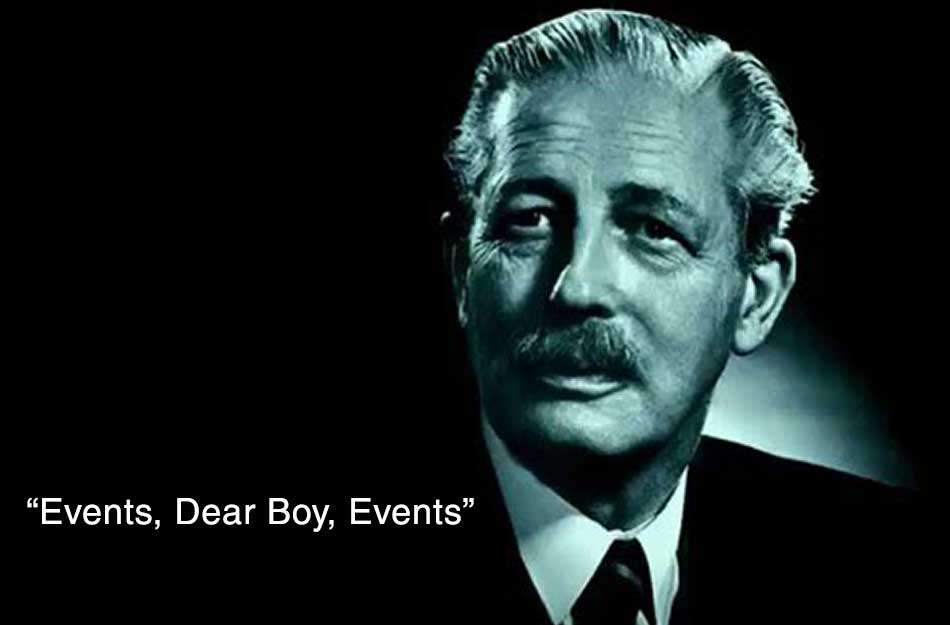
Events, dear boy. The October streets, the intact ham aisle, and the midterm ranking that does not move by itself.
The Streets Did Not Look Like a Student Protest
The streets of Limoges, Paris, Marseille, Lyon, and Milan did not look like a student protest over classroom conditions or the price of bread. A nineteenth-century town hall in Limoges burned until its roof collapsed. The tourist office went up in Lyon. Rioters entered and damaged town halls in Marseille and Lille. Looters emptied hundreds of shops in a single day. Police made between twelve hundred and eighteen hundred arrests. The violence injured hundreds of officers and firefighters. Italian reporting on the Milan Duomo clashes described the violent subset as second-generation youths. Marches displayed Palestinian flags. In a Franprix on Rue du Faubourg du Temple, looters stripped the shelves of nearly everything else while the ham and pork section sat untouched.
The Official Frame Ignores the Pattern
Official statements and most legacy media coverage framed the violence as the work of ultra-left elements and opportunistic criminals who hijacked otherwise legitimate marches. Macron spoke of youth anguish that must not be minimized and promised that looters would face consequences. That framing treats the destruction as a messaging problem attached to domestic economic discontent. It does not account for the flags, the second-generation description, or the intact ham aisle. The refusal to name the demographic pattern already measured in European data and photographed on the same streets is the weakness that shrouds the rest of the story.
French and European statistics have tracked the pattern for years. Antisemitic incidents rose sharply after 2000, with further spikes after 2014 and after October 2023. A large share of street-level assaults and attacks on Jewish sites involve young men from North African and Middle Eastern immigrant backgrounds or their children. The same cohorts show lower intermarriage rates and higher neighborhood concentration. Once local density crosses the point at which coordinated action carries low social cost, residual boundaries remain visible even in opportunistic crime. The ham aisle is one such boundary. The flags are another. The second-generation black-block activity is a third.
de Gaulle Named the Threshold
Charles de Gaulle named the threshold in a private conversation with Alain Peyrefitte on 5 March 1959. He accepted small numbers of non-European citizens as evidence of a universal vocation, then insisted they must remain a minority or France would no longer be France. He described the country as primarily a European people of the white race, of Greek and Latin culture and of the Christian religion. The full reported exchange includes the oil-and-vinegar image and the demographic projection:
“Have you seen the Muslims with their turbans and their djellabas? You can see they are not French. Try to integrate oil and vinegar. Shake the bottle. After a moment they separate again. The Arabs are Arabs, the French are French. Do you think that the French can absorb ten million Muslims who will tomorrow be twenty million and after tomorrow forty? … My village would no longer be called Colombey-les-deux-Eglises but Colombey-the-two-Mosques.”
Peyrefitte recorded private remarks, not public policy. Those remarks formed the private calculation that underlay his refusal of full integration during the Algerian War. The subsequent half-century of migration, fertility differentials, and lower partner-choice assimilation produced the local concentrations the October footage recorded.
The Same Arithmetic Operates Here
The same arithmetic operates in American cities and suburbs. It does not require a national majority. It requires density. In east Plano the parks and drop-off lines already show the shift. Two mosques stand less than a mile from the house. English is no longer the default language in the places where children play. They are the local version of the density threshold. The visa pipeline tightening produced the first measurable slack. The European images of selective looting and public-building arson illustrate the same process at higher intensity.
Events, Dear Boy, Events
Tradition attributes to Harold Macmillan the reply “Events, dear boy, events” when asked what was most likely to blow a government off course. The line is the short form of a longer truth: plans and rankings remain provisional until the unforeseen arrives and forces the conversation. The October streets are that kind of event. They are not abstract. Photographers captured them, and the selective details already circulate. Whether they move the midterm ranking depends on whether the selective details keep circulating and whether Republican candidates treat the images as the answer to the Democrat record on enforcement.
Democrats Do Not Divide on Enforcement
Democrats do not divide on enforcement in any meaningful sense. The Democratic Socialists of America and the progressive wing that operates in its orbit remain dominant and ascendant. They introduced legislation this month to abolish ICE, Customs and Border Protection, and major elements of the Department of Homeland Security. Multiple nominees and a DNC resolution used abolition language. An August survey found 51 percent of self-described moderate Democrats and 67 percent of progressive Democrats supporting abolition. James Talarico now calls himself a border security Democrat and states that he does not support abolishing ICE. Those statements do not match years of his prior public record, including statements through this summer in which he labeled ICE a secret police force and called for it to be torn down. The New Democrat Coalition offers a framework that calls for more Border Patrol agents and prioritization of violent-crime removals, yet that framework remains a minority position inside a party whose base, primary electorate, and rising candidates treat the enforcement agencies themselves as the obstacle. The prior Democrat administration sustained high encounter volumes with mass-scale releases into the interior. That record is the policy the dominant faction continues to defend.
The Administration Framed the Footage
The administration has already framed the French footage as the endpoint of the policy choices large parts of the Democrat Party continue to defend. Trump wrote that France is burning because of immigration from an entirely different world and told the country to close its borders. Vance wrote that Western liberals imported the third world while ignoring assimilation and compatibility, then added that this is the future congressional Democrats seek for your country. Current national surveys still rank the economy and cost of living first. Immigration ranks secondary overall, though higher among Republican voters. The visual selectivity of the ham aisle, the flags, and the second-generation subsets is harder to square with the student or cost-of-living frame than abstract rankings. Whether those images move the ranking in the remaining weeks depends on sustained circulation of the selective details, continued defense of the prior high-release record, and the absence of a larger shock that reorders priorities before November 3.
Republicans Have the Event in Front of Them
Republicans who have spent months saying immigration will decide the midterms now have the event in front of them. The task is simple and specific: put the ham aisle, the flags, the second-generation subsets, and the Democrat abolition language in the same frame as the high-release record of the prior administration. Do it in the ads, the debates, and the local stops. Do not wait for the national ranking to move on its own. Macmillan’s point was that events force the conversation. This one will not force it unless the candidates treat the selective details as the message and keep them in front of voters until November 3.
Europeans measured the threshold de Gaulle named in 1959. American observers can see it in Plano parks and drop-off lines, and photographers captured it on the October streets. The process is the same. National surveys may rank other issues higher this month. The process does not wait on the ranking. Events, dear boy. Events.
