
Terror, Mud, and the Flight for Life, 190 Years On
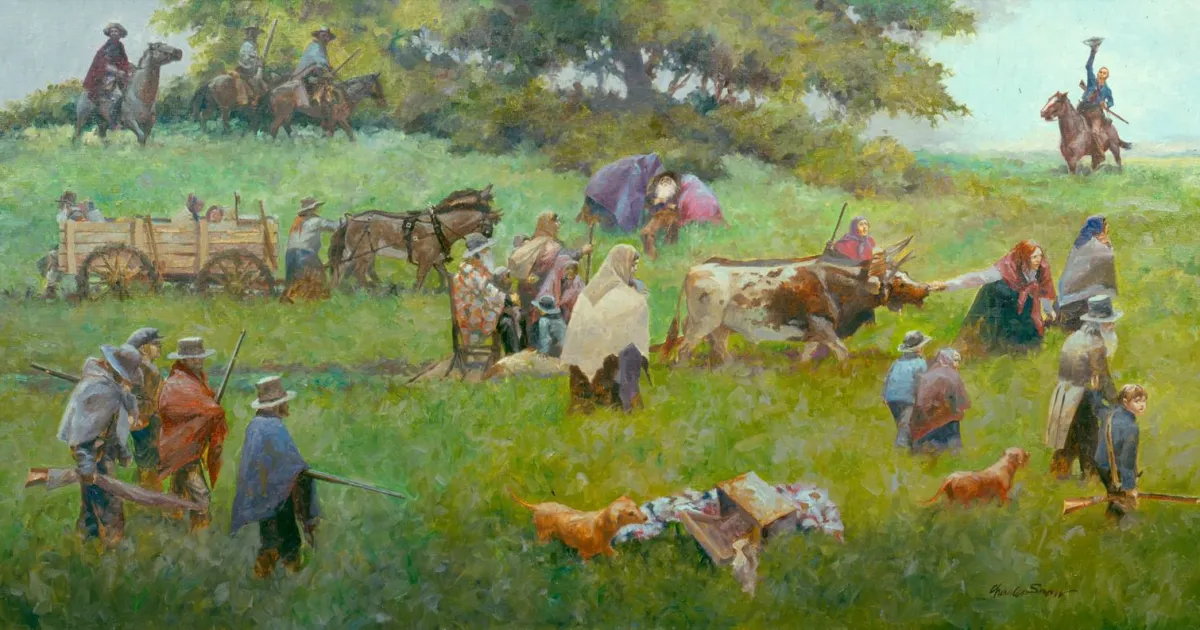
Imagine the panic sweeping across Texas settlements in late March and early April 1836. News of the Alamo’s fall and the Goliad Massacre traveled faster than any courier. “Santa Anna is coming; he will show no mercy!” Families abandoned homes in haste, loading wagons with whatever they could carry while burning crops and cabins to deny supplies to the enemy. Rain turned roads into rivers of mud. Children cried. Women drove oxen through flooded crossings. Disease stalked every camp. This was the Runaway Scrape, the desperate eastward exodus of thousands of Texian civilians fleeing Santa Anna’s advancing army.
It was not one single event, but a weeks-long ordeal of fear, hardship, and quiet heroism that tested the very soul of those who would become the Republic of Texas. As we mark the 190th anniversary, we remember not only the soldiers who fought, but the families who fled so that a new nation might live.
The Spark: Horror from the West
After the fall of the Alamo on March 6 and the executions at Goliad on March 27, terror gripped the settlements. Sam Houston, retreating strategically from Gonzales, ordered civilians to join the army’s movement eastward. He knew his small force could not yet face Santa Anna in open battle. Time had to be bought, even if it meant abandoning homes and farms.
Thousands answered with their feet. From the Colorado to the Brazos and beyond to the Trinity and San Jacinto, a ragged river of humanity flowed east: women, children, the elderly, enslaved people, and a few men too old or ill to fight. They traveled in wagons, carts, on horseback, or on foot, carrying bedding, food, and precious heirlooms while leaving most possessions behind.
“We Left Home at Sunset”: Voices from the Scrape
One of the most vivid accounts comes from young Dilue Rose Harris, who later recalled:
“We left home at sunset, hauling clothes, bedding, and provisions on the sleigh with one yoke of oxen. Mother and I were walking, she with an infant in her arms… We camped the first night near Harrisburg… Our hardships began at the Trinity River. The river was rising and there was a struggle to see who should cross first. Measles, sore eyes, whooping cough, and every other disease that man, woman or child is heir to broke out among us.”
Other families told similar stories of endless rain, sinking wagons, drowning livestock, and the constant fear of Mexican cavalry appearing on the horizon. Women gave birth in the open, children died of exposure or illness, and many buried loved ones along the muddy trail. Some burned their own cabins as they left, a heartbreaking act of denial to the enemy.
The Medium post captures this human drama beautifully: families fleeing with whatever they could carry, the chaos at river crossings, and the quiet determination of mothers protecting their children amid unimaginable hardship. These personal stories remind us that the Runaway Scrape was not abstract history; it was lived in tears, exhaustion, and unbreakable spirit.
Houston’s Strategic Retreat
Sam Houston’s army moved with the civilians, burning Gonzales behind them on March 13 to prevent its use by Santa Anna. Houston faced criticism for “running,” but his caution was deliberate. He drilled his growing force, waited for reinforcements, and chose the ground for the eventual showdown. The Scrape, painful as it was, bought him the time he needed.
By mid-April, the refugees had crowded along the San Jacinto River and beyond. Exhaustion and despair hung heavy, yet hope flickered as more volunteers arrived, inspired by the cries of “Remember the Alamo! Remember Goliad!”
Echoing Today: The Human Cost of Liberty
On this 190th anniversary, the Runaway Scrape stands as a powerful reminder of the price paid by ordinary Texans, especially women and children, for independence. Their suffering in the mud and rain helped create the conditions for victory at San Jacinto on April 21.
Modern commemorations include exhibits and living history programs at sites along the historic route, from Washington-on-the-Brazos to the San Jacinto Battlefield. They honor not only the generals and soldiers, but the nameless families who endured the Scrape so that Texas could be born.
Next in our series: The Battle of San Jacinto, 18 minutes that secured Texas independence. Until then, remember the courage of those who ran not from fear alone, but toward a future of liberty.
