
The Imperative of Passing the SAVE Act to Safeguard American Elections
The integrity of American elections teeters on the edge, as demonstrated by the Ian Roberts case, where a non-citizen illegally registered to vote in Maryland since 2012 exposes systemic flaws. The Safeguard American Voter Eligibility (SAVE) Act, passed by the House in April 2025, stands as the critical remedy to address these vulnerabilities and protect the citizen franchise. With evidence of inadequate voter roll maintenance, Democrat resistance to transparency, and the inability to quantify non-citizen voting without audits, the need for this legislation is urgent. The SAVE Act is not just a policy adjustment-it is a vital defense against electoral fraud and a restoration of public confidence.
The Ian Roberts scandal, breaking on September 26, 2025, underscores this crisis. A Guyanese national with a deportation order since May 2024, Roberts’ registration reactivated in February 2017 while living in St. Louis, Missouri, despite Maryland law requiring residency. This reactivation, uncaught by the state’s 2023 audit flagging 2,400 potential ineligibles, reveals a process ripe for exploitation-false negatives like Roberts remain hidden without proactive checks. The current reliance on self-attestation under the National Voter Registration Act (NVRA) fails to enforce federal law (18 U.S.C. § 611l) banning non-citizen voting, a gap the SAVE Act directly targets.
The SAVE Act mandates documentary proof of citizenship-passports, birth certificates-for federal registration, leveraging federal data (e.g., DHS SAVE program) to verify eligibility upfront. This mirrors Georgia and Texas, where ID laws since 2008 lifted turnout to 67.2% and 66.6% in 2024, respectively, without suppression, as validated by the Supreme Court in 2008 in the case Crawford v. Marion County Election Bd. Free IDs and provisional ballots ensured access, proving security enhances participation. The SAVE Act extends this model, addressing undetected non-citizens like Roberts head-on.
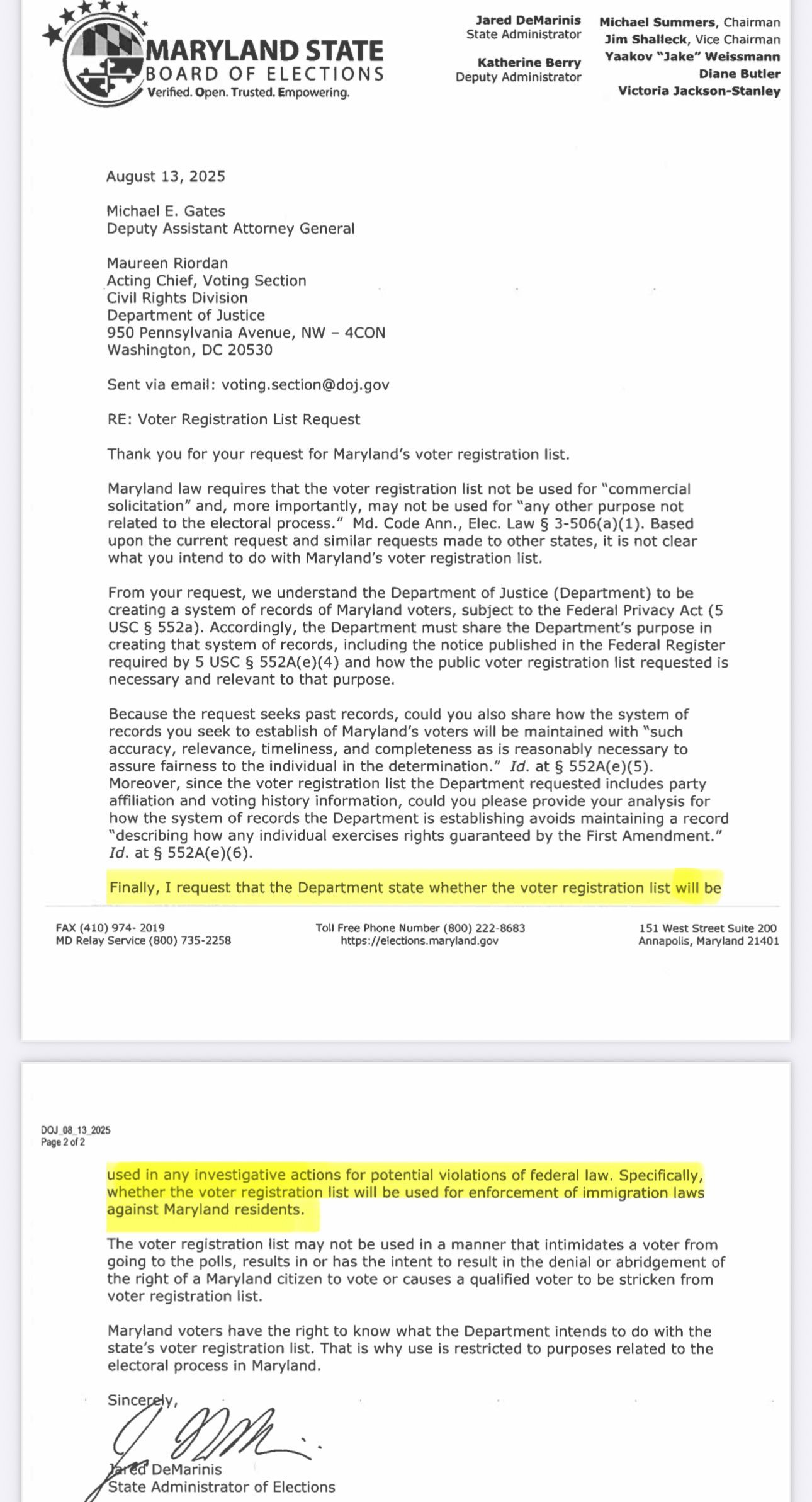
Democrat opposition, claiming disenfranchisement of the 9% lacking documents, crumbles against evidence of successful ID states and Supreme Court precedent. Yet their resistance, epitomized by Maryland’s Jared DeMarinis, betrays a deeper intent. In his August 2025 letter, DeMarinis’ statement “Specifically, whether the voter registration list will be used for enforcement of immigration laws against Maryland residents” gives away the game of Democrats wanting non-citizens registered and voting. His use of “specifically” to call out the federal interest in enforcing federal law to protect citizens’ franchise reveals a defensive posture, suggesting a desire to shield ineligible voters from scrutiny.
This aligns with resistance in states like California and New York, now sued by the DOJ on September 25 for withholding data, and Maryland’s ongoing stalling. Critics, including Fox News and X users like Townhall Columnist Dustin Grage, see this as evidence of cover-up, reinforced by Roberts’ case. Without audits to uncover false negatives, the “exceedingly rare” label for non-citizen voting is misleading, masking the true risk.
Political momentum favors action. With a 53-47 Republican Senate majority and all GOP senators backing S. 145, passage via reconciliation needs only 51 votes. The Roberts scandal, with has driven public support to 68% (Rasmussen, September 29). Though Senate Majority Leader John Thune has not scheduled it, the October 9 pre-recess window or October 21 post-recess offers a chance to act. Vulnerable Democrats like Jon Ossoff (GA) and open-seat contenders in Michigan and Minnesota may refrain from obstructing, wary of 2026 backlash.
The conclusion is inescapable: Without the SAVE Act, states like Maryland will perpetuate systems allowing non-residents and non-citizens to dilute citizen votes. Its upfront verification and federal support are essential to ensure elections reflect only citizens’ will. As the Senate nears its next session, passing the SAVE Act is a moral imperative to preserve American democracy. The time to act is now.
