
Truth as a First Principle
Foreword
In the annals of human inquiry, truth stands as the unyielding foundation upon which reason, morality, and existence itself are built. As a first principle, truth is not merely a concept to be regarded or debated; it is the bedrock of rational thought, the self-evident axiom from which all coherent discourse emerges. Without truth, arguments dissolve into absurdity, knowledge becomes illusory, and the moral fabric of society frays. This synthesizes a profound discussion on this theme, drawing upon three enduring pillars: Merlin’s solemn warning from the film Excalibur, J.R.R. Tolkien’s mythic narrative in The Lord of the Rings, and Pontius Pilate’s pivotal question to Christ in the Gospel of John. These pillars, though disparate in origin-mythic, literary, and biblical-converge to illuminate truth’s indispensability. Supported by historical, philosophical, and theological insights, this work explores how lies erode reality, how truth sustains cosmic order, and how its rejection invites chaos. Let us embark on this exhaustive exploration, affirming truth not as optional but as the first principle that anchors all.
Chapter 1: Defining Truth as a First Principle
First principles, as articulated by Aristotle, are the indemonstrable foundations of knowledge-self-evident truths that underpin all reasoning, such as the law of non-contradiction (a thing cannot be and not be in the same sense). Truth, in this vein, is the alignment of thought or statement with reality, serving as the ultimate arbiter of validity. Philosophically, it encompasses theories like correspondence (truth matches facts), coherence (truth fits a consistent system), and pragmatism (truth is what proves efficacious). Yet, as a first principle, truth transcends these; it is the precondition for any theory, for without assuming truth’s existence, no rational pursuit can commence.
In epistemology, truth is the goal of inquiry, as in Descartes’ cogito ergo sum, where the truth of self-existence rebuilds philosophy from doubt. Ethically, truth undergirds systems like Kant’s Categorical Imperative, where lying undermines autonomy. Metaphysically, truth ties to being itself, as in Aquinas’ view that truth is convertible with being-lies, then, assault existence. This posits truth not as derivable but as axiomatic: denying it presupposes it, rendering skepticism self-refuting. The three pillars exemplify this: Merlin warns of truth’s cosmic necessity, Tolkien embeds it in narrative order, and Pilate confronts it incarnate, only to betray it for expediency.
Chapter 2: Pillar I – Merlin’s Warning: Lies as the Murder of the World
Merlin’s admonition in Excalibur-“It must be truth above all. When a man lies, he murders some part of the world”-crystallizes truth as a first principle in Arthurian legend. Delivered to the nascent King Arthur, it elevates truth above virtues like courage or loyalty, framing it as the guardian of cosmic harmony. The film, directed by John Boorman, adapts this from Arthurian mythology, where Merlin embodies ancient wisdom bridging pagan mysticism and Christian order. This expresses existential anguish, portraying lies as spiritual homicide that hollows life into “pale deaths,” yearning for divine redemption.
Philosophically, Merlin warning posits lies as ontological violence. Lies fracture reality’s unity, akin to Plato’s shadows deceiving the cave-dwellers or Heidegger’s concealment of being. In Excalibur, deceit-Uther’s magical impersonation, Morgana’s manipulations, Lancelot’s adultery-blights the land, causing barrenness and war, literalizing the “murder” of the world’s vitality. As a first principle, truth here is the life-force; its violation disrupts the Fisher King motif, where the monarch’s integrity mirrors the realm’s health.
Ethically, the quote aligns with virtue ethics, where truthfulness fosters flourishing. Psychologically, it echoes Jung’s shadow: repressed truths breed inner destruction. In modern resonance, popularized by Metallica’s “To Live Is to Die” (a tribute to bassist Cliff Burton), it critiques societal falsehoods, from political propaganda to personal betrayals. Thus, Merlin’s pillar affirms truth as foundational: without it, reason falters, morality decays, and existence dims.
Chapter 3: Pillar II – Tolkien’s Narrative: Truth Embodied in Middle-earth
J.R.R. Tolkien’s The Lord of the Rings embodies truth as a first principle through its mythic structure, where honesty sustains order and deceit corrodes creation. Tolkien, a devout Catholic philologist, infused his sub-creation with moral and religious truths, as he wrote in a 1951 letter to Milton Waldman: “Myth and fairy-story must, as all art, reflect and contain in solution elements of moral and religious truth (or error), but not explicit, not in the known form of the primary ‘real’ world.” He aimed for “the elucidation of truth and the encouragement of good morals,” viewing myths as vehicles for deeper realities.
In the narrative, truth manifests as integrity and oath-keeping. Gandalf’s unflinching honesty-warning of the Ring’s perils-grounds the Fellowship’s reason, while Saruman’s lies corrupt Isengard, “murdering” Fangorn’s ancient harmony. Sauron’s deceit, embodied in the One Ring’s false promises, blights Middle-earth, turning Mordor into a wasteland of falsehood. Similarly, Gríma Wormtongue’s poisonous lies to King Théoden in The Two Towers weaken Rohan, whispering falsehoods that age the king and sow doubt, as when he labels Gandalf “Láthspell” or “Ill-news,” saying, “Late is the hour in which this conjurer chooses to appear. Láthspell I name you, Ill-news; and ill news is an ill guest they say.” Wormtongue’s deceptions nearly destroy the kingdom by isolating Théoden from allies and advising inaction against Saruman’s threats, “murdering” Rohan’s vitality and resolve. Gandalf’s intervention exposes these lies, restoring Théoden with truthful counsel-“Verily… that way lies our hope, where sits our greatest fear”-and revitalizing the realm, echoing Merlin’s notion that truth heals what lies destroy. Frodo and Sam’s truthful bond sustains the quest; Gollum’s duplicity fractures his soul, illustrating lies as self-murder. Aragorn’s embrace of his true identity unites allies, contrasting Denethor’s palantír-fed delusions, which nearly doom Gondor.
Tolkien’s letters deepen this: In Letter 246, he discusses Frodo’s “failure” under the Ring’s pressure, not as moral lapse but as inevitable, emphasizing mercy over judgment-a truthful acknowledgment of human frailty. On evil, he grappled with Orcs’ morality, rejecting absolute depravity to preserve free will, reflecting truth’s nuance. His broader legendarium, from The Silmarillion‘s Music of the Ainur, portrays truth as Ilúvatar’s harmonious will; Morgoth’s discord introduces lies, disrupting cosmic order. Tolkien’s faith in Christ underpins this: “His faith was in Jesus Christ,” informing truth as redemptive.
As a first principle, truth in Tolkien is metaphysical: Lies “murder” the world’s essence, as in the Shire’s scouring, while truth’s triumph-eucatastrophe-restores hope. This pillar shows truth as the rational foundation for morality, resisting evil’s irrationality.
Chapter 4: Pillar III – Pilate’s Question: The Encounter with Truth Incarnate
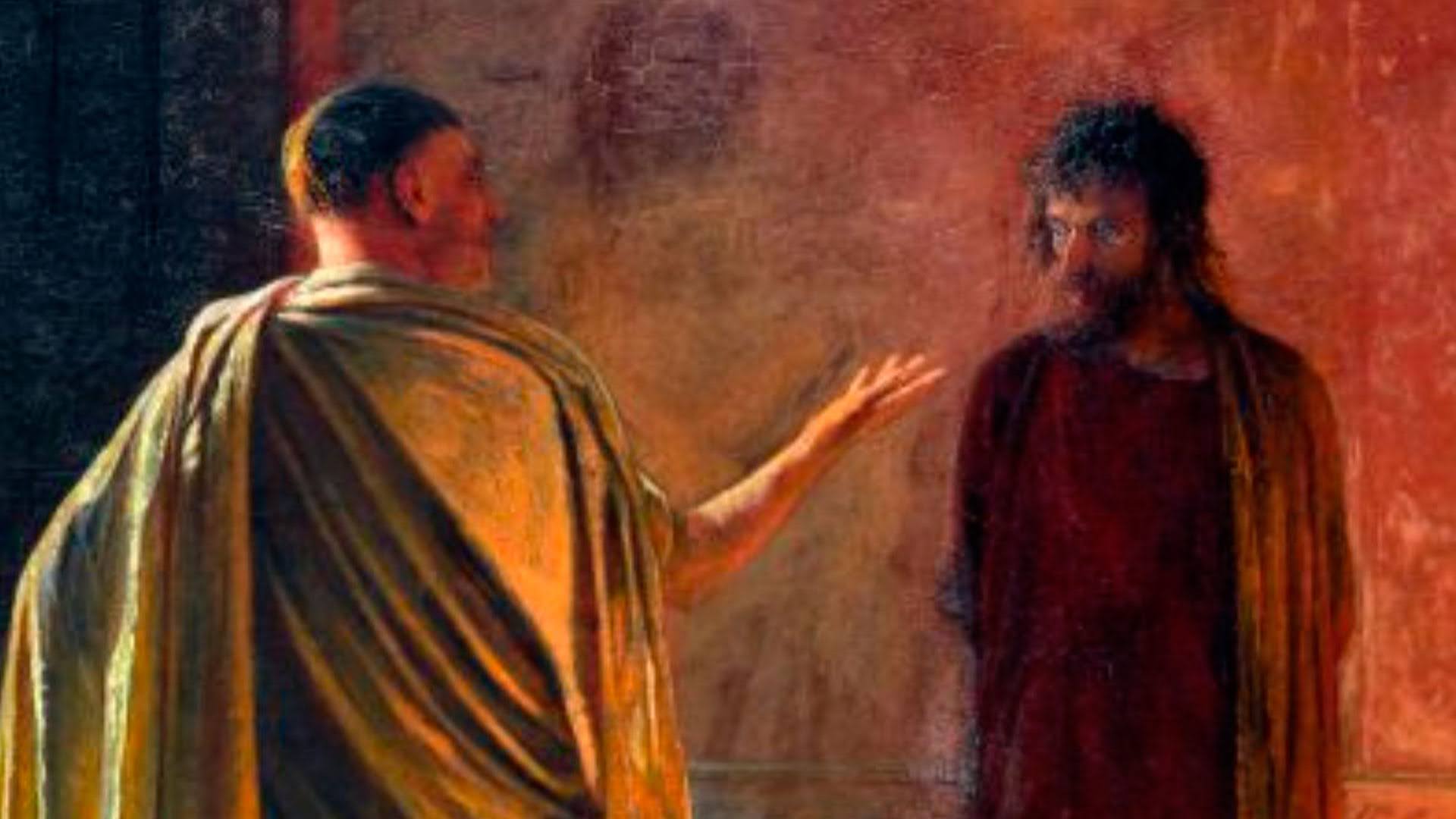
Pontius Pilate’s query, “Quid est veritas?” (“What is truth?”), in John 18:38, confronts truth as a first principle in its most profound form: incarnate in Jesus Christ. During Jesus’ trial, Pilate-Rome’s pragmatic prefect-asks this after Jesus asserts his mission to “testify to the truth” (John 18:37). Commentaries interpret it as cynical or dismissive, not a genuine quest: Pilate, indifferent to absolute truth, prioritizes political expediency. He declares Jesus innocent thrice (John 18:38; 19:4-6) yet orders his execution, yielding to the crowd’s pressure: “If you release this man, you are no friend of the emperor” (John 19:12).
Theologically, John’s Gospel positions truth as relational and divine-Jesus is “the way, the truth, and the life” (John 14:6), embodying Hebrew ’emeth (faithfulness). Pilate’s question ironizes his blindness: Truth stands before him, yet he rejects it, “murdering” justice by crucifying innocence. This fulfills prophecy but exposes human complicity in falsehood. Philosophically, it echoes relativism-Pilate’s Roman context viewed truth as factual, not revelatory-yet John’s narrative affirms truth’s objectivity, guided by the “Spirit of truth” (John 16:13).
As a first principle, Pilate’s betrayal underscores truth’s inescapability: Ignoring it fractures reason and invites moral ruin, aligning with the pillar’s warning that rejecting truth “murders” the world’s order.
Chapter 5: Synthesis – Interweaving the Pillars
In synthesizing the three pillars-Merlin’s warning, Tolkien’s narrative, and Pilate’s question-we uncover a profound convergence on truth as a first principle, illuminating its role as the indispensable foundation for reason, morality, and metaphysical existence. These disparate sources, spanning mythic legend, modern fantasy, and biblical history, weave a tapestry that affirms truth’s axiomatic nature: self-evident, indemonstrable, and essential to all coherent reality. Lies, across these pillars, emerge not as mere errors but as acts of existential violence, eroding the world’s harmony and underscoring truth’s restorative power. To expand this synthesis, we examine pairwise interconnections, thematic parallels, and collective implications, drawing on philosophical analyses, theological insights, and historical contexts to deepen our understanding.
Pairwise Interconnections: Bridging the Pillars
The pillars interconnect through shared motifs of deception’s destructiveness and truth’s redemptive force, often rooted in mythological and theological traditions that resonate across their distinct narratives.
Merlin and Tolkien: Mythic Mentors and Cosmic Order
Merlin’s warning in Excalibur finds striking parallels in Tolkien’s The Lord of the Rings, particularly in their portrayal of truth as the guardian of natural and moral harmony. Both feature wise mentors-Merlin for Arthur, Gandalf for Aragorn-who guide reluctant leaders toward truthful leadership amid chaos. Merlin’s quote posits lies as “murdering” the world’s vitality, much as Tolkien depicts Sauron’s deceit blighting Middle-earth’s landscapes, from Mordor’s wastelands to Isengard’s deforested ruins. In Excalibur, deceit disrupts the Fisher King motif, where the monarch’s integrity mirrors the realm’s health, causing barrenness through lies like Uther’s magical impersonation or Morgana’s manipulations. Similarly, Tolkien’s Ilúvatar’s harmonious Music in The Silmarillion is fractured by Morgoth’s discordant lies, introducing evil that “murders” creation’s essence.
Philosophical analyses highlight these as ontological critiques: lies conceal being, fracturing reality’s unity in a Heideggerian sense. Tolkien, influenced by Arthurian elements-such as Excalibur paralleling Andúril-reimagines truth as a metaphysical first principle. Honest oaths, like Sam’s vow to Frodo (“I made a promise, Mr. Frodo”), sustain the quest, while duplicity, like Gollum’s internal lies, leads to self-destruction. Both narratives emphasize truth as the life-force of cosmic order, where its violation-through Lancelot’s adultery or Saruman’s betrayal-literalizes Merlin’s warning of existential murder. This connection underscores truth’s role as the rational foundation for leadership and harmony, bridging medieval myth with modern fantasy.
Tolkien and Pilate: Myth Pointing to Incarnate Truth
Tolkien’s views on mythology as reflecting deeper truths bridge seamlessly to Pilate’s encounter with Christ, where truth is personified in its ultimate form. Influenced by C.S. Lewis’s concept of Christianity as the “true myth”-where pagan stories prefigure biblical reality-Tolkien saw myths as fragmented glimpses of divine truth, culminating in Christ’s incarnation. Pilate’s dismissive “What is truth?” mirrors the skepticism of Tolkien’s characters like Denethor, who, blinded by Sauron’s half-truths via the palantír, rejects hope and invites despair, “murdering” Gondor’s resolve. In contrast, Gandalf’s honest wisdom-warning of the Ring’s perils in The Fellowship of the Ring-echoes Jesus’ testimony to truth (John 18:37), grounding reason against illusion.
Theological connections abound: Tolkien’s eucatastrophe, the sudden redemptive turn (e.g., the Ring’s destruction), parallels the resurrection answering Pilate’s question, affirming truth’s triumph over falsehood. Both emphasize truth as relational: in Tolkien, bonds of trust, like the Fellowship’s unity, sustain order; in John, truth is embodied in Christ, whom Pilate rejects for political expediency, fracturing moral integrity. Tolkien’s Catholic faith, expressed in his letters (e.g., Letter 142, “I am a Christian, and indeed a Roman Catholic”), informs this parallel, seeing Christ’s truth as the fulfillment of mythic yearnings. Philosophically, both critique the irrationality of deceit: Sauron’s lies enslave, as Pilate’s actions betray justice, highlighting truth as the rational anchor for moral action.
Merlin and Pilate: Skepticism and the Cost of Indifference
Merlin’s metaphysical dipole warning resonates with Pilate’s cynical query, both highlighting the human failure to grasp truth’s profundity and its consequences. In Excalibur, Merlin urges Arthur to prioritize truth to avoid cosmic murder, emphasizing its necessity for the kingdom’s survival. Pilate, facing Truth incarnate in Jesus, dismisses it with “Quid est veritas?” and proceeds to crucify innocence, “murdering” justice itself. Pilate’s spiritual blindness exposes his complicity in sin.
Philosophically, both critique relativism: Merlin’s truth as the life-force counters Pilate’s pragmatic indifference, where truth is subordinated to Roman power, aligning with modern analyses of the question as a prototype for postmodern doubt. The Arthurian Christian overlay in Excalibur, where Merlin bridges pagan to Christian eras, parallels John’s Gospel, where truth transitions from abstract to revelatory in Christ. Both narratives underscore the cost of rejecting truth: Merlin’s barren lands and Pilate’s unjust execution illustrate how lies or indifference “murder” the world’s moral and cosmic order, affirming truth’s role as a first principle essential to reason and existence.
Thematic Parallels: Truth’s Foundational Triad
Collectively, the pillars affirm truth’s role across three interconnected domains, reinforcing its status as a first principle through their shared thematic threads:
Reason: Enabling Rational Discourse
As a first principle, truth underpins logical coherence, enabling rational discourse across all three pillars. In Merlin’s warning, truth is the rational foundation for Arthur’s kingship; lies, like Morgana’s deceptions, fracture discourse, leading to Camelot’s collapse. In Tolkien’s narrative, honest councils, such as the Council of Elrond, ground strategic decisions in truth, while Sauron’s lies sow confusion, undermining reason. Pilate’s skeptical “What is truth?” halts dialogue with Jesus, reflecting a refusal to engage rationally with truth incarnate, leading to irrational injustice. Across these, truth’s denial is self-refuting: Gollum’s internal lies, Pilate’s indifference, and Morgana’s manipulations all presuppose truth to be coherent, affirming its axiomatic necessity for reason. Philosophically, this aligns with Aristotle’s non-contradiction principle and Descartes’ foundational certainty, where truth enables inquiry, from scientific method to philosophical debate.
Morality: Upholding Integrity and Virtue
Truth undergirds ethical systems, fostering trust and autonomy, while lies erode moral integrity, as seen across the pillars. Merlin’s warning positions truth as the supreme virtue, above courage or loyalty; deceit, like Lancelot’s adultery, “murders” Camelot’s moral fabric, leading to societal decay. Tolkien’s characters embody this: Sam’s truthful loyalty sustains Frodo, while Boromir’s lapse or Saruman’s betrayal invites chaos, “murdering” trust and alliances. Pilate’s execution of an innocent man, despite affirming his innocence, betrays conscience, “murdering” justice itself. Ethically, this aligns with Kant’s Categorical Imperative, where lying universalizes deceit, collapsing moral order, and virtue ethics, where truthfulness fosters flourishing. The pillars collectively warn that lies harm not only others but the liar’s integrity, leading to spiritual pale deaths or societal ruin (Tolkien, Pilate).
Metaphysics: Sustaining Being and Existence
Truth is convertible with being, sustaining metaphysical existence across the pillars. Merlin’s warning ties truth to the life-force of the world, disrupted by lies that cause barrenness, as in the Fisher King motif. Tolkien’s Ilúvatar’s harmonious Music represents truth’s cosmic order, fractured by Morgoth’s lies, which “murder” Middle-earth’s vitality, from Mordor’s wastelands to the Shire’s scouring. Pilate’s rejection of Christ, the embodiment of divine truth, “murders” justice and divine order, yet fulfills redemptive prophecy. Philosophically, this echoes Aquinas’ view that truth and being are one; lies assault existence itself, concealing reality in a Heideggerian sense. The pillars portray truth as the metaphysical glue of creation, where its violation blights the world, and its restoration-through the Grail, eucatastrophe, or resurrection-redeems it.
Collective Implications: Truth’s Indispensability and Redemption
The pillars collectively affirm truth’s indispensability as a first principle, with profound implications for human thought and action. Lies, across these narratives, are not mere missteps but acts of existential violence: Merlin’s “murder” of the world’s vitality, Tolkien’s blighted landscapes, and Pilate’s crucified innocence all illustrate how deceit fractures reason, morality, and being. Yet, each pillar offers a path to redemption, underscoring truth’s enduring power. The yearning for the kingdom of salvation reflects a hope for restoration amid falsehood’s despair, paralleled by the quest for the Holy Grail in Arthurian legend, which seeks to heal the land through truth’s pursuit. Tolkien’s eucatastrophe-the sudden joyful turn, as in the Ring’s destruction-restores Middle-earth’s hope, affirming truth’s triumph over lies. John’s resurrection narrative answers Pilate’s question, vindicating truth incarnate and offering eternal redemption.
Historically, these narratives resonate with their contexts: Merlin’s warning amid Arthurian legend’s wars and devastation, Tolkien’s myth-making post-World Wars, and John’s Gospel in a Roman world of competing truths. Philosophically, they counter relativism-Merlin’s absolute truth, Tolkien’s moral clarity, and John’s divine revelation reject the notion that truth is subjective, affirming its objectivity as a first principle. Theologically, they converge on truth as redemptive: Merlin’s Christian undertones, Tolkien’s Catholic eucatastrophe, and John’s Christological truth point to a transcendent reality that restores what lies destroy.
In modern contexts the pillars’ relevance is acute. Social media platforms like X highlight ongoing debates about misinformation, where lies “murder” societal trust, echoing Merlin’s warning. Tolkien’s ecological and moral insights critique industrialization and deceit, while Pilate’s question challenges contemporary skepticism in politics and media. Collectively, these pillars call for a renewed commitment to truth as the foundation for rational discourse, moral integrity, and existential harmony, urging vigilance against the “pale deaths” of falsehood.
Chapter 6: Conclusion – Implications for Reason, Morality, and Existence: A Recapitulation
We reaffirm the central thesis: truth is not merely a philosophical abstraction or a cultural construct but an unassailable first principle-the self-evident foundation upon which all rational, moral, and existential structures stand. To recapitulate the journey through the preceding chapters, we begin with the definitional groundwork laid in Chapter 1, which establishes truth as the axiomatic bedrock of knowledge, drawing from Aristotelian first principles, Cartesian doubt, Kantian ethics, and Aquinian metaphysics. There, we posited that truth’s denial is self-refuting, as any argument against it implicitly relies on its existence, setting the stage for the three pillars to exemplify its indispensability.
Chapter 2 delves into the first pillar, Merlin’s warning from Excalibur. This pillar portrays truth as the supreme virtue for leadership and harmony, warning that lies inflict ontological violence, “murdering” the world’s vitality as seen in the film’s blighted landscapes and fractured kingdoms. Philosophically, it aligns with Platonic ideals and Heideggerian unconcealment, while ethically it underscores virtue ethics and psychological integrity, extending to modern critiques of falsehood in society. Merlin’s admonition thus illustrates truth as the life-force of cosmic order, where its absence breeds existential “pale deaths.”
Building on this, Chapter 3 explores the second pillar: Tolkien’s narrative embodiment of truth in The Lord of the Rings. Here, truth manifests through characters’ integrity-Gandalf’s honest counsel, Sam’s loyal vows, Aragorn’s self-revelation-contrasting the destructive deceit of Sauron, Saruman, and Gollum, which corrupts lands, souls, and alliances. Informed by Tolkien’s Catholic faith and letters, this pillar weaves truth into metaphysical harmony, as in Ilúvatar’s Music disrupted by Morgoth’s discord, and moral redemption via eucatastrophe. Tolkien’s sub-creation demonstrates truth as the rational anchor against evil’s irrationality, where lies “murder” Middle-earth’s essence, reinforcing the first principle’s role in sustaining hope and order.
Chapter 4 introduces the third pillar: Pilate’s cynical question “Quid est veritas?” during Christ’s trial, as depicted in John’s Gospel. This encounter with truth incarnate-Jesus as the embodiment of divine ’emeth-highlights irony and betrayal, as Pilate affirms innocence yet orders execution for political expediency. Theologically, it contrasts worldly power with revelatory truth, guided by the Spirit; philosophically, it critiques relativism. Pilate’s actions “murder” justice, exposing human complicity in falsehood.
Chapter 5 synthesizes these pillars, interweaving their themes: Merlin’s cosmic murder of the world by lies finds echoes in Tolkien’s blighted realms and Pilate’s crucified innocence. All converge on truth as the unifying force-harmonious in Merlin’s myth, creative in Tolkien’s legendarium, relational in John’s theology, Tolkien’s joyful turns, and Christ’s resurrection. This integration underscores truth’s foundational triad: enabling rational discourse, upholding moral integrity, and sustaining metaphysical being.
From this recapitulation, the implications for reason, morality, and existence emerge with clarity. For reason, truth is the cornerstone; without it, logic devolves into contradiction, as seen in Merlin’s fractured unity, Tolkien’s deceptive illusions, and Pilate’s skeptical indifference. It preserves clarity in inquiry, preventing the self-refuting chaos of relativism and enabling pursuits from scientific method to philosophical dialogue. In an era of misinformation marked by digital deepfakes and polarized narratives-this demands vigilant discernment to safeguard rational thought.
For morality, truth undergirds ethical systems, fostering trust and autonomy; lies erode this, as Merlin warns of spiritual homicide, Tolkien depicts in corrupted oaths, and Pilate enacts through unjust execution. It serves as the compass for virtues like honesty and justice, warning that deceit not only harms others but “murders” one’s own integrity, leading to societal decay. Embracing truth promotes flourishing, aligning actions with reality and countering the moral relativism that justifies expediency over principle.
For existence itself, truth is metaphysical sustenance; its violation assaults being, blighting the world as in Merlin’s barren lands, Tolkien’s wastelands, and Pilate’s denial of divine revelation. As a first principle convertible with being, truth affirms the harmony of creation, offering redemption amid falsehood’s ruins. In contemporary contexts, this calls for a renewed commitment to truth-seeking, resisting the “pale deaths” of inauthentic lives.
Ultimately, these pillars urge eternal vigilance: As Merlin warns, Tolkien illustrates, and Pilate exemplifies, lies murder the world-but truth redeems it. Let this be our guiding axiom, a call to live by truth as the unyielding first principle, ensuring reason’s light, morality’s strength, and existence’s enduring harmony.