
Update to My Originalist Critique
Federal Circuit Grants Stay and Expedites En Banc Review of Trump Tariff Cases
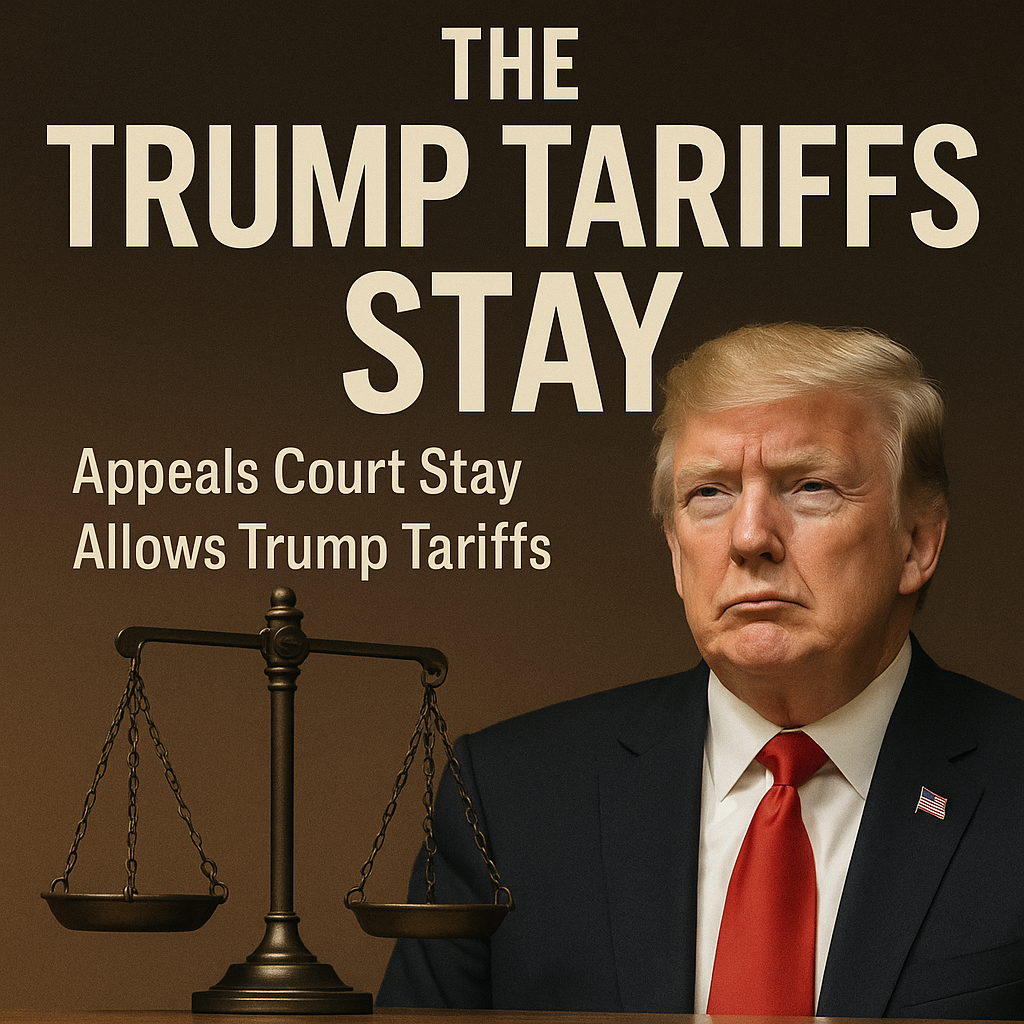 In my article “The Trump Tariffs Stay”, I provide below an expanded analysis of my original points, incorporating today’s Federal Circuit order granting a stay and expediting en banc review in V.O.S. Selections, Inc. v. Trump (2025-1812) and State of Oregon v. Trump (2025-1813). This expansion deepens my originalist critique, reflects the updated legal developments, and maintains my first-person perspective as the article’s author.
1. My Originalist Concern: Separation of Powers and Executive Authority
In my article, I argued that the Trump tariff cases raise critical questions about the separation of powers, a foundational principle for originalist constitutional interpretation. From an originalist perspective, the Constitution assigns distinct roles to each branch, with Congress holding the power to regulate commerce with foreign nations under Article I, Section 8, Clause 3, and the President wielding executive authority under Article II. I suggested that President Donald J. Trump’s tariffs, imposed through Executive Orders, test the limits of executive power, particularly whether the President can act unilaterally in areas traditionally requiring congressional approval or delegation.
The Federal Circuit’s June 10, 2025, order strengthens my analysis. By granting a stay of the United States Court of International Trade’s (CIT) injunctions, the court temporarily upholds the Executive Orders, reflecting a cautious approach to limiting presidential action before a full merits review. This aligns with my observation that originalists are skeptical of judicial overreach that prematurely curtails executive power, especially when Congress has delegated significant trade authority to the President (e.g., through the Trade Act of 1974 or Section 232 of the Trade Expansion Act of 1962). The court’s citation of Nken v. Holder (556 U.S. 418, 426 (2009)) and Trump v. Wilcox (145 S. Ct. 1415 (2025)) emphasizes balancing equities, suggesting that the judiciary is hesitant to disrupt executive functions without clear constitutional grounds.
Expanding on my point, the Federal Circuit’s decision to expedite en banc review highlights the stakes of this separation-of-powers dispute. The en banc process, involving all non-recused active judges, underscores that the court views these cases as presenting “issues of exceptional importance” (as stated in the order). As an originalist, I see this as an opportunity to clarify the constitutional boundaries of executive authority in trade policy. The court may examine whether Congress’s delegations to the President comply with the non-delegation doctrine, which prohibits Congress from transferring its legislative powers without an intelligible principle. If these delegations are deemed overly broad, as I hinted in my article, the tariffs could be struck down, reinforcing Congress’s constitutional role in regulating commerce.
2. The Judiciary’s Role in Checking Executive Power
In my article, I critiqued the CIT’s injunctions as potentially exceeding the judiciary’s proper role, arguing that courts should defer to the political branches in trade policy unless a clear constitutional violation exists. I noted that originalists favor judicial restraint, particularly when executive actions are grounded in statutory authority or national security rationales, as Trump’s tariffs often are. However, I acknowledged that plaintiffs-private companies like V.O.S. Selections, Inc., and states like Oregon-contend that the tariffs exceed statutory limits and encroach on Congress’s commerce powers, raising valid constitutional concerns.
The Federal Circuit’s stay order supports my call for judicial caution. By pausing the CIT’s injunctions pending appeal, the court avoids prematurely invalidating executive action, consistent with my originalist preference for limited judicial intervention in politically sensitive areas. The order’s reference to Trump v. Int’l Refugee Assistance Project (582 U.S. 571, 580 (2017))-which stresses that interim equitable relief should balance equities rather than resolve rights-reflects this restraint. The stay allows the tariffs to remain in effect while the court evaluates the merits, preserving the executive’s role in trade policy.
Expanding on my analysis, the en banc review signals that the Federal Circuit is prepared to issue a definitive ruling on the judiciary’s role in tariff disputes. As an originalist, I am particularly interested in whether courts should strictly interpret statutes delegating trade authority or defer to executive discretion, especially when national security is invoked. The involvement of twelve states in State of Oregon v. Trump introduces a federalism dimension, as states argue that the tariffs harm their economies, potentially implicating the Tenth Amendment. I believe an originalist analysis should consider whether the federal government’s actions infringe on state sovereignty, complicating the judiciary’s task of balancing constitutional principles.
3. Congressional Delegation and the Non-Delegation Doctrine
In my article, I briefly discussed the non-delegation doctrine, an originalist principle that prohibits Congress from delegating its legislative powers to the executive without clear guidance. I suggested that the statutes authorizing Trump’s tariffs might be vulnerable to non-delegation challenges, as they grant the President broad discretion to impose tariffs for economic or security reasons. However, I noted that modern courts have been reluctant to enforce the non-delegation doctrine rigorously, often upholding expansive delegations.
The Federal Circuit’s order does not directly address the non-delegation doctrine, but the en banc review provides an opportunity to explore this issue, as I anticipated. The plaintiffs in V.O.S. Selections, Inc. v. Trump and State of Oregon v. Trump likely argue that the tariffs exceed delegated authority or that the delegations are constitutionally flawed. For instance, if the tariffs rely on Section 232 (national security) or Section 301 of the Trade Act of 1974 (unfair trade practices), the court may assess whether these statutes provide an “intelligible principle” to constrain executive discretion.
Expanding on my original point, an originalist critique would emphasize that the non-delegation doctrine is rooted in the Constitution’s text and structure. Article I vests “all legislative Powers” in Congress, and excessive delegation undermines this allocation. Recent Supreme Court decisions, such as Gundy v. United States (139 S. Ct. 2116 (2019)) and West Virginia v. EPA (142 S. Ct. 2587 (2022)), indicate growing interest in reviving the non-delegation doctrine, particularly among originalist justices. I believe the Federal Circuit could draw on these precedents to evaluate the tariff statutes’ constitutionality. A ruling invalidating the delegations would align with my originalist view, reasserting Congress’s primary role in trade policy and limiting executive overreach.
4. Practical and Economic Implications in My Originalist Framework
In my article, I highlighted the economic impact of the tariffs, noting that plaintiffs argue they raise costs for businesses and consumers while disrupting trade relationships. As an originalist, I argued that economic policy disputes are primarily for the political branches to resolve, not the courts, unless a constitutional boundary is crossed. The Federal Circuit’s stay order aligns with this view by preserving the tariffs’ effect pending appeal, avoiding immediate economic disruption while legal issues are resolved.
Expanding on this, the diverse plaintiffs-private companies (e.g., V.O.S. Selections, Inc., Plastic Services and Products, LLC) and twelve states (e.g., Oregon, New York)-underscore the tariffs’ widespread economic impact. While economic consequences are secondary to constitutional principles in my originalist framework, they inform the equitable considerations in granting a stay. The Federal Circuit’s application of Nken v. Holder’s stay factors (likelihood of success, irreparable harm, balance of equities, and public interest) suggests that the court weighed the government’s interest in maintaining trade policy against the plaintiffs’ economic harms. The stay indicates that the court found the government’s arguments substantial, as noted in the order (“Both sides have made substantial arguments on the merits”).
The en banc review’s expedited schedule, with oral arguments set for July 31, 2025, reflects the urgency of resolving these economic and constitutional questions, as I anticipated in my article. For me, as an originalist, the court’s role is to ensure that the political branches operate within constitutional limits, not to dictate trade policy outcomes. The en banc proceeding may clarify whether the tariffs comply with statutory and constitutional requirements, guiding future executive actions in trade policy.
5. Federalism and State Interests
While my article focused primarily on separation of powers, the State of Oregon v. Trump case introduces a federalism dimension that I believe warrants further exploration. The twelve plaintiff states argue that the tariffs harm their economies, potentially implicating the Tenth Amendment and the principle that the federal government cannot unduly interfere with state powers. As an originalist, I view federalism as a critical constitutional safeguard, ensuring that states retain sovereignty over matters not delegated to the federal government.
The Federal Circuit’s order does not explicitly address federalism, but the en banc review may consider whether the tariffs infringe on state interests, as I would expect. States like New York and Colorado may argue that the tariffs disrupt local industries (e.g., agriculture, manufacturing) or increase consumer costs, effectively forcing states to bear the economic burden of federal policy. In my originalist analysis, the court should examine whether the tariffs exceed federal authority under the Commerce Clause or violate the Tenth Amendment by encroaching on state prerogatives. The court’s decision could set a precedent for how federal trade policies interact with state sovereignty, a key issue for originalist scholars like myself.
Conclusion
The Federal Circuit’s June 10, 2025, order granting a stay and expediting en banc review in V.O.S. Selections, Inc. v. Trump and State of Oregon v. Trump amplifies the constitutional questions I raised in my article. From my originalist perspective, these cases highlight the delicate balance between executive authority, congressional power, and judicial oversight in trade policy. The stay reflects judicial restraint, preserving the Executive Orders’ effect while the court evaluates their constitutionality. The en banc review offers a critical opportunity to address separation of powers, the non-delegation doctrine, and federalism, potentially reshaping the constitutional framework for executive action in trade.
As an originalist, I believe the outcome will depend on whether the tariffs align with the Constitution’s text, structure, and original meaning. A ruling upholding the tariffs could affirm broad executive discretion under existing delegations, while a decision striking them down could reinvigorate the non-delegation doctrine and Congress’s commerce powers. The Federal Circuit’s expedited review underscores the urgency of resolving these issues, ensuring that the judiciary fulfills its role as a constitutional check without usurping the political branches’ authority, as I emphasized in my original critique.
