
Narrative Analysis
The Legacy Media and Social Media’s Role in the Biden Hoax Campaign and Administration (2019–2025)
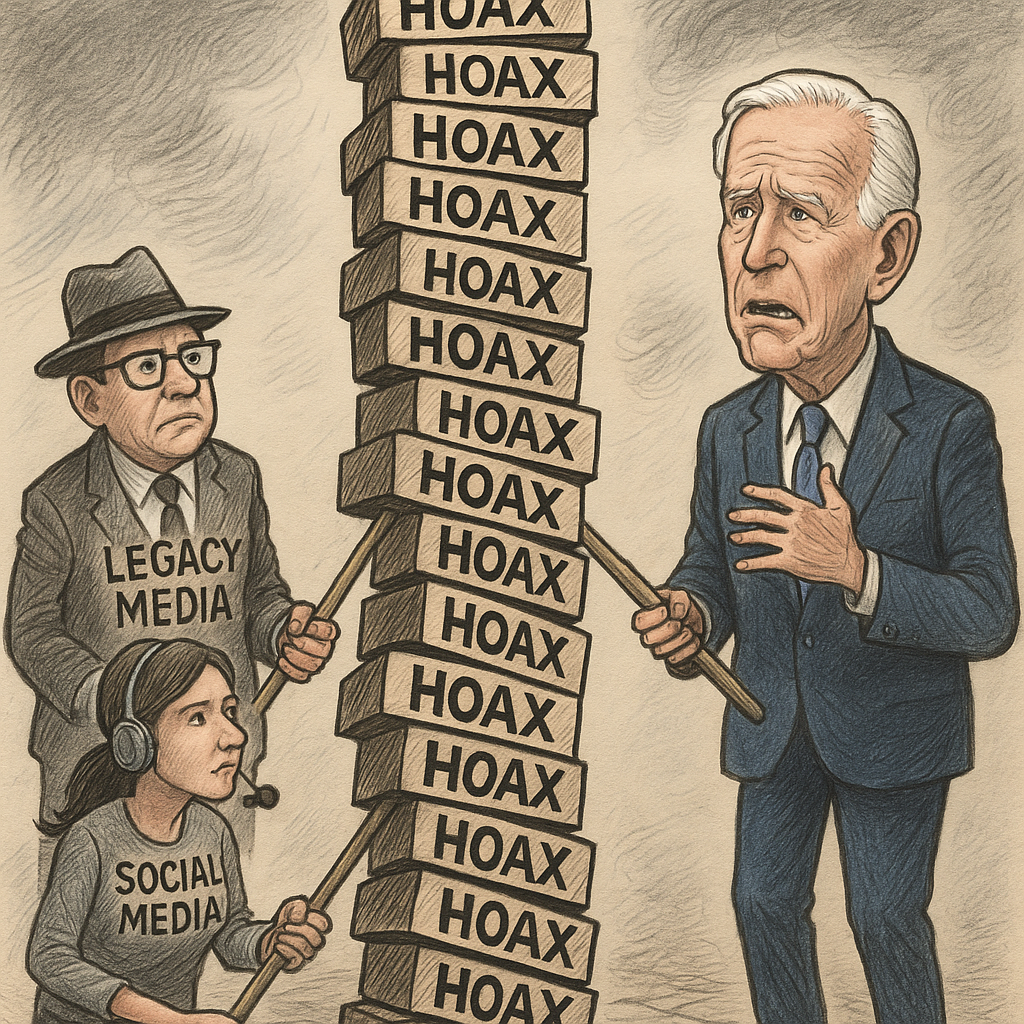 Across the turbulent U.S. political landscape, David Strom’s Monday HotAir article unveils a hoax campaign and administration, accusing Joe Biden’s inner circle-a “Politburo” of aides and family-of crafting a false reality portraying Biden as a competent, untainted leader despite cognitive decline and scandals, notably the Hunter Biden laptop story. This deception, amplified by complicit legacy media and social media, forms a “stack of hoaxes” to secure Biden’s 2020 victory and sustain his presidency. The narrative unfolds in four acts: the 2019 Trump impeachment, sparked by whistleblower Eric Ciaramella; the 2020 laptop story suppression, including a pivotal moment on Jake Tapper’s show; administration “hoax moments” (2021–2024); and a 2025 “smoke-and-turn” maneuver involving the Axios leak of the Robert Hur audio (May 16, 2025) and Biden’s alleged prostate cancer diagnosis announcement (May 19, 2025). The October 19, 2020, letter from 51 intelligence officials in Politico and Facebook’s censorship of Ciaramella’s name-despite its public availability in Congressional testimony-are linchpins. Using self-justification, self-actualization, and self-realization, this analysis, drawing on HotAir, JamesKay.online, a summary on the impeachment-laptop connection, and web sources, scrutinizes the legacy media and social media’s role, including Tapper and Alex Thompson, authors of the book,
Act I: The Prelude-Impeachment, Ciaramella’s Whistleblower Role, and the Hoax’s Genesis (2019)
The narrative opens in late 2019 with the first impeachment of Donald Trump, ignited by a July 25 phone call with Ukrainian President Volodymyr Zelenskyy, where Trump urged investigations into Joe and Hunter Biden’s ties to Burisma Holdings, a Ukrainian energy firm where Hunter served on the board. Democrats allege Trump withheld $391 million in military aid to pressure Ukraine into probing Biden, his potential 2020 rival, and a discredited theory of Ukrainian 2016 election interference. Eric Ciaramella, a CIA officer with Ukraine expertise, files a whistleblower complaint on August 12, 2019, alleging Trump abused power. Coordinating with Rep. Adam Schiff’s staff, Ciaramella’s complaint sparks a September 2019 impeachment inquiry. His identity, protected by law, leaks via RealClearInvestigations (October 2019) and appears in Congressional testimony transcripts, yet legacy media avoid naming him, citing safety, and social media platforms censor his name RealClearInvestigations.
On December 18, the House impeaches Trump on two articles: abuse of power (230–197) and obstruction of Congress (229–198). Testimonies from Gordon Sondland, Bill Taylor, and Alexander Vindman suggest a quid pro quo, though Trump denies wrongdoing, BBC News. The Senate, rejecting witnesses like John Bolton, acquits Trump on February 5, 2020: 52–48 on abuse of power (Mitt Romney joins Democrats) and 53–47 on obstruction, The New York Times.
Legacy media-CNN (Tapper’s platform), Politico (Thompson’s then-outlet), The New York Times, The Washington Post-frame Trump’s inquiries as a smear, noting no evidence of Joe Biden’s misconduct. Ciaramella’s role is downplayed, reinforcing the hoax’s genesis. Facebook and YouTube censor posts naming Ciaramella, with Facebook citing its “coordinating harm” policy, despite the public record. The FBI’s unreported seizure of Hunter’s laptop in December 2019 buries potential validation of Trump’s claims. Self-justification-protecting whistleblower safety and avoiding unverified allegations-preserves credibility. Self-actualization drives authoritative coverage, but self-realization falters as biases prioritize narrative. This nonfeasance-not probing the Bidens or Ciaramella’s ties-and misfeasance-biased reporting and censorship-sets the hoax’s foundation.
Act II: The Deception Solidifies-Laptop Suppression, Tapper’s Dismissal of Lara Trump, and Cognitive Cover (2020)
In October 2020, the New York Post publishes a story by Emma-Jo Morris and Gabrielle Fonrouge, alleging Hunter Biden leveraged Joe’s influence for Burisma, based on laptop emails obtained via Rudy Giuliani. Twitter locks the Post’s account for two weeks, citing its “hacked materials” policy, and blocks the article’s URL, suspending users like White House Press Secretary Kayleigh McEnany for sharing it BBC News. Facebook reduces the story’s visibility, citing FBI warnings of Russian disinformation, with executives calibrating to avoid backlash from a potential Biden administration. Legacy media-CNN, The New York Times, The Washington Post, Politico, MSNBC, NPR-dismiss the story as “disinformation,” with Tapper’s CNN segments questioning its credibility and Thompson’s Politico articles ignoring it. NPR avoids it, citing sourcing issues.
On October 19, Politico publishes a letter from 51 former intelligence officials, “Public Statement on the Hunter Biden Emails,” organized by Michael J. Morell, asserting the story resembles a “Russian information operation.” Signers include John Brennan, Leon Panetta, Michael Hayden, James Clapper, and Morell, some Biden endorsers. Not a paid ad the letter was published as an act of journalism, its cautious tone contrasts Politico’s headline, “Hunter Biden story is Russian disinfo,” later called misleading by Clapper. Joe Biden cites it in an October 22 debate, dismissing allegations. The FBI, aware of the laptop’s authenticity, remains silent BBC News.
On October 18, 2020, Lara Trump appears on Tapper’s State of the Union on CNN. Tapper plays a January 2020 clip of Lara Trump saying, “Every time [Biden] comes onstage…I’m like, ‘Joe, can you get it out? Let’s get the words out, Joe,’” implying Biden struggles to speak. Lara Trump insists this reflects Biden’s “very clearly a cognitive decline,” not his stutter, which she claims she was unaware of. Tapper, showing a clip of a 13-year-old Biden supporter with a stutter from the DNC, accuses her of mocking Biden’s stutter, asking, “How do you think it makes little kids with stutters feel?” He interrupts her, saying, “I think you were mocking his stutter…I think you have absolutely no standing to diagnose somebody’s cognitive decline,” and sarcastically ends, “I’m sure it’s from a place of concern” CNN, BBC News. Tapper’s dismissal, using Biden’s stutter as a cudgel, aligns with the campaign’s narrative that Biden’s verbal stumbles were benign, despite concerns raised by Democrats like Cory Booker and Julián Castro in 2019.
Social media censorship extends to Ciaramella: Facebook removes posts naming him, citing “coordinating harm,” despite his identity in testimony RealClearInvestigations. This mirrors the laptop suppression, stifling Biden-related controversies. Biden’s gaffes are framed as a stutter, not decline. Self-justification-combating disinformation and protecting whistleblowers-rationalizes censorship and Tapper’s rebuke. Self-actualization drives influence, but self-realization fails as bias trumps truth. This nonfeasance-not investigating-and misfeasance-censoring, amplifying the letter, and dismissing cognitive concerns-cement Strom’s hoax. JamesKay.online calls this a “cynical” betrayal.
Act III: The Hoax Persists-Administration Moments, Media, and Social Media Compliance (2021–2024)
From 2021–2024, “hoax moments” sustain Biden’s competence narrative, minimized by administration figures and a compliant legacy media, with social media reinforcing suppression:
-
Physical Stumbles: Biden’s falls-Air Force One stairs (March 2021), bicycle (June 2022), Air Force Academy (June 2023)-prompt shorter stairs and Hoka sneakers (2023). Jen Psaki (2021) cites “windy conditions,” Karine Jean-Pierre (2022–2023) mentions “balance issues,” and Andrew Bates calls Hokas “practical” (2023). CNN and The Washington Post downplay as age-related. Social media limits fall videos, citing “misinformation.”
-
Scripted Events: Biden’s press interactions use notecards and pre-selected questions (e.g., March 2021). Jake Sullivan and John Kirby deflect health queries, claiming “engagement” (2022–2023). Jean-Pierre insists Biden is “sharp” (2023). MSNBC and The New York Times normalize scripting. Social media deprioritizes posts questioning autonomy.
-
Cognitive Lapses: Biden calls on deceased Rep. Jackie Walorski (September 2022) and wanders at G7 summits (2022–2023). Jean-Pierre calls these “missteps,” Kirby claims Biden is “present” (2022). CNN and Politico frame as gaffes. Twitter and Facebook shadowban posts, citing “harmful content.”
-
Managed Appearances: Staff control exposure-an Easter Bunny redirects Biden (April 2022), aides usher press away (2021–2023). Psaki and Jean-Pierre cite “logistics,” while The Washington Post sees routine management. Social media limits clips.
-
Sleeping and Wandering: Biden dozes at COP26 (2021) and ASEAN summits (2023), wanders at NATO (2023). Jean-Pierre and Kirby blame “jet lag,” while The New York Times and MSNBC call them “human moments.” Social media suppresses posts.
-
“Cheap Fakes” (June 2024): Before Biden’s faltering June 27 debate, videos of Biden’s confusion are labeled “cheap fakes” by Jean-Pierre, Bates, and Kirby, accusing “misleading edits” (June 17). CNN, The New York Times, and The Washington Post debunk “manipulated” clips, despite unedited footage. Meta throttles videos, amplifying the hoax.
Administration figures-Psaki’s humor, Jean-Pierre’s “context,” Bates’ policy focus, Sullivan and Kirby’s “leadership” claims-deflect scrutiny. Self-justification-privacy and disinformation concerns-excuses inaction. Self-actualization drives compliant coverage, but self-realization fails. This nonfeasance and misfeasance sustain Strom’s hoax.
Act IV: The Hoax Teeters, Yet Endures-Smoke-and-Turn (2025)
In May 2025, the hoax faces its most significant challenge. The Axios leak of the Robert Hur audio on May 16, co-bylined by Thompson, exposes Biden’s memory lapses during a 2023 interview, aligning with Original Sin’s claims of a “Politburo” concealing decline. Legacy media, including The New York Times and CNN, cover it as evidence of long-hidden frailty, with some outlets framing it as a belated reckoning with Biden’s cognitive state. However, on May 19, Biden’s alleged prostate cancer diagnosis announcement shifts the narrative abruptly to sympathetic health coverage, a “smoke-and-turn” maneuver-a naval tactic of evasion through smoke and sharp turns-to deflect scrutiny, weaving a secular haze to obscure the hoax’s exposure.
Weave us a mist, fog weaver
Hide us in shadows, unfathomable
Wall-less maze. A secular haze
This sequence raises critical questions about media complicity. The Hur audio, revealing Biden’s confusion over basic details, directly undermines the competence narrative sustained since 2019. Its release, tied to Original Sin’s promotional cycle, suggests a calculated attempt to address past oversights, yet the media’s coverage remains selective, focusing on the audio’s revelations without interrogating their own role in suppressing earlier evidence, such as the laptop story or cognitive concerns raised by figures like Lara Trump in 2020. The rapid pivot to the cancer diagnosis-covered with empathetic headlines by The Washington Post, The New York Times, and CNN-dilutes the audio’s impact, redirecting public focus to Biden’s health struggles rather than his cognitive capacity. The timing, just three days after the audio leak, mirrors the “cheap fakes” defense of 2024, where evidence of decline was dismissed to protect the narrative. While no evidence proves media orchestrated the announcement, their self-justification-framing the pivot as human-interest reporting-allows them to sidestep deeper scrutiny of their 2019–2024 complicity. Self-actualization is evident in breaking the audio story, leveraging their influence to shape discourse, but self-realization falters as biases prevent a full reckoning with past failures.
The misfeasance lies in the selective, promotional coverage of the audio, which critics like Kay argue serves as a self-serving mea culpa rather than genuine accountability. The nonfeasance is stark: legacy media fail to confront their role in suppressing the laptop, dismissing cognitive concerns (e.g., Tapper’s Lara Trump interview), and normalizing Biden’s managed appearances. Social media platforms, less aggressive in 2025, amplify sympathetic narratives, with algorithms favoring health-focused posts over critical discussions of the audio. This act encapsulates Strom’s hoax: a moment of potential truth is overshadowed by a new narrative, perpetuating evasion. The cancer announcement, whether coincidental or strategic, functions as a counter-hoax, redirecting focus from Biden’s frailty to his resilience, leaving the underlying deception unaddressed. The media’s failure to connect the 2025 events to their earlier inaction-such as the 2020 laptop censorship or the “cheap fakes” campaign-underscores a persistent refusal to dismantle the hoax’s framework, allowing its legacy to endure in the public’s fragmented perception of Biden’s presidency.
Narrative Arc and Critical Reflection
The narrative arc traces a legacy media and social media complicit in Strom’s hoax through nonfeasance and misfeasance, weaving a tapestry of omission, distortion, and selective amplification that sustained a false image of Biden’s competence from 2019 to 2024. In 2019, Ciaramella’s whistleblower complaint and the impeachment’s focus on Trump’s Ukraine call, amplified by media like CNN and Politico, deflected scrutiny from Biden’s Burisma ties, with Facebook and YouTube censoring Ciaramella’s name, establishing a pattern of suppressing inconvenient truths. By 2020, the Politico letter and Twitter/Facebook’s censorship of the New York Post’s laptop story by Morris and Fonrouge, alongside Tapper’s dismissal of Lara Trump’s cognitive decline claims on CNN, entrenched the hoax by silencing evidence of Biden’s vulnerabilities, with social media throttling amplifying media narratives. From 2021–2024, administration “hoax moments”-falls, scripted events, lapses, and the “cheap fakes” defense-were normalized by Psaki, Jean-Pierre, Bates, Sullivan, and Kirby, with media like The Washington Post and social media platforms downplaying or throttling critical content, perpetuating the illusion of vigor. The 2025 smoke-and-turn, where the Hur audio’s revelation of Biden’s frailty is overshadowed by the cancer diagnosis, suggests a final act of evasion, with media pivoting to empathy rather than accountability, leaving the hoax’s core intact.
The arc’s psychological drivers-self-justification, self-actualization, and stunted self-realization-illuminate a media ecosystem prioritizing institutional survival over truth. Self-justification manifests in rationalizing censorship and biased reporting as safeguards against disinformation or harm, evident in Facebook’s Ciaramella policy, Tapper’s stutter defense, and the 2024 “cheap fakes” narrative. Self-actualization fuels influence, with outlets like CNN and The New York Times wielding narrative control through authoritative coverage, yet their failure to investigate the laptop, Ciaramella’s ties, or cognitive decline betrays self-realization, as biases toward access, ideology, and audience alignment trump journalistic purpose. Social media’s algorithmic curation-suppressing laptop discussions in 2020 and critical posts in 2021–2024-extends this dynamic, prioritizing engagement over truth. Strom’s framework holds weight, pinpointing a coordinated effort to obscure Biden’s limitations, but its conspiratorial tone overstates intent, as systemic bias, institutional caution, and fear of backlash, not malice, drive most failures. Verifications, like the 2022 Washington Post laptop confirmation, expose missed opportunities, while Kay’s critique frames Original Sin as a flawed, self-serving reckoning that avoids confronting the media’s role in the hoax’s longevity. The 2025 pivot, lacking evidence of media orchestration, underscores a deeper issue: a “wall-less maze” where truth is obscured by fragmented, competing narratives, leaving the hoax’s legacy to linger in a public memory fractured by media and social media’s selective storytelling, unable to reconcile Biden’s portrayed strength with his evident frailties.
