
Analysis of April Inflation News
Trump’s Tariff Strategy Vindicated Against Media and Expert Skepticism
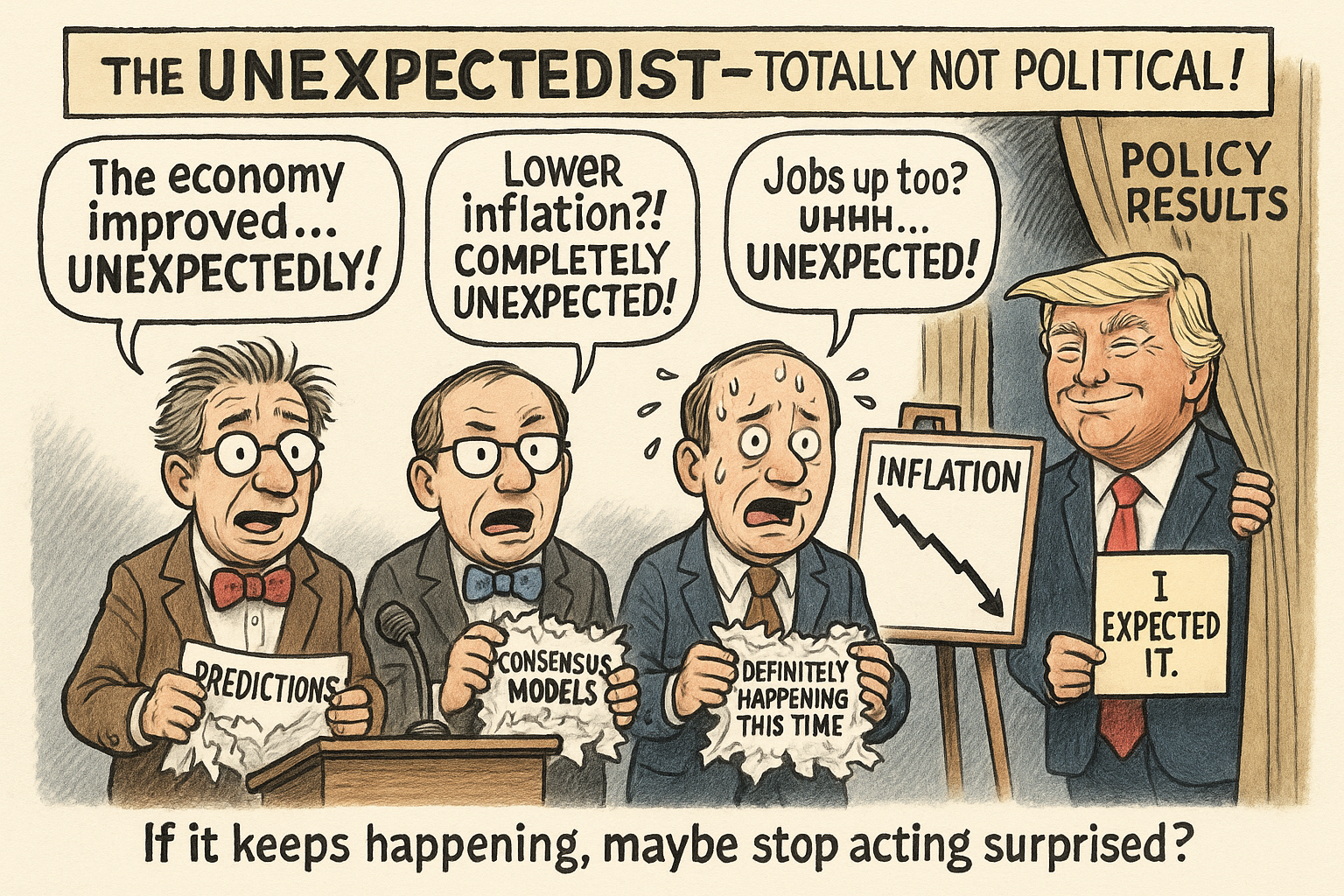 On Tuesday, the U.S. Bureau of Labor Statistics reported that the Consumer Price Index (CPI) for April showed an annual inflation rate of 2.3%, down from 2.4% in March and below economists’ forecasts of 2.4%. This unexpected slowdown, the lowest since February 2021, follows a temporary U.S.-China trade deal signed on Monday, prompted by President Trump’s 145% tariffs on Chinese goods imposed on April 2, which slashed China’s exports to the U.S. by 21% in a single month. The deal reduces U.S. tariffs to 30% for 90 days (10% baseline plus 20% fentanyl-related duties) and sees China cut its 125% retaliatory tariffs to 10% while lifting restrictions on rare earth minerals, effective May 14. Despite relentless media skepticism and dire predictions from
stones stacked upon my chest,
each one a silent vow to endure.
I carry it all-
the deadlines, the doubts,
the threats that lurk like code gone rogue,
until my bones groan,
until the crush feels certain.
I am a sentinel,
trained to guard against collapse,
but who guards the guard when darkness falls?
from weaving a face that isn’t mine.
In boardrooms, I am steel,
a leader who never falters.
At home, I am smiles,
a shadow playing at light.
The mask is heavy,
its edges cutting into my truth,
and I am so tired
of pretending I am whole.
hissing of failure, of fracture,
its voice a blade in the quiet.
But I’d rather hear
a still small voice,
soft as a breath,
clear as a star in the black.
It speaks of rest,
of a place beyond this weight,
but it’s faint,
drowned by the clamor of my fear.
where shadows swallow sound.
I want to reach out,
to clasp a hand,
to feel the warmth of another’s care.
But what if I’m slapped away?
What if my plea is met with cold,
or worse, with nothing at all?
So I stay silent,
curled in this obsidian cage,
the weight my only companion.
a crack lets light slip through.
A word scrawled in the dark,
a step toward a voice that listens,
a moment when the mask slips
and I am simply me.
The still small voice hums,
not loud, but steady,
promising I am not alone.
I reach, trembling,
and find the weight
just a little lighter
when I dare to speak its name.


Mental Health Awareness Resources
If you or someone you know is struggling, you are not alone. These organizations provide help, guidance, and support during Mental Health Awareness Month and beyond:
- National Alliance on Mental Illness (NAMI)
- SAMHSA National Helpline (1-800-662-HELP)
- 988 Suicide & Crisis Lifeline
- MentalHealth.gov – U.S. Government Resource
- Crisis Text Line – Text HOME to 741741
- American Foundation for Suicide Prevention
Mental Health Awareness Month is an opportunity to reduce stigma, open up conversations, and encourage people to seek help when they need it most.
economic experts, this inflation slowdown and rapid trade deal vindicate Trump’s tariff-driven strategy to leverage the U.S. consumer economy, rebalance trade, and reduce the $295.4 billion U.S.-China trade deficit. This analysis explores how the inflation news underscores Trump’s foresight, proving his critics wrong while advancing U.S. economic interests.
Defying Media and Expert Predictions on Inflation
Leading up to the April CPI report, mainstream media outlets and economic analysts warned that Trump’s April 2 tariffs-a 10% across-the-board import tariff and 145% duties on Chinese goods-would trigger runaway inflation. Networks like CNN and MSNBC predicted sharp price increases on consumer goods, emphasizing China’s $427.2 billion in U.S. imports in 2024 as a key source of affordable products. Economists surveyed by Reuters and Bloomberg forecasted inflation holding at 2.4% or rising to 2.5%, with some projecting core CPI nearing 3% due to tariff-related cost pressures. Publications like The New York Times and The Washington Post labeled Trump’s tariffs “reckless,” warning of economic turmoil, including stagflation risks combining high inflation with unemployment.
The April CPI’s drop to 2.3%, driven by a 13% decline in egg prices and lower costs for used cars, apparel, and airline fares, directly contradicts these forecasts. The absence of immediate tariff-driven price surges suggests that the 21% collapse in Chinese exports reduced the volume of tariffed goods entering the U.S., temporarily curbing inflationary pressure. This outcome aligns with Trump’s claim that tariffs would force China to negotiate without devastating U.S. consumers. The media’s exaggerated fears and experts’ miscalculations reveal their underestimation of Trump’s strategic use of the U.S. consumer market, which accounts for 70% of U.S. GDP and absorbs $427.2 billion in Chinese exports annually.
Trade Deal Triumph: China’s Capitulation Proves Trump Right
The temporary U.S.-China trade deal, signed just six weeks after the April 2 tariffs, further validates Trump’s approach. Media commentators and trade experts had dismissed his tariff strategy as a gamble, arguing that China’s export-driven economy could endure U.S. pressure and that negotiations would stall, as seen during the 2020 Phase One deal under Biden’s weak enforcement. The Financial Times and CNBC published analyses questioning whether Trump’s “trade war” would backfire, predicting prolonged supply chain disruptions and higher prices for American consumers. Instead, the 21% export drop-costing China billions-forced Beijing to negotiate in Geneva, agreeing to a 90-day tariff reduction to 30% and slashing their 125% retaliatory tariffs to 10%. China’s lifting of rare earth mineral restrictions, vital for U.S. tech and energy sectors, underscores their urgency to regain access to the U.S. consumer market.
Trump’s foresight in exploiting China’s dependence on the U.S. consumer economy, which absorbed $427.2 billion of their exports in 2024, proved spot-on. The deal’s consultation mechanism, led by Vice Premier He Lifeng, Treasury Secretary Scott Bessent, and Trade Representative Jamieson Greer, sets a clear path toward a permanent agreement by August. This swift progress defies expert predictions of a drawn-out trade conflict, with markets rallying-Dow futures up 3.1%, Asian indexes rising-as tensions eased. The deal’s potential to boost U.S. exports in agriculture, energy, and manufacturing, targeting the $295.4 billion trade deficit, echoes Trump’s 2020 Phase One goals, which aimed for $200 billion in Chinese purchases but fell short due to Biden’s failure to enforce compliance. Trump’s insistence on enforceable terms in the new deal addresses this past failure, positioning the U.S. to capitalize on China’s economic vulnerability.
Tariff Revenue: A Fiscal Win Mocked by Critics
The April tariffs generated a record $16.3 billion in receipts, an 86% increase from March’s $8.75 billion and more than double April 2024’s $7.1 billion. This surge, driven by the 10% across-the-board tariff and targeted duties, contributed to a $258.4 billion monthly budget surplus, up 23% from the prior year, reducing the fiscal year-to-date deficit to $1.05 trillion. Media outlets like The Wall Street Journal and think tanks like the Brookings Institution had downplayed tariff revenue’s fiscal impact, arguing it would be negated by higher consumer prices and economic slowdown. Instead, the inflation slowdown and surplus demonstrate that Trump’s tariffs delivered a dual benefit: pressuring China while strengthening federal coffers without the predicted price spikes.
Critics who ridiculed Trump’s claim that tariffs could fund domestic priorities, such as infrastructure or tax cuts, now face evidence of their error. The year-to-date tariff total of $63.3 billion, up 18% from 2024, supports Trump’s argument that trade policy can offset fiscal pressures. The temporary trade deal’s tariff reductions, effective May 14, may moderate future receipts, but a permanent deal increasing U.S. exports could drive economic growth, further shrinking the deficit. This fiscal success, paired with the inflation slowdown, dismantles the narrative that Trump’s policies would harm American consumers and businesses.
Strategic Implications and Long-Term Vindication
The inflation slowdown and trade deal highlight Trump’s strategic mastery in using the U.S. consumer economy’s dominance to reshape global trade. By imposing tariffs that crippled China’s exports, he forced a negotiation that media and experts deemed improbable, setting the stage for a permanent deal to narrow the $295.4 billion trade deficit. The Federal Reserve’s flexibility to maintain rates at 4.25%-4.50% or consider cuts in September, supported by the 2.3% inflation rate, bolsters economic stability as trade talks progress. Market optimism, with the S&P 500 and Nasdaq rising, reflects confidence in Trump’s approach, despite earlier warnings of market crashes.
Risks persist, as the deal’s 90-day window and potential for renewed 145% tariffs could reignite inflation if negotiations falter. Rising housing costs and a 0.7% energy price increase in April signal underlying pressures, but the immediate inflation relief and trade progress overshadow these concerns. Media and expert skepticism, rooted in underestimating China’s reliance on the U.S. market and overestimating tariff-driven inflation, has been thoroughly debunked. The 2020 Phase One deal’s failure, where China met only 60% of its $200 billion commitment due to Biden’s inaction, contrasts sharply with Trump’s proactive enforcement, reinforcing his credibility.
Conclusion
The April inflation slowdown to 2.3% and the U.S.-China trade deal signed on Monday, vindicate President Trump’s tariff strategy against a chorus of media and expert criticism. By leveraging the U.S. consumer economy’s dominance, Trump forced China to negotiate after a 21% export collapse, defying predictions of economic chaos and runaway inflation. Record tariff revenues of $16.3 billion and a $258.4 billion budget surplus further disprove claims that tariffs would harm the U.S. economy. As negotiations advance toward a permanent deal by August , Trump’s approach promises to shrink the $295.4 billion trade deficit, boost U.S. exports, and sustain economic stability, proving his critics wrong and solidifying his legacy as a transformative economic strategist.
