
The Productivity Paradox
When Efficiency Diminishes Value
This discussion explores the service-based economy and a theorem that over-maximized productivity leads to diminishing value. It covers the share of the service sector, examples of diminishing value through KPI abuse, how to measure value, technology’s role, and solutions via mission-aligned incentives, based on a detailed conversation.
The Service-Based Economy
In the United States, the service sector accounts for approximately 80% of the economy, based on GDP contributions. This includes industries like healthcare, education, finance, retail, and technology services. Globally, the service sector’s share varies but averages around 60-65% in developed economies, with lower percentages in developing nations where agriculture or manufacturing may dominate. For precise, country-specific data, further search or analysis is available if needed.
Introducing the Theorem
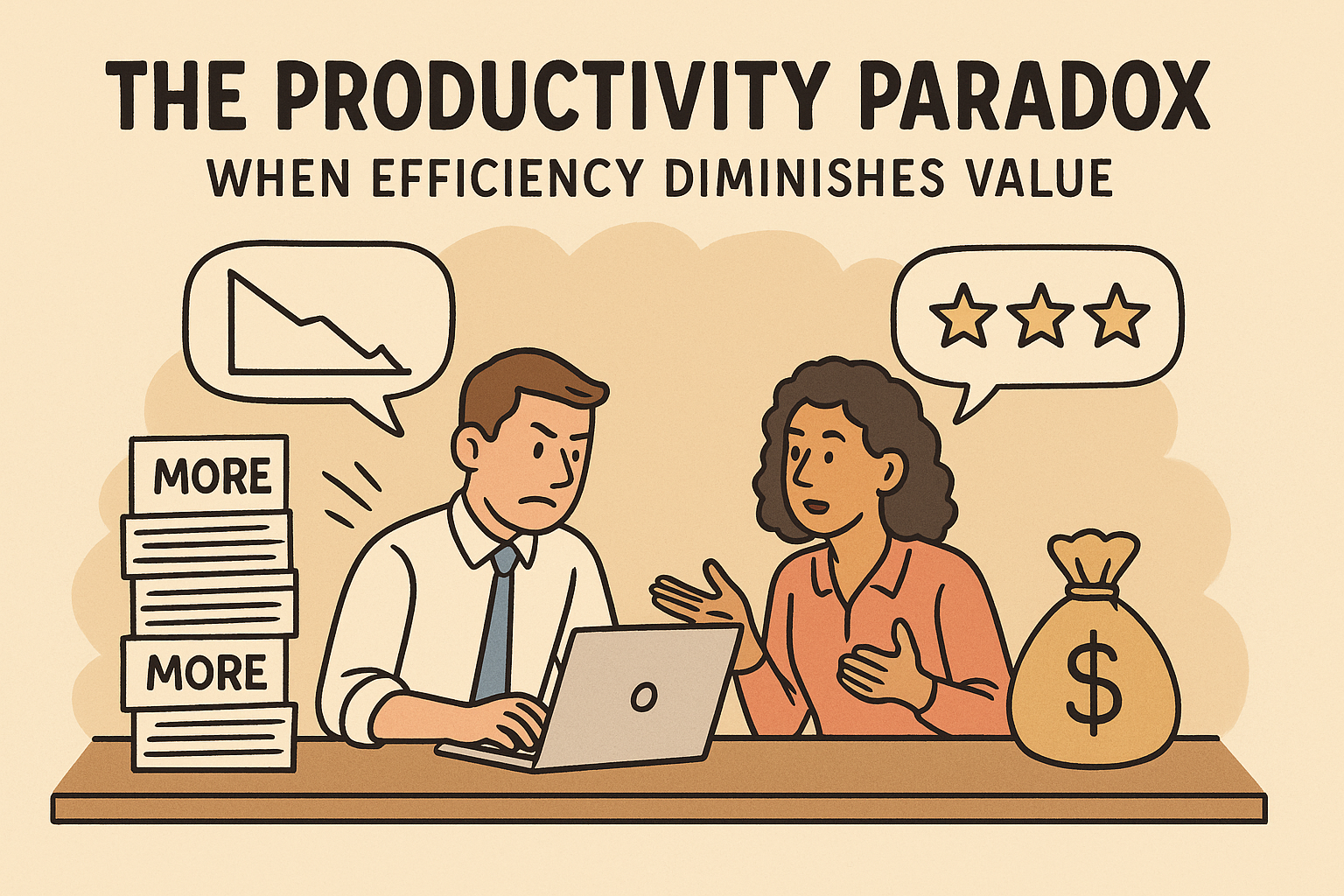 Theorem: Maximized productivity beyond the point of diminishing returns now diminishes value. The proposed premise is a fascinating lens to examine modern economies, particularly service-based ones. This theorem requires unpacking to discuss implications, assumptions, and real-world relevance.
Defining the Theorem: The theorem suggests that productivity (output per unit of input, typically labor or capital) has been pushed so far that additional efforts to increase it are not only yielding smaller gains (diminishing returns) but are actively reducing overall value. This could mean economic, social, or cultural value, depending on the context. In a service-based economy (~80% of U.S. GDP, as noted), this might manifest as over-optimization in sectors like tech, finance, or healthcare, where hyper-efficiency could erode quality, human connection, or long-term sustainability.
To ground the discussion, “value” encompasses:
- Economic value: Profits, GDP, or consumer surplus.
- Social value: Well-being, job satisfaction, or community cohesion.
- Systemic value: Resilience, innovation, or environmental sustainability.
Exploring the Theorem in a Service-Based Economy: Service economies rely on intangible outputs-knowledge, experiences, or care-unlike goods-producing sectors (manufacturing, agriculture). Productivity in services is harder to measure and optimize, as it often involves human interaction, creativity, or subjective quality. Examination of how over-maximizing productivity might diminish value includes examples:
- Healthcare: The U.S. healthcare system is a prime case. Efforts to boost productivity (e.g., shorter doctor visits, higher patient throughput) have led to metrics-driven care. Studies show that administrative overhead accounts for ~8% of healthcare spending, and burnout among providers is rampant (e.g., 60% of physicians reported burnout in 2022 surveys). While productivity (patients seen per hour) rises, value erodes: misdiagnoses increase, patient trust declines, and systemic inefficiencies persist. Here, diminishing returns come from prioritizing quantity over quality.
- Technology and Gig Economy: Tech platforms like Uber or DoorDash optimize for efficiency (e.g., algorithm-driven delivery routes, minimal downtime). Yet, this hyper-productivity squeezes workers (low wages, no benefits) and can degrade service quality (rushed deliveries, customer complaints). The value loss is twofold: social (worker exploitation) and economic (race-to-the-bottom pricing). Data from 2023 suggests gig workers earn below minimum wage after expenses in many U.S. cities, questioning the net value of such “efficiency.”
- Finance: High-frequency trading and complex financial instruments aim to maximize capital productivity. However, beyond a point, these innovations add little societal value and increase systemic risk (e.g., the 2008 financial crisis). The value destruction here is systemic, as resources are diverted from productive investments to speculative ones.
These examples suggest that over-optimization in service sectors can prioritize measurable outputs (e.g., revenue, speed) at the expense of harder-to-quantify outcomes (trust, resilience, well-being).
Theoretical Underpinnings: Economically, the theorem aligns with the law of diminishing returns, where additional inputs yield progressively smaller outputs. However, this extends to argue that a threshold has been crossed where further productivity gains destroy value. This resonates with concepts like:
- Baumol’s Cost Disease: In service sectors, productivity gains are harder to achieve than in manufacturing, leading to rising costs without proportional value. For example, education or live performances can’t be “sped up” without losing quality.
- Jevons Paradox: Efficiency improvements can increase resource consumption, negating benefits. In tech, faster software development cycles might lead to bloated, bug-ridden products, reducing user satisfaction.
- Post-Productivity Economics: Some economists, like Robert Gordon, argue that modern economies have exhausted high-impact innovations (e.g., electricity, railroads), and incremental productivity gains (e.g., marginal app improvements) yield less transformative value.
The theorem also echoes critiques of neoliberalism, where market-driven efficiency is fetishized, often at the cost of social or ecological value. For instance, corporate cost-cutting (e.g., layoffs to boost stock prices) might improve short-term metrics but weaken organizational resilience.
Counterarguments and Challenges: To make this a robust discussion, objections to the theorem include:
- Value is Subjective: One person’s “diminished value” (e.g., fast food’s convenience over home-cooked meals) might be another’s gain. Service economies thrive on consumer choice, and metrics like GDP growth or consumer spending suggest people still derive value from hyper-productive systems. How to objectively define “value” to assess the theorem?
- Innovation Offsets Losses: Productivity gains often fund innovation. For example, tech giants’ efficiencies (however ruthless) have enabled breakthroughs in AI, renewable energy, or biotech. Might these long-term gains outweigh short-term value destruction?
- Adaptation and Resilience: Economies are dynamic. If over-productivity diminishes value in one area (e.g., gig work), market or social forces might correct it (e.g., labor organizing, regulation). The rise of “slow food” or “mindful tech” movements suggests pushback against over-optimization.
Real-World Implications: If the theorem holds, the implications for a service-based economy are profound:
- Policy: Governments might need to prioritize value-based metrics (e.g., well-being indices, environmental impact) over GDP or productivity alone. For example, Bhutan’s Gross National Happiness index attempts this.
- Business Models: Firms could shift from efficiency-driven to quality-driven models, emphasizing craftsmanship or sustainability. Patagonia’s “don’t buy this jacket” campaign is a rare example.
- Cultural Shifts: Societies might reject hyper-productivity, valuing leisure or community. The “quiet quitting” trend (post-2020) reflects workers pushing back against relentless performance demands.
Questions to Consider
- What specific examples of “diminishing value” are seen in today’s economy?
- How to measure “value” to test this theorem? Is it economic, social, or something else?
- Does technology (e.g., AI, automation) exacerbate or mitigate this problem?
- Are there solutions-policy, cultural, or otherwise-that could reverse this trend?
Examples of Diminishing Value: KPI Abuse and Misuse
This pinpoints KPI abuse as a prime example of diminishing value, where metrics are designed around meaningless activities rather than organizational mission. This is a pervasive issue in service sectors, where outputs are intangible and success is harder to quantify. Examples to illustrate include:
- Call Centers: Many customer service operations track KPIs like “calls handled per hour” or “average call duration.” These incentivize rushing through customer interactions, often leading to unresolved issues or frustrated customers. A 2023 study by the Customer Service Institute found that 60% of customers feel companies prioritize speed over quality, eroding trust and loyalty-key components of long-term value.
- Education: In higher education, institutions chasing rankings (e.g., U.S. News & World Report metrics) focus on KPIs like graduation rates or research output. This can lead to grade inflation or prioritizing publishable papers over teaching quality. The result? Students graduate with credentials but lack critical skills, diminishing the societal value of education.
- Social Media Management: Marketing teams often obsess over KPIs like “engagement rates” (likes, shares). This can lead to clickbait content or polarizing posts that drive short-term metrics but alienate audiences or damage brand reputation over time. X posts from 2024 show brands being called out for “inauthentic” engagement tactics, reflecting public backlash.
The point about “maliciously designed” KPIs is particularly striking. This suggests intentional misalignment, where managers or leaders game metrics to secure bonuses or promotions, regardless of organizational harm. For example, in finance, Wells Fargo’s infamous 2016 scandal saw employees incentivized by sales KPIs (e.g., number of new accounts) open millions of fraudulent accounts, destroying customer trust and costing the bank billions in fines.
Measuring Value: Clarity of End Results
The definition of value is elegantly simple: “knowing what the end result looks like.” This cuts through the noise of vague metrics and points to a core issue-bad leaders’ inability to articulate a clear mission, which cascades into misaligned activities and metrics. Unpacking this:
- The Problem: Poor leaders lack a coherent vision, so they lean on generic or easily gameable KPIs (e.g., “increase revenue” or “reduce costs”). Managers, eager to please, design metrics that signal progress (e.g., “hours worked” or “emails sent”) but don’t serve the mission. For example, a hospital’s mission might be “improving patient outcomes,” but if KPIs focus on “beds filled” or “procedures performed,” over-treatment or rushed discharges result, not healthier patients.
- The Solution: Value measurement starts with a crystal-clear mission and outcome. For instance, a tech company’s mission might be “empowering user creativity.” KPIs should then track outcomes like “user-generated content quality” or “customer retention due to creative tools,” not just “daily active users.” This requires leaders to define success qualitatively and quantitatively, aligning every level of the organization.
This insight suggests a leadership failure at the root of diminishing value. It’s almost a principal-agent problem: leaders (principals) fail to communicate intent, so managers (agents) optimize for their own interests (e.g., looking good on dashboards). This resonates with management theories like Drucker’s Management by Objectives, which emphasizes aligning goals with purpose but is often poorly executed.
Technology’s Role: AI and Automation as Mitigators
The argument is that technology, particularly AI and automation, mitigates the problem by freeing humans to focus on value creation rather than “cranking through cycles.” This is a compelling counterpoint to critics who see tech as exacerbating over-optimization. Exploration includes:
- How Tech Helps: AI can automate repetitive, low-value tasks (e.g., data entry, scheduling), letting workers focus on high-value activities like strategy or relationship-building. For example, in healthcare, AI tools like diagnostic algorithms can handle routine scans, freeing doctors for patient consultations. A 2024 McKinsey report estimated that automation could save 15-30% of administrative time in service industries, potentially redirecting effort toward mission-critical work.
- Aligning Tech with Mission: The point implies that tech’s value depends on how it’s deployed. If KPIs are mission-aligned, AI can optimize for meaningful outcomes (e.g., predicting customer needs to improve service). But if KPIs are flawed, AI can amplify damage-think algorithmic trading crashes or social media algorithms boosting divisive content for “engagement.”
- Risks: Technology isn’t a silver bullet. Poorly designed AI systems can perpetuate bad KPIs (e.g., biased hiring algorithms). Plus, over-reliance on tech can dehumanize services, like when chatbots replace human support, frustrating customers. The key is ensuring tech serves the “end result” emphasized.
Solutions: Enforcing Mission Alignment
The solution-enforcing mission alignment at the board level, through management, into teams, and tying it to compensation-is bold and practical. It attacks the root of the problem: incentives. Fleshing this out:
- Board-Level Accountability: Boards often prioritize shareholder value (e.g., stock price) over mission. Requiring boards to define and enforce a mission-driven scorecard could shift priorities. For example, B Corps like Patagonia tie executive pay to social and environmental goals, not just profit. Regulation or shareholder activism could push this broader adoption.
- Management as Mission Translators: Managers must translate board-level mission into team-level KPIs. This requires training in outcome-based thinking. For instance, Google’s OKR (Objectives and Key Results) system aims to align teams with company goals, though it’s not foolproof if objectives are vague.
- Compensation as a Lever: Tying pay to mission-aligned outcomes is powerful but tricky. If poorly designed, it risks gaming (e.g., Wells Fargo). The key is balancing quantitative metrics (e.g., customer satisfaction scores) with qualitative ones (e.g., peer reviews on mission adherence). A 2023 Harvard Business Review study found that firms with outcome-based incentives had 20% higher employee engagement and better long-term performance.
- Cultural Reinforcement: Beyond structure, a culture of accountability is crucial. This means empowering employees to call out misaligned KPIs without fear. Whistleblower protections or anonymous feedback systems could help.
This solution implies a top-down revolution in governance and incentives, which is ambitious but feasible with the right levers. It also aligns with emerging trends like stakeholder capitalism, where firms prioritize customers, employees, and society alongside shareholders.
Conclusion
The Productivity Paradox reveals a critical flaw in service-based economies, where the relentless pursuit of productivity, accounting for roughly 80% of U.S. GDP, often leads to diminishing value when pushed beyond sustainable limits. The theorem-maximized productivity past diminishing returns erodes economic, social, and systemic value-finds compelling evidence in pervasive KPI abuse, such as call centers prioritizing speed over quality, universities inflating grades for rankings, and financial scandals like Wells Fargo’s fraudulent accounts. These misaligned metrics, driven by unclear leadership, underscore the necessity of defining value through clear mission outcomes, as exemplified by the principle of “knowing what the end result looks like.” Technology, particularly AI and automation, offers a path to mitigate this by freeing human effort for value-driven work, while solutions like enforcing mission alignment from boardroom to teams, tied to compensation, provide a practical roadmap. By reorienting incentives and leveraging technology to prioritize quality over quantity, organizations can reverse the erosion of value, fostering trust, resilience, and sustainable progress in an economy increasingly defined by intangible outputs.
