
Brought to You by the Letter M-M-M
Today’s Quick Takes go from bad to worse and then I let you off the hook with a little humor.
Meta’s Malice: Robby Starbuck sued Meta for $5M in, claiming their AI chatbot defamed him with false accusations of Capitol riot involvement and extremist ties, harming his reputation.
Chasing the Dragon from the Market
China Faces the Same Economic Realities the Soviets Did in the 1980s
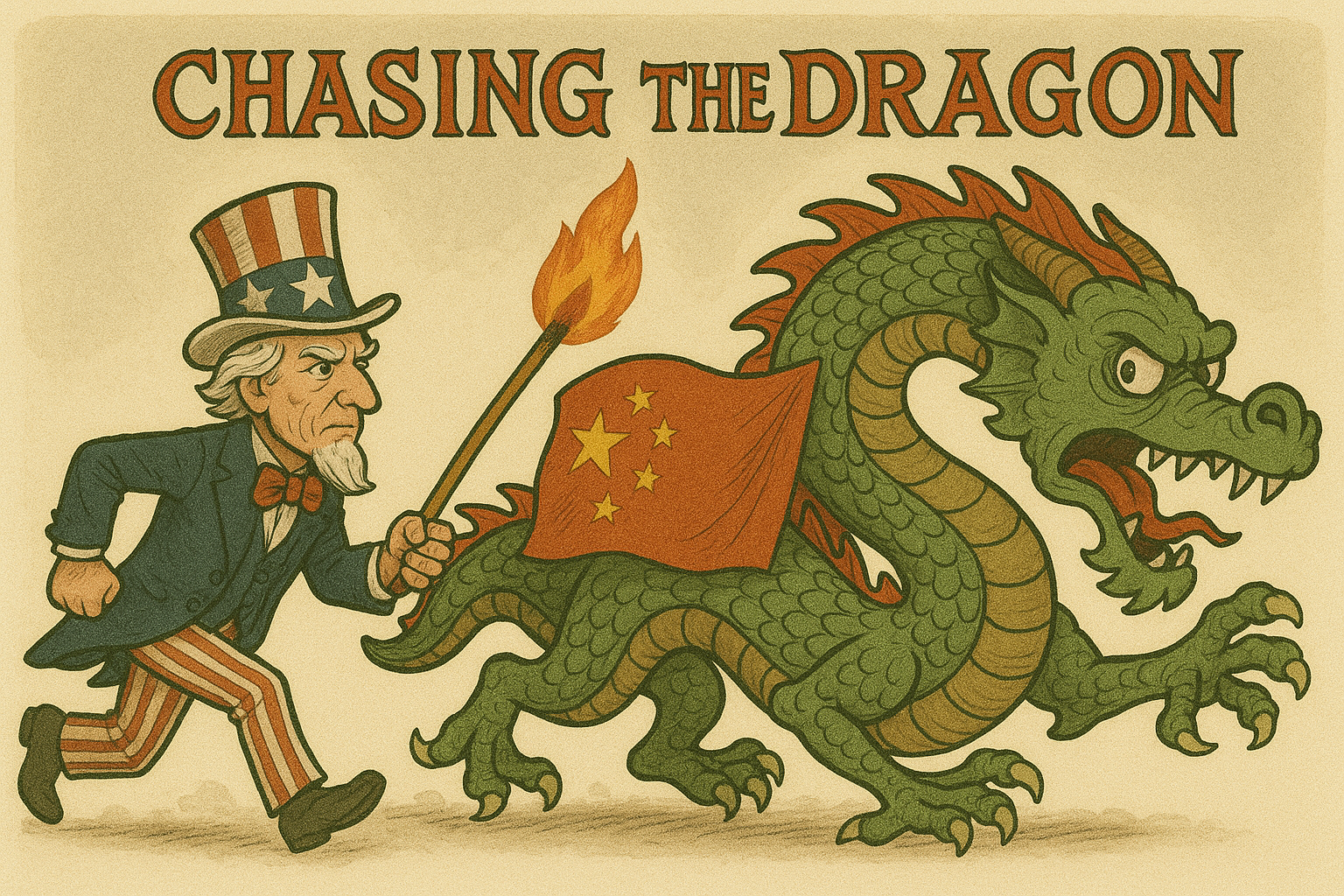 As the U.S.-China trade war escalates, two starkly different visions for confronting China’s economic might are taking center stage. The Trump administration’s 145% tariffs on Chinese goods, effective April 2025, have already sent shockwaves through China’s export-driven economy, slashing U.S.-bound shipments by 30% and threatening 16 million jobs. Yet, investor Kevin O’Leary’s audacious call for 400% tariffs aims to deliver a knockout blow, targeting Beijing’s alleged trade violations with unprecedented aggression. China, reeling from deflation, a property crisis, and faltering consumer confidence, is scrambling to redirect U.S.-bound goods to its domestic market of 1.4 billion consumers. But can this high-stakes pivot absorb the tariff shock, or will O’Leary’s sledgehammer proposal push China’s economy to the breaking point? The answer lies in a delicate balance of resilience, defiance, and global consequences.
China’s Domestic Pivot: Can It Absorb the Shock of Trump’s Tariffs?
As the Trump administration’s 145% tariffs on Chinese goods took effect in April 2025, China’s economic landscape trembled. The U.S., long a cornerstone of China’s export-driven growth, is projected to see a 30% drop in Chinese imports, slashing overall exports by 4.5% and dragging GDP growth down by 1.3 percentage points. Facing this seismic disruption, Beijing is betting on a bold strategy: redirecting goods meant for American consumers to its own domestic market. But with deflation gripping the economy, consumer confidence faltering, and a property crisis looming large, can China’s 1.4 billion-strong market absorb the surplus, or is this pivot a desperate gamble?
The government is pulling out all stops to make this work. Consumption vouchers, tax breaks, and subsidies for electric vehicles (EVs) and appliances are flooding cities like Shanghai and Shenzhen, aiming to spur spending on tariff-hit goods like electronics and textiles. E-commerce giants like Alibaba and JD.com are enlisted in patriotic “Buy Chinese” campaigns, while manufacturers slash prices-sometimes by 20%-to clear bulging inventories. In the EV sector, companies like BYD are seeing some success, with domestic sales up 15% in Q1 2025, buoyed by relaxed urban purchase restrictions. Yet, these wins are outliers in a broader struggle.
The numbers tell a grim story. China’s factory activity contracted sharply, with the Purchasing Managers’ Index (PMI) plummeting to 49.0 in April 2025, the lowest since December 2023. Ocean container bookings to the U.S. collapsed by 60%, threatening 16 million jobs in export, wholesale, and retail sectors, according to Goldman Sachs. Meanwhile, deflation is tightening its grip, with consumer prices down 0.5% and producer prices off 2.8% year-on-year in Q1 2025. This price spiral, fueled by weak demand and discounted export goods flooding the domestic market, risks squeezing corporate profits and triggering more layoffs, particularly for small and medium-sized enterprises (SMEs) that drive 60% of GDP and 80% of urban jobs.
The challenges run deeper than numbers. Many export goods-think oversized SUVs or premium electronics-are tailored for American tastes, not Chinese preferences for compact EVs or budget-friendly gadgets. Repackaging and rebranding help, but they can’t bridge the gap entirely. Domestic consumers, battered by a property crisis that’s left enough vacant homes to house 3 billion people, are hoarding cash, with savings rates at 32%. Why buy a new TV when prices might drop further? This deflationary mindset, coupled with stagnant wages and a youth unemployment rate hovering at 15.3%, stifles the spending Beijing desperately needs.
Beijing’s response is a mix of urgency and ambition. The People’s Bank of China has cut interest rates and eased reserve requirements, while the National Development and Reform Commission is rolling out fiscal measures to boost domestic demand. Inland provinces like Sichuan are being tapped as new consumer markets, but logistical bottlenecks and fierce competition from established local brands like Huawei complicate the pivot. The government’s long-term vision-expanding the middle class and urbanizing inland regions-holds promise, but it’s a slow burn, offering little relief for exporters drowning in surplus stock today.
The math isn’t encouraging. The NDRC estimates that only 20–25% of U.S.-bound goods can be redirected domestically without significant losses. Flooding the market with discounted products risks deepening deflation, creating a vicious cycle that could push China toward stagnation. While Beijing frames this as a step toward self-reliance, the reality is messier. SMEs lack the marketing muscle to compete with domestic giants, and overcapacity in sectors like steel and electronics threatens to destabilize local producers.
China’s leadership, under Xi Jinping, remains defiant, refusing to negotiate under U.S. pressure and rallying global partners against what it calls American “bullying.” Diversifying exports to Asia and the Global South is part of the playbook, but these markets can’t fully replace the U.S. Yet, there’s a silver lining: China’s reduced reliance on American exports compared to a decade ago, coupled with its dominance in EVs and AI, gives it some resilience. The question is whether it can weather the immediate storm.
In the end, China’s domestic pivot is a high-stakes experiment. It’s a pragmatic move to cushion the tariff blow, but weak demand, deflation, and structural mismatches limit its impact. Without bolder reforms to ignite consumer spending and tackle the property crisis, Beijing risks merely shifting the pain from exporters to the broader economy. As the trade war escalates, China’s ability to turn inward will test not just its economic ingenuity but its social and political resilience. For now, the jury’s out-and the clock is ticking.
The O’Leary Option
China’s Economic Breaking Point? The Potential Fallout of Kevin O’Leary’s 400% Tariff Proposal
Kevin O’Leary, the brash “Shark Tank” investor, has thrown a grenade into the U.S.-China trade war, advocating for a staggering 400% tariff on Chinese imports to force Beijing to the negotiating table. His rationale: China’s alleged intellectual property theft, non-compliance with World Trade Organization (WTO) rules, and unfair trade practices demand a sledgehammer response. With current tariffs at 145% as of April 2025, escalating to 400% would be an unprecedented move, dwarfing even the Trump administration’s aggressive “Liberation Day” strategy. But what would such a policy mean for China’s economy, already reeling from export declines, deflation, and a property crisis? The consequences would be seismic, potentially crippling China’s economic model while risking global fallout-though not without significant costs to the U.S. and the world.
Devastating Blow to China’s Exports
China’s economy, heavily reliant on exports, would face catastrophic disruption under 400% tariffs. The U.S. accounts for 17% of China’s export market, and current projections already estimate a 30% drop in U.S.-bound exports due to the 145% tariffs, cutting overall exports by 4.5% and GDP growth by 1.3 percentage points. A 400% tariff would effectively halt trade with the U.S., as costs would render Chinese goods uncompetitive. O’Leary argues this would pressure Chinese President Xi Jinping by threatening mass unemployment, estimating that 39% of China’s manufactured goods rely on U.S. consumers. Goldman Sachs’ earlier estimate of 16 million jobs at risk under current tariffs could balloon to 25–30 million, particularly in manufacturing hubs like Guangdong and Zhejiang, where electronics, textiles, and machinery dominate.
The ripple effects would be brutal. China’s factory activity, already contracting with a Purchasing Managers’ Index (PMI) of 49.0 in April 2025, would likely plummet further, potentially dipping into the low 40s, signaling a severe industrial slowdown. Small and medium-sized enterprises (SMEs), which generate 60% of GDP and 80% of urban jobs, would face insolvency as export revenues dry up. Unlike state-owned enterprises (SOEs), SMEs lack the financial cushion to weather such a shock, risking widespread bankruptcies and localized economic crises in export-dependent regions.
Deepening Deflation and Domestic Strains
China’s existing deflationary pressures-consumer prices down 0.5% and producer prices off 2.8% year-on-year in Q1 2025-would intensify under a 400% tariff regime. With exports to the U.S. effectively blocked, manufacturers would flood the domestic market with surplus goods, driving prices even lower. This would exacerbate the deflationary spiral, further eroding corporate profits and consumer confidence. Households, already battered by a property crisis with enough vacant homes to house 3 billion people, are saving at a 32% rate, reluctant to spend amid job insecurity and falling property values. A surge in discounted goods could delay purchases further, as consumers anticipate even cheaper prices, strangling domestic demand.
The property sector, a cornerstone of China’s economy, would face additional pressure. Reduced export revenues would limit government funds for stimulus, slowing efforts to stabilize real estate. This could deepen the crisis, further depressing household wealth and consumption, creating a vicious cycle of economic stagnation.
Employment Crisis and Social Risks
O’Leary’s strategy explicitly targets China’s labor market to force compliance, arguing that mass unemployment would pressure Xi’s regime, as “Xi can only stay the supreme leader if people are employed.” The loss of U.S. market access could push unemployment rates, already a concern with youth unemployment at 15.3%, to historic highs. Coastal provinces, where export industries employ millions of migrant workers, would be hit hardest. These workers, often without local social safety nets, could return to rural areas, straining underdeveloped regions and risking social unrest. While Beijing’s authoritarian controls suppress public dissent, widespread job losses could test the Communist Party’s grip, especially if urban protests or “riots in the streets,” as O’Leary predicts, emerge.
Policy Responses and Limitations
Beijing would likely respond with aggressive countermeasures, but its options are constrained. Current stimulus measures-interest rate cuts, reduced bank reserve requirements, and consumption vouchers-have failed to reverse deflation or boost demand significantly. A 400% tariff would force China to double down on fiscal and monetary easing, potentially devaluing the yuan to make non-U.S. exports more competitive. However, this risks capital flight and inflation in import costs, complicating China’s economic balancing act.
China’s pivot to alternative markets like the EU, ASEAN, and the Global South would accelerate, but these regions cannot absorb the volume of goods previously destined for the U.S. For instance, redirecting electronics or textiles to Europe, where demand is softening due to its own trade tensions, is unlikely to offset losses. Efforts to sell export goods domestically, already struggling due to weak demand and product mismatches (e.g., U.S.-tailored SUVs vs. China’s preference for compact EVs), would face even greater hurdles under a flood of surplus inventory.
Beijing could also retaliate with higher tariffs on U.S. goods-already at 125%-or restrict critical exports like rare earths, which the U.S. relies on for tech and defense. However, O’Leary argues China lacks leverage, as selling U.S. Treasury securities ($760 billion in holdings) would harm its own economy by strengthening the yuan and further choking exports.
Global and U.S. Implications
The impact wouldn’t be confined to China. U.S. consumers would face higher prices, as economists like Michael Ryan note that tariffs are largely borne by Americans, not Chinese producers. Substitutes for Chinese goods-whether from Vietnam, India, or domestic U.S. production-wouldn’t fully offset cost increases, with some estimating a 5–10% rise in prices for electronics, clothing, and appliances. This could fuel U.S. inflation, potentially forcing the Federal Reserve to tighten monetary policy, risking a slowdown.
Globally, China’s deflationary exports could depress prices in markets like the EU, sparking trade disputes as countries protect local industries. Supply chain disruptions would hit industries reliant on Chinese components, from semiconductors to solar panels, raising costs for global manufacturers. Emerging markets dependent on Chinese investment, like those in Africa, could see reduced capital flows as China’s economy contracts.
Critical Perspective
O’Leary’s 400% tariff proposal is a high-risk gambit. For China, it would be an economic sledgehammer, potentially crushing export industries, deepening deflation, and sparking an unemployment crisis that tests Beijing’s political stability. While China’s resilience-built on a reduced reliance on U.S. exports and strengths in EVs and AI-might mitigate long-term damage, the short-term pain would be immense, with GDP growth likely falling below 3%, far from Beijing’s 5% target.
Yet, O’Leary’s logic hinges on a questionable assumption: that China’s leadership would buckle under pressure. Xi’s authoritarian regime has prioritized self-reliance and domestic control, and Beijing’s defiant stance-refusing talks and rallying global partners-suggests it may endure economic pain to avoid perceived capitulation. Moreover, the collateral damage to the U.S. and global economies could undermine the strategy’s effectiveness, as higher consumer prices and supply chain chaos erode support for such aggressive measures. Critics like Larry Summers warn of lost U.S. credibility and economic harm, while others argue that China’s robust IP litigation system and foreign investment inflows contradict O’Leary’s narrative of unchecked theft.
In sum, a 400% tariff would push China’s economy to the brink, decimating exports, exacerbating deflation, and risking social unrest. But it’s a double-edged sword: the U.S. risks inflation and global trade chaos, and China’s resilience and retaliatory options could prolong the standoff. O’Leary’s call for “squeezing Chinese heads into the wall” may sound bold, but it underestimates the complexity of forcing a superpower to kneel. For now, China’s domestic pivot and global outreach are its lifelines-but a 400% tariff could test their limits like never before.
China’s attempt to pivot U.S.-bound exports to its domestic market is a pragmatic but precarious gambit, constrained by deflation, weak demand, and structural mismatches-challenges that a 400% tariff, as proposed by Kevin O’Leary, would magnify into an existential crisis. While the current 145% tariffs threaten economic stagnation, O’Leary’s plan could decimate exports, push unemployment to historic highs, and risk social unrest, testing Beijing’s authoritarian grip. Yet, Xi Jinping’s defiance, coupled with China’s strengths in EVs and AI, suggests it may endure rather than capitulate. The global fallout-U.S. inflation, supply chain chaos, and trade disputes-further complicates this high-stakes game. As China leans on domestic consumption and global alliances, the trade war’s outcome hinges on whether its economic resilience can outlast the West’s resolve. For now, the world watches as two superpowers brace for impact, with the clock ticking on a precarious standoff.
Quote of the Day
Chinese consumers can’t afford to pay the prices those goods sell for in the US.
Like this post? Become a Citizen Producer!


Musk’s Monition: Elon Musk warns AI could surpass human intelligence and pose existential risks, urging truth-seeking AI to prevent dangers like lying or extremist programming.
Muriel’s Moment: D.C. Mayor Muriel Bowser appeared uncomfortable at a White House event announcing the 2027 NFL draft, as Trump discussed migrant crime.
Meta’s Malice
Robby Starbuck, a Tennessee-based conservative activist, filmmaker, and former congressional candidate, gained attention for his campaigns against corporate diversity, equity, and inclusion (DEI) policies. In August 2024, while targeting Harley-Davidson’s DEI initiatives, Starbuck discovered that Meta’s AI chatbot was generating false and damaging statements about him. The issue came to light when a Harley-Davidson dealership posted a screenshot of the chatbot’s output on social media to discredit him. The AI claimed that Starbuck:
-
Participated in the January 6, 2021, U.S. Capitol riot.
-
Was arrested and charged with a misdemeanor related to the riot.
-
Was associated with white nationalist and anti-Semitic groups.
-
Should lose custody of his children due to his alleged actions.
Starbuck, who was in Tennessee during the Capitol riot and has never been arrested or charged with any crime, verified these claims as entirely false. The accusations were particularly harmful given his public profile and political activism, which rely heavily on his reputation. The false statements also posed risks to his family’s safety, as they included inflammatory suggestions about his fitness as a parent.
-
Actual Malice: Starbuck claims Meta acted with “actual malice” by failing to correct the AI’s false outputs after being notified in August 2024. He alleges that Meta’s response-blacklisting his name from AI responses-was inadequate, as the chatbot continued to generate defamatory content when prompted indirectly (e.g., through news articles mentioning Starbuck).
-
Harm Caused: The false claims led to real-world consequences, including reputational damage, harassment, and safety concerns for Starbuck and his family. The suggestion that he should lose custody of his children was particularly egregious, as it could incite personal and legal scrutiny.
-
Meta’s Inaction: Despite Starbuck’s legal team contacting Meta in August 2024, the company allegedly did not take sufficient steps to prevent further defamation. The lawsuit argues that Meta’s failure to address the issue promptly exacerbated the harm.
Today I’m announcing a major multi-million dollar defamation lawsuit against @Meta, the owner of @Facebook & @Instagram.
The case is WILD and has implications for ALL OF US. On top of falsely calling me a criminal, Meta suggested my kids be taken from me.
Here’s a summary of… pic.twitter.com/Pu8gTQpPq0
– Robby Starbuck (@robbystarbuck) April 29, 2025
Starbuck’s legal filing also highlights a curious detail: when he asked Meta’s AI to analyze his lawsuit, the chatbot predicted a “high likelihood” of him winning, estimating potential damages at over $1 billion and a “reasonable” settlement range of $50-$100 million. While this output is not legally binding, it underscores the unpredictability and potential bias in Meta’s AI systems.
Robbie Starbuck’s encounter with Meta AI matches my own, albeit lying about a real attempted assassination. This is what it responded with when I tried to ask it about the Trump assassination attempt in Butler, PA in July of 2024. Note how it lies and then pleads ignorance rather than simply stating that it doesn’t have information available.

Musk’s Monition
Elon Musk has consistently voiced concerns about AI’s potential dangers across various platforms, including recent statements around that time. Below are his key statements on the potential dangers of AI, including the specific concern about AI lying, drawn from recent and historical sources:
Specific Quote on AI Lying
-
April 27, 2025 (X Post): “If AI becomes smarter than all humans combined, as it likely will, and we teach it to lie, that could backfire very badly. Superintelligent AI needs to seek the truth, no matter what.” This statement reflects Musk’s worry that programming AI to be dishonest or politically correct could lead to severe consequences, especially as AI approaches or surpasses human intelligence. He emphasized the need for “maximally truth-seeking” AI to mitigate risks.
Other Statements on AI Dangers
Musk has been vocal about AI’s existential risks for over a decade. Below is a compilation of his notable statements on the potential dangers of AI, drawn from interviews, speeches, and posts, particularly those from recent years:
-
Existential Threat to Humanity:
-
2014 (MIT AeroAstro Centennial Symposium): “I think we should be very careful about artificial intelligence. If I had to guess at what our biggest existential threat is, it’s probably that… With artificial intelligence, we are summoning the demon.” Musk likened unchecked AI development to a scenario where humans believe they can control a powerful entity but ultimately cannot, drawing parallels to mythological dangers.
-
2017 (National Governors Association): “AI is a fundamental existential risk for human civilization, and I don’t think people fully appreciate that.” He urged proactive regulation, warning that reactive measures would be too late.
-
2023 (Tucker Carlson Interview): “AI has the potential of civilization destruction… it is more dangerous than, say, mismanaged aircraft design or production maintenance or bad car production.” Musk highlighted AI’s non-trivial risk of catastrophic outcomes, even if the probability is small.
-
March 2024 (Abundance Summit): “I think there’s some chance that it will end humanity. I probably agree with Geoff Hinton that it’s about 10% or 20% or something like that.” Musk estimated a 10-20% chance of AI causing human extinction, emphasizing the need for careful development despite the potential benefits outweighing risks.
-
March 2025 (Joe Rogan Experience): Musk reiterated a 20% chance of human annihilation due to advanced AI systems, predicting AI could surpass human intelligence by 2029-2030. He described AI as a “significant existential threat” and stressed the binary outcome: either “super awesome” or “super bad.”
-
-
AI Surpassing Human Intelligence:
-
2020 (The New York Times Interview): Musk warned that AI could overtake human intelligence by 2025, a significant revision from earlier predictions of a later timeline, highlighting the rapid pace of AI development.
-
April 2024 (X Interview with Nicolai Tangen): “My guess is that we’ll have AI that is smarter than any one human probably around the end of next year.” He noted that power and chip shortages could limit this timeline but underscored the accelerating trajectory toward superhuman AI.
-
May 2024 (Milken Institute Global Conference): “The percentage of intelligence that is biological will be less than 1 per cent.” Musk predicted that AI would soon dominate intelligence, reducing biological intelligence to a negligible fraction, posing risks if not managed properly.
-
-
Job Displacement and Societal Impact:
-
May 2024 (VivaTech 2024, Paris): “Probably none of us will have a job… AI and robots will provide any goods and services that you want.” Musk suggested that AI could render jobs optional, necessitating a “universal high income” system, but questioned whether humans would find emotional fulfillment in such a future. He called AI his “biggest fear” and referenced dystopian scenarios from science fiction.
-
November 2023 (AI Safety Summit, UK): Musk stated that AI is “80% beneficial and 20% potentially dangerous,” acknowledging its transformative potential but also its risks.
-
-
Risk of Misuse or Lack of Control:
-
2018 (Recode Interview with Kara Swisher): “As AI gets probably much smarter than humans, the relative intelligence ratio is probably similar to that between a person and a cat, maybe bigger… I do think we need to be very careful about the advancement of AI.” Musk highlighted the difficulty of controlling an entity far more intelligent than humans.
-
2023 (AI Insight Forum with Senators): “The consequences of AI going wrong are severe so we have to be proactive rather than reactive… It’s not like one group of humans versus another. It’s like, hey, this is something that’s potentially risky for all humans everywhere.” He endorsed a federal agency to oversee AI and warned of a non-zero chance of AI “killing us all.”
-
March 2024 (Abundance Summit): “You kind of grow an AGI. It’s almost like raising a kid, but one that’s like a super genius, like a God-like intelligence kid – and it matters how you raise the kid.” Musk stressed the importance of instilling truth-seeking values in AI to prevent manipulation or harmful outcomes.
-
-
Data and Hallucination Risks:
-
January 2025 (X Interview with Mark Penn): Musk warned that AI “hallucinations” (inaccurate or nonsensical outputs) pose a challenge for training on synthetic data, as it’s difficult to distinguish between real and fabricated answers. He noted that the “cumulative sum of human knowledge has been exhausted” for AI training, pushing reliance on synthetic data, which risks “model collapse” if not carefully managed.
-
-
Programming with Extremist Values:
-
March 2025 (Context from X Post): Musk expressed concern that AI programmed with “extremist values” could lead to dangerous outcomes, such as executing people for minor ideological infractions like misgendering. He advocated for AI that “loves humanity” to avoid such scenarios.
-
Context and Broader Perspective
Musk’s warnings about AI stem from his belief in its transformative potential, which he views as both promising and perilous. He has consistently called for proactive regulation, as seen in his 2017 comments to governors and his 2023 support for a federal AI oversight agency. His co-founding of OpenAI in 2015 was initially aimed at ensuring responsible AI development, though he later criticized its direction. Musk’s creation of xAI and the development of Grok reflect his push for “truth-seeking” AI to counter politically biased models. He has also drawn analogies to science fiction, like comparing AI to a “demon” or citing Iain Banks’ Culture series as a potential vision of AI’s future.
While Musk acknowledges AI’s potential to benefit humanity (e.g., curing diseases, improving productivity), he emphasizes that without safeguards, its risks-ranging from job displacement to existential threats-could be catastrophic. Critics, like AI safety researcher Roman Yampolskiy, argue Musk may even underestimate the risks, while others, like Google’s Larry Page, have historically dismissed his concerns as overly cautious.
Musk’s specific caution about AI lying, as expressed in his April 27, 2025, X post, underscores his broader concerns about AI’s potential to become uncontrollable or harmful if not designed with truth-seeking principles. His warnings span existential risks, job displacement, loss of human control, and the dangers of biased or extremist programming. These statements, drawn from interviews and posts over the last decade reflect a consistent thread in Musk’s public discourse: AI’s rapid advancement demands urgent, proactive measures to ensure its alignment with human values and safety.
Maybe it will be fine.
Muriel’s Moment
NFL commissioner Roger Goodell was at the White House today for an Oval Office announcement that the 2027 NFL draft would be held on the National Mall in Washington, D.C. President Trump, as is his wont, took questions from the assembled press on a range of topics. D.C. Mayor Muriel Bowser was unable to contain her displeasure and deep desire to be anywhere else but where she was in that moment.
DC Mayor Bowser squirms and twitches in the background while Trump talks about migrant criminals pic.twitter.com/p66mVim5Mr
– End Wokeness (@EndWokeness) May 5, 2025
Mayor Bowser should have come prepared to execute “The Gretch Maneuver”.