
As part of an effort to deliver content and keep my writing wits sharp, I’m going to post a daily series of Quick Takes. Some may carry more weight and be more serious than others. Today’s Monday Musings post began with a funny post in my Facebook timeline and ended up being an academic exercise in the dangers of consanguineous marriage resulting in a not-so-Quick Take. Have a great day, everyone!
One of my favorite page follows on Facebook is Terrible Maps. On Sunday they posted a map of states where it is legal to marry your first cousin. I didn’t realize my Monday Musing column topic would be consanguineous marriage, but here we are.
 The map is legit. Let’s start with Maine and North Carolina where first cousin marriage is legal in both Maine and North Carolina, with specific conditions.
In Maine, first cousin marriage is permitted if the couple agrees to undergo genetic counseling prior to the marriage. This requirement is in place to address potential genetic risks to offspring.
In North Carolina, first cousin marriage is legal as long as the couple is not “double first cousins,” meaning they are not cousins through both parental lines (e.g., when siblings from one family marry siblings from another). Regular first cousin marriages, however, are allowed without additional conditions.
Since Terrible Maps used an Electoral College style map, I wondered who would have won the First Cousin Presidential Election. Thankfully 270towin.com is very clicky clicky to quickly create your own scenarios. Including the “allowed with exceptions” and “banned with exceptions” states in the allowed column gives FCM a comfortable Electoral College win.
First cousin marriage is banned in Arizona, Utah, and Wisconsin, but each state has specific conditions based on procreation that allow first cousin marriage.
In Arizona, first cousins may marry if both are 65 or older, or if one or both can prove they are unable to reproduce, as determined by a superior court judge.
In Utah, first cousins can marry if both are 65 or older, or if both are 55 or older and a district court finds that one of them is unable to reproduce.
In Wisconsin, first cousins are allowed to marry if the female partner is 55 or older, or if either partner provides a physician’s affidavit confirming permanent sterility.
Several states in the U.S. allow first cousin marriage without any legal restrictions or requirements, meaning couples can marry without conditions such as age limits, genetic counseling, or proof of infertility.
These states include Alabama, California, Colorado, Connecticut, Florida, Georgia, Hawaii, Maryland, Massachusetts, New Jersey, New Mexico, New York, Rhode Island, South Carolina, Tennessee, Vermont, and Virginia.
In these jurisdictions, first cousin marriage is treated like any other marriage under the law, with no additional hurdles or stipulations imposed on the couple.
This reflects a more permissive approach compared to states that either ban the practice outright or allow it only under specific circumstances.

If we consider procreation as the reason Arizona, Utah, and Wisconsin have the legal exception and the marrying couple are either beyond childbearing age or are sterile, we can include them in the banned column. In that case, the No First Cousin Marriage candidate ekes out a ten vote Electoral College win.
Bans on first cousin marriage in the United States and elsewhere are primarily rooted in concerns about genetic risks to offspring, though historical, cultural, and social factors also play a role. Scientifically, the main justification is the increased likelihood of recessive genetic disorders in children born to closely related parents.
First cousins share about 12.5% of their DNA, which can double the chance of inheriting identical copies of a harmful recessive gene compared to unrelated couples-raising the risk of conditions like cystic fibrosis or Tay-Sachs disease from roughly 2-3% in the general population to 4-6% for cousin couples. This risk, while elevated, is still relatively low, and some argue it’s comparable to risks accepted in other contexts, like women giving birth over age 35.
Beyond genetics, historical and cultural influences have shaped these laws. In the U.S., bans emerged in the 19th century, often tied to eugenics movements and moral anxieties about “inbreeding,” influenced by European traditions where cousin marriage was sometimes frowned upon by the church or aristocracy.
Social stigma also grew, painting such unions as taboo or backward, even in places where they were once common. Today, 19 states fully prohibit first cousin marriage, reflecting a mix of these outdated concerns and modern public health policies, though critics question whether the restrictions are still justified given current genetic understanding and testing options.
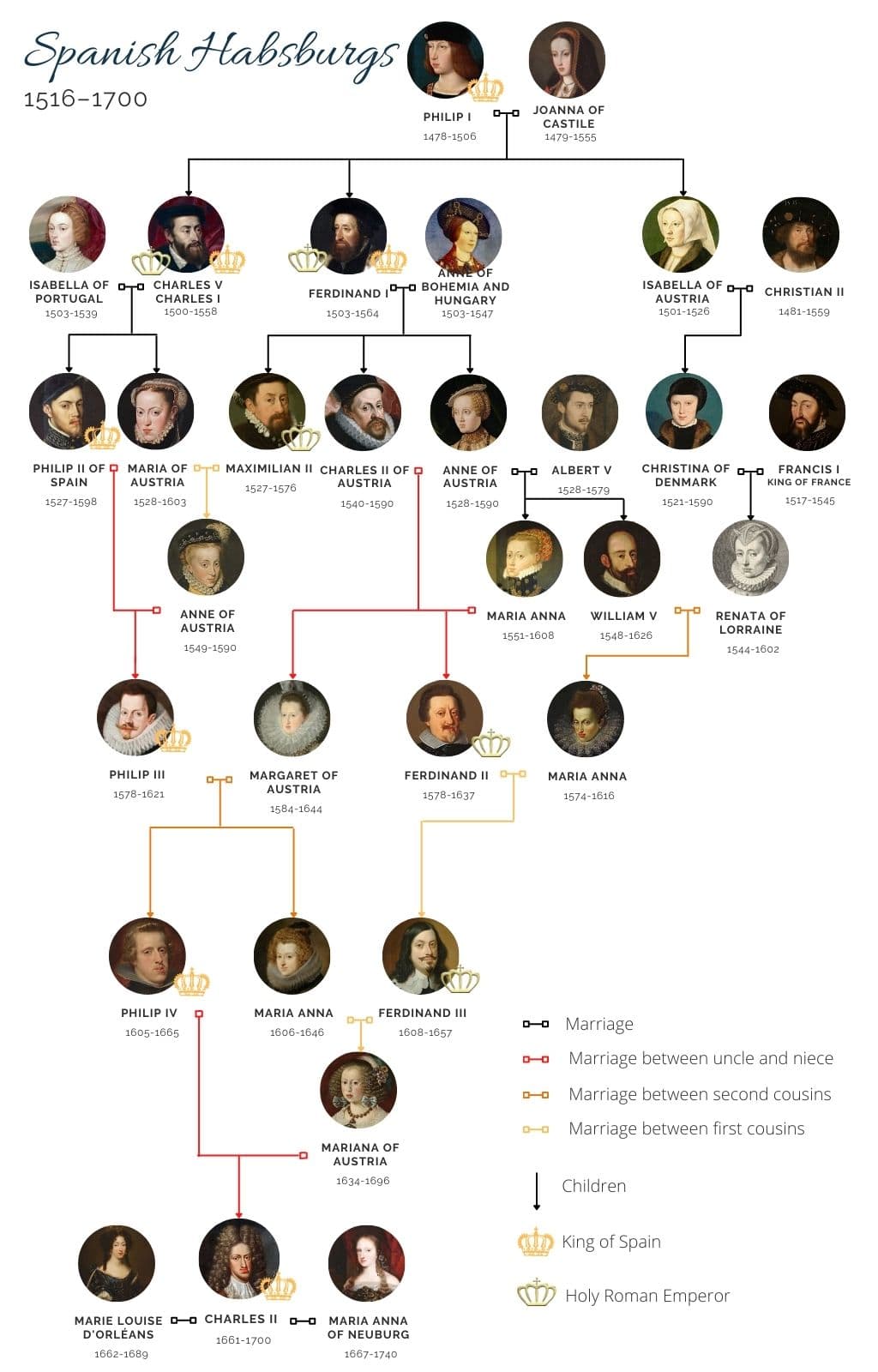
The Habsburgs of Spain had a multigenerational practice of consanguineous marriage of a means of consolidating their power. They ruled the Holy Roman Empire from 1440 until their inbreeding shallowed the gene pool to such a degree that it produced Charles II of Spain resulting in the extinction of the male line and leading to the War of Spanish Succession.
It is said that Charles was “always on the verge of death but repeatedly baffled Christendom by continuing to live.”

Charles II of Spain, born November 6, 1661, and reigning from 1665 until his death on November 1, 1700, was the last Habsburg king of Spain and a striking example of the consequences of royal inbreeding. Known as “El Hechizado” (“The Bewitched”), he suffered from severe physical and mental disabilities, widely attributed to the extensive intermarriage within the Habsburg dynasty.
His parents, Philip IV of Spain and Mariana of Austria, were uncle and niece, and his family tree was a tangled web of cousin and uncle-niece unions over generations. Geneticists estimate his inbreeding coefficient was around 25%, equivalent to the offspring of a brother-sister pairing, leading to a host of health issues including a deformed jaw (the infamous “Habsburg jaw”), infertility, and a frail constitution.
Charles ascended to the throne at age three after his father’s death, but his mother and a series of regents ruled in his stead due to his incapacity. His reign was marked by Spain’s decline as a global power, plagued by economic stagnation, military weakness, and political instability.
Unable to produce an heir-despite two marriages, first to Marie Louise of Orléans and then to Maria Anna of Neuburg-his death sparked the War of the Spanish Succession (1701–1714), as European powers vied to control the Spanish throne. Charles named Philip of Anjou, a French Bourbon and grandson of Louis XIV, as his successor, shifting Spain’s dynasty and ending Habsburg rule. His life and reign remain a cautionary tale about the perils of dynastic inbreeding, blending personal tragedy with geopolitical upheaval.
The exploration of first cousin marriage laws across U.S. states reveals a patchwork of policies, from outright bans to unrestricted legal acceptance, reflecting a broader tension between historical taboos and modern understanding of genetics. States like Colorado and New Mexico permit these unions without conditions, while others impose restrictions rooted in concerns over genetic risks to offspring-risks that, while real, are often overstated, with the likelihood of birth defects only modestly higher than in the general population.
The story of Charles II of Spain and the Habsburgs serves as a dramatic counterpoint, illustrating the extreme consequences of repeated consanguineous unions, where centuries of inbreeding culminated in a king whose physical and mental decline mirrored Spain’s fading glory. Yet, Charles’ case is an outlier, far removed from the typical first-cousin marriage today, where genetic counseling and awareness mitigate risks.
Ultimately, the debate over consanguineous marriage bridges science, culture, and law, balancing individual freedom against societal norms-a tension as old as the Habsburg dynasty itself, but one that continues to evolve with our growing knowledge.
