
How Ranked-Choice Voting Gets Gamed
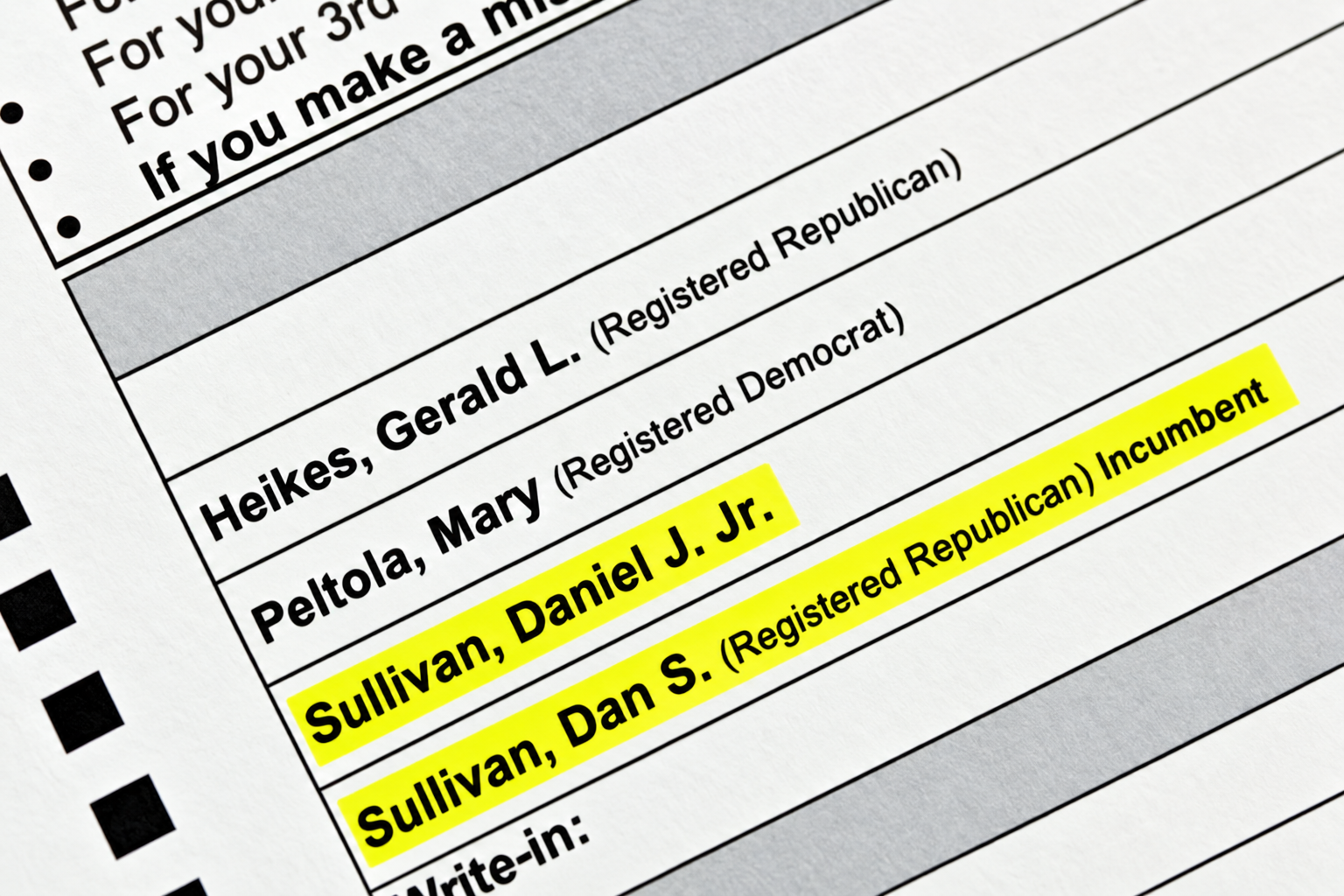
Two Dan Sullivans sit on Alaska’s general-election ballot for the United States Senate. One is the incumbent Republican senator who has held the seat for twelve years. The other is a retired teacher from Petersburg. He had never registered as a Republican. He had given money to Democrat candidates. His campaign materials and spending pattern track a Democrat effort to shape the field. Alaska’s top-four primary and ranked-choice voting system produced that result. Voters are now deciding whether to keep the system that made the outcome possible.
How the Ballot Works
Alaska runs a nonpartisan top-four primary. Any candidate who files advances if he finishes in the top four, regardless of party affiliation or prior registration. The general election places all four candidates on a single ballot. Voters rank them in order of preference. Officials eliminate the lowest finisher and redistribute those votes to the next ranked choice until one candidate exceeds 50 percent. The structure does not filter the field through party primaries. It places a premium on finishing in the top four and then occupying a ranking slot that can confuse voters or transfer votes. A candidate who finishes fourth still occupies space on the ballot that a traditional primary would have closed. The system rewards the ability to occupy a slot more than it rewards the ability to build a majority coalition before the general election begins.
The Ballot Composition Project
In the summer of 2025, a staffer for Mary Peltola received instructions from top campaign aides to search Alaska voter records for people named Dan Sullivan. The internal name for the effort was the “ballot composition project.” Peltola campaign aides and Democrat Senatorial Campaign Committee officials participated in regular discussions about the project. The goal was to place a second Dan Sullivan on the ballot to siphon first-choice or ranking votes from the incumbent. The group also explored recruiting additional spoilers and supporting them through outside spending. That included the possibility of establishing a new right-wing political party to house one of them. The New York Times reported the project based on interviews with a dozen people, dozens of text messages, and documents prepared for a potential lawsuit against the campaign. Former Peltola campaign manager Elisa Rios told the paper that Peltola was aware of the effort. The campaign’s public denial does not match the contemporaneous record of texts and internal discussions.
A Candidate Built for the Slot
Dan J. Sullivan listed himself as a Republican. He had no prior GOP registration history and had given money to Democrat candidates. He initially sought to appear on the ballot with the middle initial “S” to match the incumbent, even though that was not his middle initial. His campaign materials and website created visual and name confusion with the sitting senator. Nearly all of the early spending from his committee went to a Washington, D.C. firm with Democrat ties. The Alaska Division of Elections initially rejected his filing for lack of good faith. The Alaska Supreme Court ordered him onto the primary ballot. He finished in the top four with a few thousand votes and advanced to the general election alongside the incumbent, Peltola, and one other candidate. A Wisconsin-based super PAC later spent money elevating him after earlier efforts to back other potential spoilers had failed to place them in the top four.
Why the Structure Makes the Tactic Work
The system made the tactic effective because a traditional primary would have required the second Sullivan to win a Republican primary or run as an independent with limited reach and different ballot treatment. Under top-four and ranked-choice voting he only needed to finish in the top four. He then occupied a ranking slot that could confuse voters or harvest second-choice votes. Name duplication is potent when the ballot is already complex and many voters are not deeply familiar with every candidate on a four-person field. The same structure that let Peltola win in 2022 when Republicans split their votes now works in reverse against the Republican incumbent. The four-slot engineering opportunity exists because the primary does not close the field. The system converts a modest primary performance into a general-election presence that a closed primary would have prevented.
From the House to the Senate
Peltola lost her House seat in 2024. Nick Begich defeated her under ranked-choice tabulation, 51.3 percent to 48.7 percent, after leading on first-choice votes 48.4 percent to 46.4 percent. She had won the seat in the 2022 special election and full term after Don Young’s death. Voters who rejected her for the House are now asked to promote her to the Senate two years later while her orbit engineered the ballot against the sitting senator. That sequence undercuts the claim that the decoy was an organic, independent candidacy. The voters who fired her from the House are watching the same campaign attempt to manage the Senate field rather than win it outright.
Measure 2 Closes the Mechanism
Measure 2 repeals the top-four primary and ranked-choice general. It restores partisan primaries and plurality general elections. A second Dan Sullivan would have had to clear a Republican primary or run as a true independent with different ballot treatment and lower visibility. The four-slot engineering opportunity disappears. Systems that maximize the number of candidates on the final ballot also maximize the value of deliberate confusion and spoiler recruitment. Alaska has supplied a documented national example of how the mechanism works in practice. Voters can close the mechanism that made the example possible.
The documented effort is not a hypothetical or a partisan theory. It is in the Times reporting, the texts, the former campaign manager’s account, the Justice Department lawsuit, and the FEC filings. Ranked-choice voting did not create the desire to manipulate a ballot. It created a low-cost, high-leverage mechanism for doing so. Alaskans can close that mechanism with Measure 2. The rest of the country can watch what happens when the mechanism stays open.
