
📊 Economic Wisdom Across Decades: Lindsey 1997 vs. Tuesday Trajectories 2025
 A three-decade span separates Lawrence Lindsey’s 1997 testimony to the Joint Economic Committee from the April 2025 edition of Tuesday Trajectories-but the dialogue between them is surprisingly direct. This post walks through the shared
Dateline: Minnesota Privilege
Anything Less Than the Best is a Felony

Yo, first degree! Let’s kick it. Dylan Bryan Adams, a 33-year-old fiscal policy analyst for the Minnesota Department of Human Services, was arrested on March 29, 2025, for allegedly vandalizing at least six Tesla vehicles in Minneapolis, causing over $20,000 in damages. Surveillance footage from Tesla cameras captured Adams keying the vehicles, often while walking his dog, in incidents between March 18 and March 25, 2025, primarily in downtown Minneapolis, with one occurrence at a Northeast Minneapolis Target parking lot.
The videos showed him casually scraping keys across the cars, stripping paint and, in some instances, appearing to write something on the vehicles. The Hennepin County Attorney’s Office, led by Soros-funded D.A. Mary Moriarty, chose not to pursue criminal charges, instead enrolling Adams in a pre-charge diversion program for first-time, low-level offenders. This program emphasizes restitution and aims to prevent recidivism while allowing Adams to retain his job to pay damages. His attorney, Robert Paule, stated Adams is remorseful and committed to compensating victims.
The decision to forgo criminal charges sparked significant controversy. Minneapolis Police Chief Brian O’Hara criticized the move, arguing the felony-level damage and clear evidence made prosecution straightforward. Minnesota House Public Safety Committee Chair Rep. Paul Novotny echoed this, asserting that $20,000 in damages warrants felony charges. Public sentiment reflects widespread frustration, with speculation about political motivations, referencing Minnesota Gov. Tim Walz’s March 18, 2025, comments mocking Tesla’s stock decline, though no evidence directly ties Adams’ actions to politics beyond the actions themselves. 👀
The FBI and DOJ have flagged Tesla vandalism as potential “domestic terrorism” due to possible political motives, fueling calls from some quarters for federal involvement. The Minnesota Department of Human Services, where Adams has worked since September 2018, is reviewing his employment status, emphasizing adherence to a code of conduct. Logically one assumes if Adams is entering a diversionary program to retain his job to make restitution, he will get a wrist slap at the office. A just program would make him sit through hours of required training on how to be a decent human being and respect property rights.
“No evidence…”
 Democrats shifted their talking points regarding their advocacy for Kilmar Abrego Garcia and their visits to El Salvador in April 2025 reflecting a pivot from immigration-focused rhetoric to emphasizing constitutional integrity, due process, and humanitarian concerns. This shift is designed to counter Republican narratives and appeal to a broader electorate ahead of the 2026 midterms. Below is a breakdown of how their messaging has…evolved:
Initial Talking Points (Early March 2025)
Democrats shifted their talking points regarding their advocacy for Kilmar Abrego Garcia and their visits to El Salvador in April 2025 reflecting a pivot from immigration-focused rhetoric to emphasizing constitutional integrity, due process, and humanitarian concerns. This shift is designed to counter Republican narratives and appeal to a broader electorate ahead of the 2026 midterms. Below is a breakdown of how their messaging has…evolved:
Initial Talking Points (Early March 2025)
-
Immigration and Humanitarian Focus: Initially, Democrats framed the issue of Kilmar Abrego Garcia’s deportation as a humanitarian crisis tied to immigration policy. They claimed he was “a Maryland resident with legal protections” and criticized the Trump administration’s aggressive deportation tactics. The focus was on the injustice of deporting someone with no criminal charges to El Salvador’s notorious CECOT megaprison, emphasizing the harsh conditions and risks of gang persecution.
-
Critique of Mass Deportations: Democrats linked Abrego Garcia’s case to broader concerns about the Trump administration’s mass deportation policies, particularly the removal of over 250 migrants (mostly Venezuelans) in violation of a 2019 federal court order. Their rhetoric centered on protecting vulnerable immigrants and opposing what they called “cruel” and “indiscriminate” immigration enforcement.
-
Appeal to Immigrant Communities: Early messaging targeted constituencies supportive of immigration reform, such as Latino voters, by portraying the deportations as an attack on communities with legal protections under U.S. law.
Shifted Talking Points (Mid-to-Late April 2025)
-
Constitutional Crisis and Rule of Law: By mid-April, Democrats pivoted to frame the issue as a constitutional crisis. They emphasized the Trump administration’s refusal to comply with a U.S. Supreme Court order to facilitate Abrego Garcia’s return, casting it as a dangerous precedent for undermining judicial authority. Senator Chris Van Hollen, for instance, stated during his April 17 visit that the administration’s actions were “plunging the country into a constitutional crisis,” shifting the narrative from immigration to the integrity of the U.S. legal system.
-
Due Process Over Immigration: Democrats began focusing on due process as a universal principle, distancing their advocacy from immigration politics. They argued that Abrego Garcia’s case was not about immigration status but about the government’s obligation to honor court rulings and protect individuals’ legal rights. This was evident in statements from Representatives Yassamin Ansari, Maxine Dexter, Maxwell Frost, and Robert Garcia, who, during their April 21 visit, stressed that their fight was for “fairness” and “justice” for all Americans, not just immigrants.
-
Humanitarian Neutrality: While still acknowledging the harsh conditions in CECOT, Democrats toned down explicit references to immigration policy, instead framing their visits as humanitarian missions to ensure Abrego Garcia’s safety and secure “daily proof of life.” This shift aimed to broaden their appeal to moderates and swing voters who might be skeptical of immigration-focused arguments but support fairness and accountability.
-
Countering Republican Narratives: Republicans have accused Democrats of defending MS-13 gang members, citing claims about Abrego Garcia’s affiliations. In response, Democrats shifted to directly debunking these claims, with figures like Van Hollen citing federal judges’ rulings that the evidence against Abrego Garcia was “flimsy.” This allowed Democrats to portray Republicans as misleading the public and politicizing a legal issue for electoral gain.
-
Strategic Political Positioning: Recognizing their minority status in Congress post-2024, Democrats used the El Salvador visits to reclaim moral and political ground. By focusing on constitutional principles, they aimed to appeal to voters concerned about checks and balances, especially in light of Republican dominance on issues like border security. The messaging also served to energize their base while avoiding the immigration debate, where Republicans have held a stronger public opinion advantage (e.g., a YouGov survey showed 61% of Americans oppose deportations without due process, giving Democrats a foothold).
Why the Shift?
-
Electoral Strategy: After losses in 2024, Democrats needed to reframe the narrative to avoid being painted as “soft on immigration,” a vulnerability Republicans exploited. Emphasizing due process and constitutional integrity allows them to critique the Trump administration without engaging directly in the divisive immigration debate.
-
Broadening Appeal: The shift to universal themes like rule of law and fairness aims to resonate with moderates, independents, and even some conservatives who value judicial authority, especially after the Supreme Court’s ruling.
-
Countering Republican Attacks: By focusing on legal and constitutional issues, Democrats deflect Republican accusations of supporting criminals, instead portraying themselves as defenders of American democratic principles against authoritarian overreach.
-
Media and Public Sentiment: Posts on X and media coverage show polarized reactions, with conservatives mocking Democrats’ trips and liberals praising their stand. The shift to due process helps Democrats align with public sentiment (e.g., the YouGov survey) while avoiding the trap of being seen as solely pro-immigrant in a politically charged climate.
Examples of Shift in Rhetoric
-
Before (Early March): “Kilmar Abrego Garcia is a law-abiding resident who faces danger in El Salvador. The Trump administration’s deportations are tearing families apart and targeting innocent immigrants.” (Paraphrased from early Democrat statements.)
-
After (April 17–21): “This is about upholding the Constitution and ensuring no administration can ignore the Supreme Court. Kilmar’s case is a test of whether we respect due process for all.” (Paraphrased from Van Hollen and House Democrats’ statements.)
The Democrat shift in talking points from an immigration-centric defense of Kilmar Abrego Garcia to a broader emphasis on constitutional integrity, due process, and humanitarian fairness reflects a calculated response to political realities. By reframing the issue, Democrats hope to neutralize Republican attacks, appeal to a wider audience, and position themselves as “defenders of democratic principles” ahead of future elections.
If it’s not about him, why did they go to El Salvador?
Whip It Good
Dick Durbin, the Senate Democrat Whip is not running for reelection in 2026. Jeanne Shaheen of NH, Tina Smith of MN, and Gary Peters of MI have already announced their retirements ahead of the midterms. Durbin would be in line to be the Democrat Leader if Chuck Schumer were to retire or be primaried by AOC. Durbin is 80 and would be 88 at the end of a sixth term, but Senators in their 80s aren’t exactly a rarity. With Jon Ossoff up for reelection in Georgia, it isn’t likely that Dems will pick up the Senate in the midterms. The retirements — especially Durbin’s — pretty much confirm that.Martha vs. Randi
American Federation of Teachers President Randi Weingarten had a rather compelling interview on The Story with Martha MacCallum on Tuesday. They were discussing the United States Supreme Court against the Maryland public school system that forces students to participate in “instruction” that includes LGBTQ readings and other LGBTQ-themed “education”, when this happened. Yikes.
Quote of the Day
Can’t never could and won’t ever.Like this post? Become a Citizen Producer!


 themes, contextual shifts, and warnings from both fiscal commentaries, examining how lessons unheeded in the 1990s are now manifesting in full.
🔍 Foundational Premise: Revenue ≠ Prosperity
At the heart of both Lindsey’s and Tuesday Trajectories’ arguments lies a central critique: pursuing maximum government revenue is a flawed goal.
“The Laffer Curve’s peak is not the summit of good policy.” – Lawrence Lindsey, 1997
Lindsey (1997):
- Warned against confusing tax revenue peaks with optimal outcomes.
- Argued that high rates reduce productivity and shrink the tax base.
Tuesday Trajectories (2025):
- Notes record receipts fail to tame rising deficits.
- Cautions against relying on tax hikes amid productivity slowdowns.
🧾 Takeaway: Both agree that prosperity depends more on economic dynamism than on Treasury balances.
💸 Marginal Excess Burden: The Hidden Cost of Taxation 

Lindsey:
- Introduced Marginal Excess Burden (MEB)-the idea that every additional tax dollar can destroy more than it collects in societal value.
Tuesday Trajectories:
- Applies MEB today: High debt service and aging demographics reduce returns on additional taxation.
💡 Insight: Lindsey offered the theory; Tuesday Trajectories shows us what it looks like when ignored.
📈 Economic Context: Then vs. Now
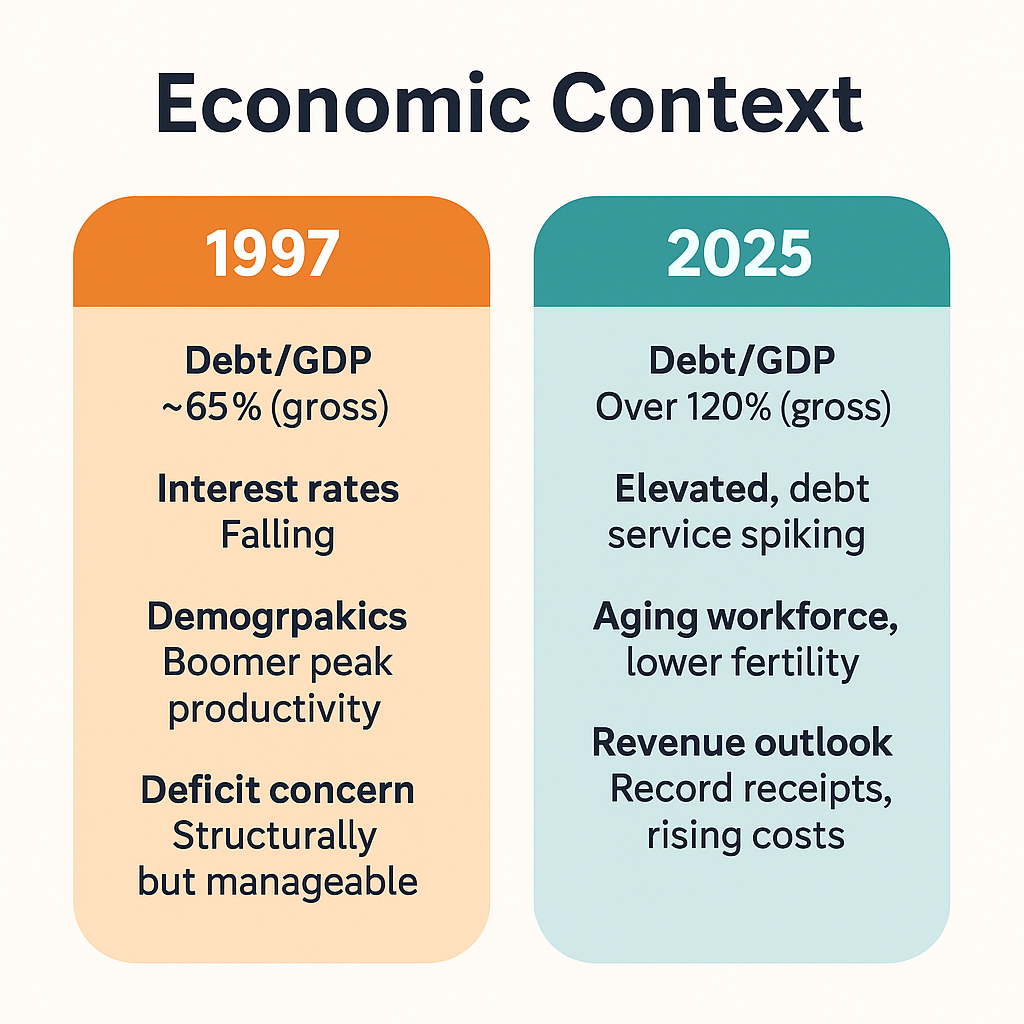
📌 Frame Shift: Lindsey offered a warning. Today’s blog sounds the alarm.
🏛️ Role of Government: For Treasury or For People?
- Lindsey saw taxation as a necessary evil-one that should be minimized in its damage.
- Tuesday Trajectories sees modern policy as having lost sight of this principle, overloading a shrinking tax base to fund politically untouchable spending.
📣 Shared Principle: Government should aim to maximize well-being, not just revenues.
🛠️ Reform Roadmap: Where They Align
| Theme | Lindsey 1997 | Tuesday Trajectories 2025 |
|---|---|---|
| Reject revenue maximization | ✅ | ✅ |
| Consider marginal burden | ✅ | ✅ (implied) |
| Cut distortionary taxes | ✅ | ✅ |
| Structural entitlement reform | ⚠️ (hinted) | ✅ (explicit) |
| Broaden growth foundations | ✅ | ✅ |
🧠 Rhetorical Style: Academic vs. Alarm Bell
- Lindsey: Dense, model-driven, aimed at technocrats.
- Tuesday Trajectories: Clear, vivid, aimed at a public reckoning.
🎙️ Tone Evolution: The theory of 1997 has become the diagnosis of 2025.
🧩 Final Word: A Warning Revisited
Lindsey’s warnings weren’t heeded. Tuesday Trajectories chronicles what happens when we kick the can 28 years down the road.
What was once abstract is now urgent.
As fiscal gravity pulls harder, both sources urge us toward a similar conclusion:
